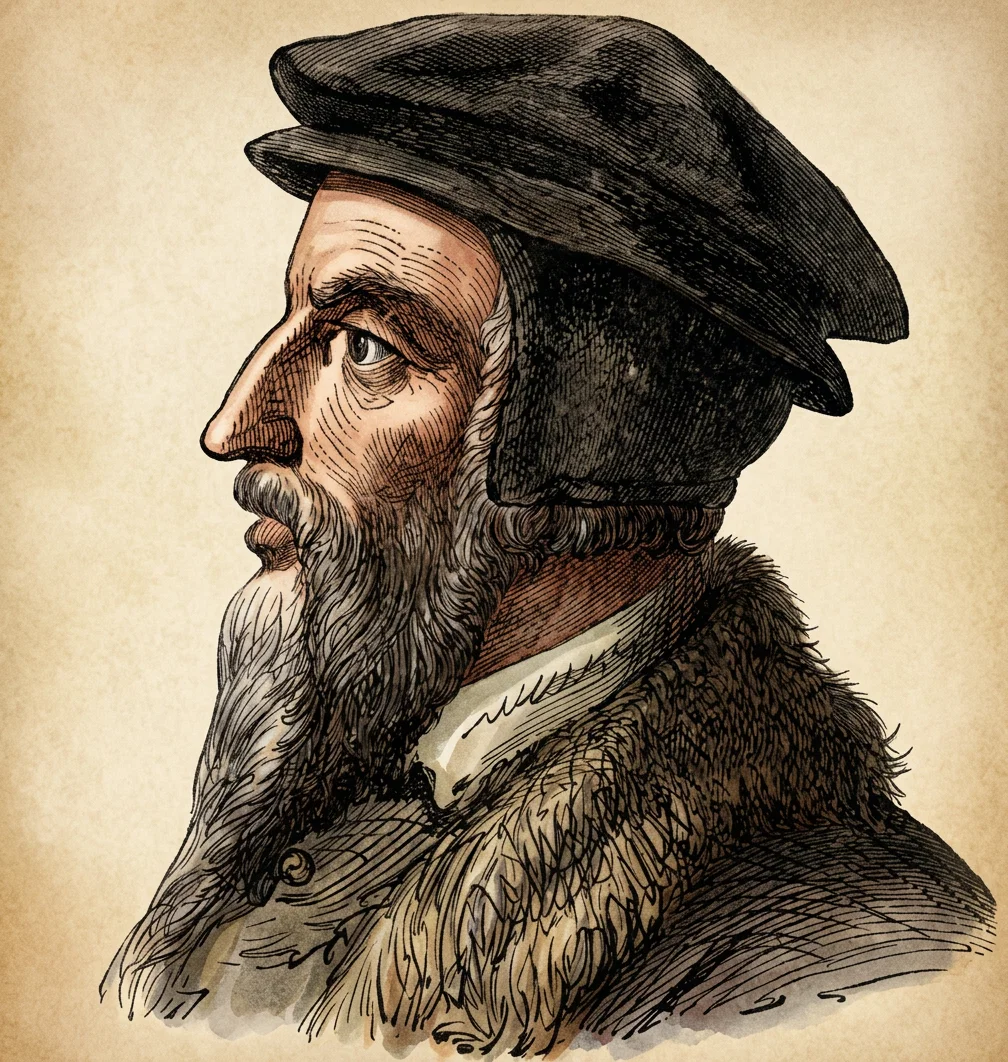
The portrait in connection with this article, is that of John Calvin, one of the prominent characters in the Great Reformation of the sixteenth century. This distinguished man was born at Noyon, in France, a short distance from Paris, July 10, 1509. The family name seems to have been spelled variously, as Cauvin, Chauve, Chauvin, Calvus, and Calvinus. The father of Calvin was a man of shrewd intelligence, and held honorable civil and ecclesiastical offices in the town in which he lived. His mother was a woman of great personal beauty and deep piety, and she left the stamp of her strict religious views upon her son John. Young Calvin’s parents, who were Catholics, intended their son for the Church, and consequently his early education was in the direction of theology. When but a young lad, twelve years of age, he was presented with a benefice in the cathedral of Noyon, and a few years later, before he was twenty years old, he had the responsible office of curé, with its titles and revenues.
About this time, Calvin’s father changed his mind in regard to his son’s being a theologian, and persuaded him to study law, as the surer road to wealth. Doubtless an overruling Providence had much to do with this change; for young Calvin himself was already convinced of many of the errors of the Romish church. While in Paris, as a student, a copy of the Holy Scriptures had been furnished him by his relative, Robert Olivetan, who first translated the Bible into French. The study of the Bible, with the help of the Latin commentaries, led him to question more and more the doctrines of the papal religion. Under the best masters, Calvin pursued the study of law through the day, and at night he would study the Scriptures by himself. Evidently God was preparing the future reformer for truths that as yet had not dawned upon his mind.
Near this time, also, he studied the Greek language under Melchoir Wolmar, one of the Reformers, who opened his eyes more and more in regard to the unscripturalness of the Romish faith. Indeed, not far from this, Calvin had become so fully persuaded in regard to the doctrines taught by Luther and Melancthon, that he began to preach them himself. His father having died, he now resigned all his church benefices, and devoted his naturally strong and well-cultivated mind entirely to the study of divinity. He also laid aside his legal profession, and devoted himself wholly to the doctrines of the Reformation, which were being widely diffused through France.
In 1529 Calvin was in Paris, struggling with other reformers to spread the doctrines of Luther, and contending with persecution. Having written an oration for his friend, Nicolas Cop, to deliver in the Sorbonne, a theological school in Paris, at the feast of All-Saints, the indignant faculty ordered it to be burned. The discourse dwelt very fully upon the doctrine of justification by faith. For this bold venture, Cop and Calvin were obliged to flee from the city, and the latter, it is said, was let down from the walls of the city by a basket.
Restored with AI
After leaving Paris, Calvin for a time found refuge with Queen Margaret of Navarre, the sister of Frances I., and who favored the cause of the Reformers. At Angoulême he supported himself by teaching Greek, and here he also composed the greater part of his “Institutes of the Christian Religion,” which has rendered his name famous. This was written in Latin, for the benefit of the learned, and was afterward translated into French. Many editions of the work were printed in Calvin’s time. It has also been issued in the various European languages, and in Greek and Arabic. The “Institutes” contained a written declaration of the doctrines of the Reformers, as well as unanswerable arguments against the errors and corruptions of the Catholic faith.
Calvin was contemporary with Luther and Melanchthon, as well as Bucer, Farel, Viret, Beza, Bullinger, and Capita,—names that so frequently occur in connection with the cause of the Great Reformation.
Let us now, for a little, trace the varied experience of this intrepid man in the noble cause which he had espoused.
We find him at one time in Italy, at the court of the daughter of Louis XII., winning others by his persuasive words to the doctrines of the Reformers; the ever-vigilant Inquisition, already crushing out the work in Italy, compels him to leave. He then goes to his native place for the last time, to arrange his family affairs. In August, 1536, when he is twenty-seven years old, he comes, in the midst of personal peril, to Geneva. Here he preaches, and is obliged to become one of the pastors. He proceeds to organize a distracted church, and publishes in French a catechism for the children. He has a public disputation with the Anabaptists, and puts them to silence; and holds a disputation in Lausanne, and speaks against the Catholic doctrine of the real presence. With Farel, the reformer, he is banished from Geneva. He is welcomed at Strasburg by Bucer, and a church of French refugees is put under his charge. He is present at the conferences between the Romanists and Protestants at Frankfort and Worms; prepares a treatise on the Lord’s Supper; holds a conference with the Lutherans at Hagenau, in which he gives his view about the eucharist; lectures on the epistle to the Romans and John’s Gospel, crowds of students from all parts of France attending his lectures. The authorities of Geneva now urge him to return, and he reluctantly consents. He institutes a system of strict discipline in the Genevese church, and in the city. Opposers persecute him, and name their dogs after him. An apostate assails his character. Next occurs the execution of the Spanish physician, Servetus, for which Calvin is largely responsible, though Melanchthon, Farel, and the Swiss Church approve. He publishes an “Antidote” against the twenty-five new tenets of the Sorbonne College at Paris; another against the “Decrees” of the Council of Trent; helps John Lasco in his work of reform; starts an academy of learning in Geneva, and lectures to crowds from France, Scotland, Holland, and Germany. His labors are incessant and prodigious. Every other week he preaches every day, besides the Sabbath, and lectures three times a week on theology. Every Thursday he preaches at the Consistory, and every Friday is present with the congregation.
Such, in brief, are some of the labors and trials which this celebrated French reformer experienced. John Calvin will ever be regarded as far more than an ordinary man. His memory was remarkable, and his ability to reason was of the highest order. While he was banished from Geneva, the Romish cardinal, Sadolet, endeavored to entice the Geneva church back again to the fold of Rome; but Calvin, hearing of this, seized his pen, and wrote with such logic and wisdom as to extort praise from even his opponent. It was at Worms that Melanchthon gave him publicly the title of “The Theologian.” At the age of twenty-two, Joseph Scaliger pronounced him the most learned man in Europe. His knowledge of the Latin language was a marvel to scholars, and his correspondence was enormous. Men in the highest stations in Europe coveted a letter from his hand. Bishop Cranmer, of England, advised with him freely in regard to matters both in Church and State. His wise counsel was sought by the Moravians, and to Hungary he wrote letters of advice. He also befriended with purse and pen the Waldenses, in their bloody trials and banishments.
But with all his excellences, this talented man had his faults. Some of his doctrines have been a source of deep regret to the church. He was also severe to his opponents, and his temper was often impatient. He admitted that it was hard for him to control the “wild beast.” He tracked the foes who intended mischief to him or his cause. With him life was a combat. Duty was the one great thing constantly before him.
In 1564, when not yet fifty-five years of age, Calvin’s mortal frame began to sink under his multiplied cares and a complication of disorders. He could hardly take food, but still dictated letters to his friends, and comments on the book of Joshua. He began to preach a sermon, Feb. 4, but was obliged to stop. On April 27, the lesser council met at his bedside to hear his parting words. The next day, the ministers of the city, and others, listened for the last time to his faithful counsel. Farel, then eighty years of age, journeyed from Neuchâtel to grasp his hand. Prayers were offered for him by all the churches. He lingered on till May 27, in intense suffering, yet in the triumphs of faith, when he breathed his last in the arms of Beza, his faithful friend.
At his own request, no monument marks his resting-place, and no one can now tell where lie the remains of this remarkable man. His whole earthly wealth, only about two hundred and twenty-five dollars, he bequeathed to his relatives and poor foreigners. His salary was small, and he would not receive that part of it which accrued during his last illness.
In size, Calvin was of middle stature; his complexion was somewhat pallid and dark, and his eyes, to the latest, clear and lustrous. He was sparing in his diet, sometimes for years taking but one meal a day. In dress he was simple. He took but little sleep, and was capable of enduring great intellectual toil. O. W. A.