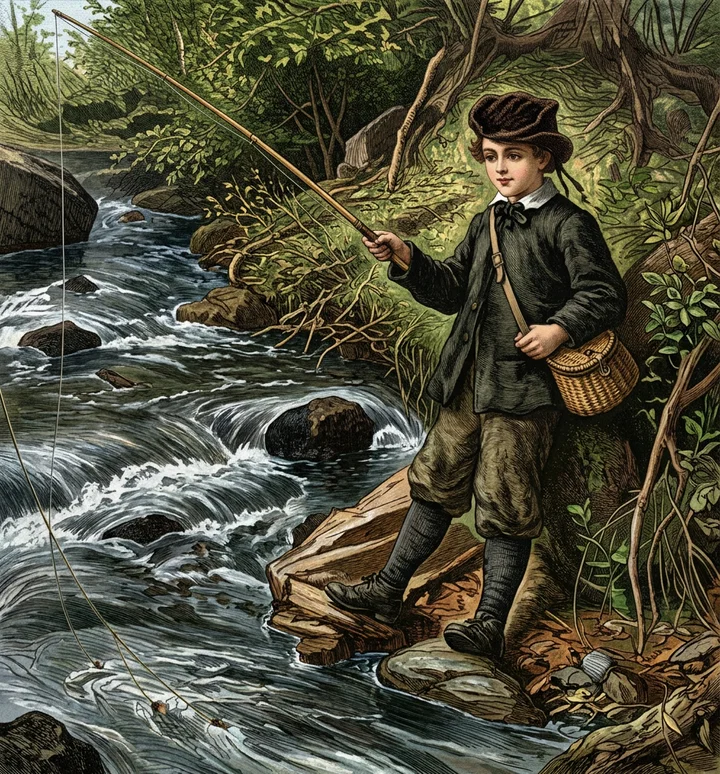
“STACY! Stacy!” called Ann from the doorway; but there was no answer. Ann went back to her washing. Stacy was not so far away that he could not hear. He was only back of the wood-house; but he did not like to answer Ann’s calls on washing day. He was digging bait, and beside him lay his fish-pole, that he had cut in the wood lot the day before.
When he had filled his bait box, he picked up his pole, and whistled to Gyp to follow. I must tell you how Gyp came there.
One stormy evening in winter time, Mr. Brown heard a faint scratching at the door, and then a pitiful moan. Looking out, he saw the sorriest little dog standing knee-deep in the snow before the door.
“Do let him in, papa,” pleaded Flossy, who had followed him.
“Well,” he replied, “we’ll keep the poor fellow to-night;” so Gyp was let in. He was a gaunt, lame, yellow, little dog. Flossy fed him, and made him a bed behind the stove. Gyp stayed that night and many more, for no one had the heart to turn him adrift.
This morning, Stacy started off through the meadow and down to the woods. When about half way there, Frank Preston, a boy about a year younger than Stacy, came up the path.
“Hello, I say!” called Stacy, running to catch up with him; “hold on a minute.” Frank turned around.
“My! what a beauty!” said Stacy, as he eyed Frank’s bamboo fishing-pole. “Where did you get it?”
“Uncle John gave it to me when he was here last fall,” Frank replied. “Is that your dog?”
“Yes,” said Stacy.
“I wish I had a dog,” said Frank. “Say, what’ll you take for him?”
“I don’t know,” returned Stacy, “as I want to sell him.” But Frank kept on urging.
“Well,” he replied, “if you’ll give me your fish-pole and basket, I will.”
Frank looked regretfully at the pole, and then longingly at the dog. “He’s lame,” he said.
“But he’ll get over it,” returned Stacy, who coveted the pole, though he knew the dog was not worth so much.
“All right,” Frank finally said, “I’ll trade.” So the pole and basket and the dog exchanged owners.
Stacy went on to the creek. He found a cool, shady place, where a great maple bough overhung the water.
“That’s a bargain,” he said to himself, as he flung out the line, and leaned back against the steep bank.
Then he waited. A little nibble, then another, then a long silence. The boughs sighed in the breeze, and the brook foamed and fretted over the stones. Then there came a tug at the end of the line, and Stacy landed a fine fish on the bank. Then another time of waiting.
The sun rose higher and higher, and at last the fishes refused to bite. So he gathered up his tackle, and taking the three fish he had caught, started for home. He was just in time to have them fried for dinner. Ann had the washing done when he got to the house. She readily forgave him for running off, since he had brought back such nice fish.
At noon, Mr. Brown came home. “Gyp! Gyp!” he called, and gave a shrill whistle as he entered the gate. But no Gyp came to greet him; he was two miles up the road, contentedly gnawing a bone in Mr. Preston’s woodshed.
“Where’s the dog?” Mr. Brown asked Stacy, as they sat down to the table.
Stacy’s face flushed, and he hesitated. “I traded him,” he said at length.
“Traded him?” laughed Mr. Brown. “Who would want such a dog as that?” For, to tell the truth, Gyp had not grown much better looking than he was the first night he came there.
“Well,” said Stacy, hopefully, feeling sure his father would think he had made a good bargain, “I let Frank Preston have him, and he gave me his pole and basket and tackle.”
“Let me see them,” said Mr. Brown.
Stacy went out into the woodshed, and brought them in. Mr. Brown looked grave when he saw what Stacy had.
“How much do you think they are worth?” he inquired.
“I don’t know exactly,” returned Stacy; “but Johnny White’s brother has got a pole that cost five dollars.”
“Yes, I should think this one, together with the basket, was worth fully that much,” said his father.
“I think it is a pretty good bargain,” said Stacy, breathing more freely now he thought his father approved.
“And I think it is a bad one,” said Mr. Brown, looking at him sharply.
Stacy shifted over to the other foot. “He wanted to,” he urged.
“Frank is younger than you are,” his father replied, “and did not know the value of his pole. It is a mean and dishonest thing to take advantage of him in this way. A wise man once said that it was a bad day for any man when he thought there was an easier way of getting a thing than by squarely earning it. You must take these all back after dinner.”
Somehow, Stacy had lost his appetite, and the fish did not taste as good as he expected. After dinner he set out. It was a hot day, and the road was very dusty; it seemed to Stacy as if the walk would never end. But he got there at length, and returned with Gyp.
Whenever he makes a trade now, he always remembers the long, hot walk, and his father’s good advice, and is very careful to be strictly honest. W. E. L.