On the southern coast of Spain, a small and very rocky promontory juts out into the western extremity of the Mediterranean Sea. This headland rises abruptly from the low, sandy isthmus that connects it with the main-land, to the height of twelve thousand feet or more. It is two and a half miles long, and less than a mile wide.
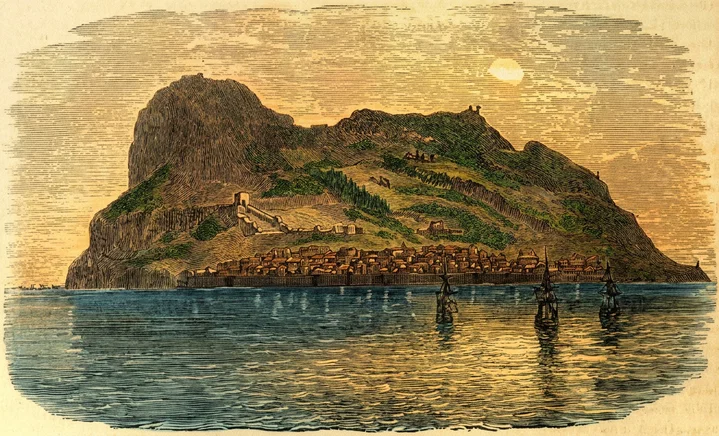
On the east side the rocks slope down into the water as abruptly as toward the north, and they are as wholly inaccessible. On the west they descend gradually to the sea, interrupted by cliffs and ravines running lengthwise of the headland. At the foot of the descent the land becomes quite level, and here stands the city of Gibraltar, overlooking the blue waters of Gibraltar Bay and the Mediterranean. A view of this city is given in the accompanying picture.
Very desolate and barren indeed the town looks from the distance, with its background of solid rock. But a nearer approach reveals grassy glens and groups of trees. The houses of the English inhabitants are surrounded by fine groves. The climate is warm, half tropical, with a rainy season and a dry one. Most of the rain falls during November, December, and January, and then the rocks are covered with a profusion of bright wild flowers. In the summer-time a cool sea-breeze blows from ten o’clock till sunset, so that the heat does not seem so oppressive.
There are not very many wild animals on the rocks. The little fawn-colored, tailless, Barbary apes, that the school-boys learn about in their geographies, are so scarce that not all the people in Gibraltar have seen them.
There are some very fine caves in the rocks on this headland. Perhaps the largest and most beautiful is St. Michael’s cave. Its entrance is eleven hundred feet above the sea. From the entrance the ground slopes rapidly down into a large hall two hundred feet long and seventy feet high. The roof is supported by stalactite pillars. A passage-way leads from this hall to four other caves, all connected one with the other by a passage-way. The last of these is three hundred feet below the surface. These caves are said to be even more beautiful and picturesque than our famous Mammoth cave in Kentucky.
The houses in Gibraltar are not very nice. The people dislike to put their money into buildings; for they are liable at any time to lose their homes. Gibraltar, you no doubt already know, is a military town; and whenever the government needs more room to carry on its work, the people are obliged to give up their homes.
The laws of the city are very strict. If a stranger wishes to stay only one day in the town, he has to go to the town-major and get a pass. If he is an artist, and wants to make a sketch, he has to get special permission to do it. So it does not make this a very desirable town to visit.
Gibraltar is a military post, and a very strong one, too. On the north and east, as we have seen, it is almost impossible to scale the straight rocks. On the west side, a high, strong sea-wall shuts in the town. The city has been taken at different times by the Mohammedans, and then by the Christians. The most memorable siege laid to this strong town, occurred in 1779–1783. At that time, as now, the English held possession of the fortress. The French and Spanish forces tried to take the city by land and by sea; and although they used every means that the most ingenious could devise, the city valiantly withstood them during four long years, and finally put them to flight.
Since that time, everything has been done that could be thought of to make the city stronger; till now it stands, guarding the entrance to the Mediterranean and the cities of the East, the most formidable and the best fortified city in the world.
W. E. L.