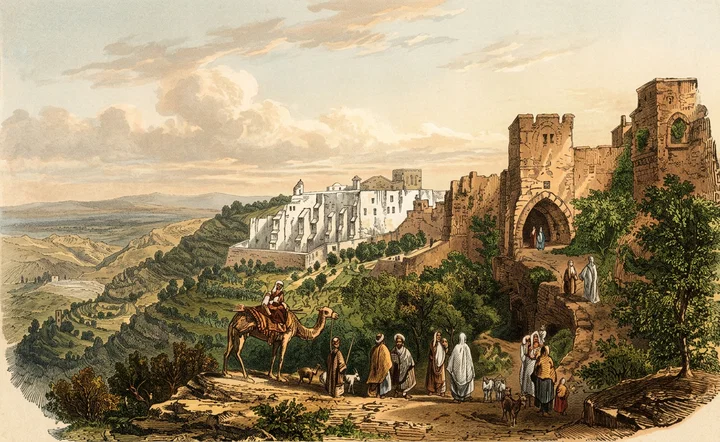
What memories are awakened, as we look at the old gate-way in the picture before us! What emotions arise, as we think how Ruth, Samuel, David and even Mary, the mother of Jesus, have passed in and out under that arch, and up and down the roadway that leads to it!
A peculiar charm pertains to the birthplace of noble men. We love the ground which our dear ones have trod, and the same tendency leads us to hold sacred everything pertaining to the benefactors of our race,—men who have touched the great heart of the people, and caused it to vibrate with pulsations that shall never cease while time continues.
How many patriotic hearts have beat with emotion and gratitude, as they lingered about the home and final resting place of Washington, at Mt. Vernon! Stratford-on-Avon is every year affectionately visited by thousands whose only interest in the place comes from its being connected with the birth, life, and death, of the poet Shakspeare.
But far away in the almost deserted land of Palestine, is a spot dearer than any other birthplace on earth. Rome is called the Eternal City, because it has existed so long; but this old town was mentioned in Scripture a thousand years before the fabulous twin brothers traced the intended boundary of the rude town which was to perpetuate their name for so many centuries. For more than three thousand years, Bethlehem has maintained an uninterrupted existence, and is as substantial to-day as ever it was. It is a small town with but a single street extending for half a mile east and west along a ridge that strikes out into a small, but fertile plain. On the north side, and at the east end, the abrupt descent is terraced, and planted with a rich variety of fruit trees. The white stone houses, perched upon the summit of the ridge, and gleaming through the foliage of the trees, present a beautiful picture when seen from a distance by the approaching traveler.
Just over that little hill to the north, and not half a mile away, a small white dome may be seen, standing all alone.
Thirty-five centuries ago there was a funeral at that place. The patriarch Jacob, with his numerous family, had traveled from the far-distant country of Padan-aram, and was within fifteen miles of Hebron, his point of destination, when his beloved Rachel, the mother of Joseph, died by the way, and was buried on the spot now covered by the simple monument just described.
Four hundred years later, two sad women, one young and beautiful, the other somewhat stricken with years, but far more by sorrow, toiled slowly up the hill, and entered through the dark gate-way which we see in this picture. The people of the place gazed upon the strangers, and finally said to the elder, “Is this Naomi?” But a few years before, she had gone out from them to the land of Moab. There she buried her husband and her two sons, and had now returned with her daughter-in-law, the faithful Ruth. In those days the plain before the town was covered with harvests, and there Ruth gleaned in the fields of Boaz, who was so attracted by her beauty and modesty that he soon made her his wife.
Two more centuries rolled by, when Bethlehem witnessed a strange scene in the home of Jesse, the grandson of Boaz and Ruth. Although Saul was still reigning, Samuel, the prophet of God, had come by divine command, to anoint one of the sons of Jesse to be king over Israel. Samuel was about to err in his choice; but God checked him, saying, “The Lord seeth not as man seeth; for man looketh on the outward appearance, but the Lord looketh on the heart.” But when David, the youngest son, was brought in from tending the sheep, the Lord said to Samuel, “Arise and anoint him; for this is he.”
Those hills and mountains seen in the background of the picture, still abound in fierce beasts, which hide in the caves and deep ravines of that wild region, and prowl upon its borders to prey upon unguarded flocks. Forth from these rocky fastnesses must have come the lion and the bear that were slain by the unaided hand of David.
Near the gate of Bethlehem is a remarkable well of pure water. We cannot distinguish the spot, but it must have been in the foreground of the picture before us. Many a time had David in boyhood and youth cooled his brow, and quenched his thirst at this copious fountain. At one timep. 202 when the Philistines had a garrison in Bethlehem, and their hosts filled the plain of Rephaim between Bethlehem and Jerusalem, David, who was hiding from his enemies in the caves of the mountains, longed for water from the well of Bethlehem, and said, “O, that one would give me drink of the water of the well of Bethlehem, which is by the gate!” Then three of the mighty men who were with David, departed secretly, broke through the hosts of the Philistines, braved the garrison at Bethlehem, drew water from the well by the gate, and took it to David. The heart of David was deeply moved by this daring act of devotion, and almost perishing for water, as he was, he deliberately poured it upon the ground, saying, “Be it far from me, O Lord, that I should do this; is not this the blood of the men that went in jeopardy of their lives?”
David was one of the noblest of earthly kings, one of whom the Lord said, “I have found David the son of Jesse a man after mine own heart.” It would seem honor enough for one town to be the birthplace of such a man; but a mightier king was to begin his earthly career within the humble walls of Bethlehem.
For a thousand years the bones of king David had been moldering in the grave. The glory of Solomon had blazed forth, and departed. The people of God had been scattered in distant lands. A remnant had returned, and rebuilt Jerusalem and the temple. Again they had suffered the most cruel abasement from their persecutors, and were now under the iron rule of the Romans. Out upon the fertile plain of Bethlehem, just where the youthful David had so faithfully kept his charge, a band of shepherds were guarding their flocks by night, when, “Lo, the angel of the Lord came upon them, and the glory of the Lord shone about them; and they were sore afraid. And the angel said unto them, Fear not; for, behold, I bring you good tidings of great joy, which shall be to all people. For unto you is born this day in the city of David a Saviour, which is Christ the Lord.” . . . “And suddenly there was with the angel a multitude of the heavenly host, praising God, and saying, Glory to God in the highest, and on earth peace, good will toward men.” On going into Bethlehem, the shepherds found the child Jesus lying in a manger, just as the angel had said.
Thus has the little town of Bethlehem been hallowed by associations that will make it sacred forever to the hearts of those who love the Prince of the house of David, the Saviour of mankind. Though the birth of that Saviour was heralded by angels, he was despised, rejected, and crucified; but the time is at hand when he shall come in the glory of his Father, and all the holy angels with him. Then shall the righteous rejoice; but the wicked will call upon the rocks and mountains to fall on them, and hide them from the glory that none can look upon but those who are made immortal. G. H. BELL.