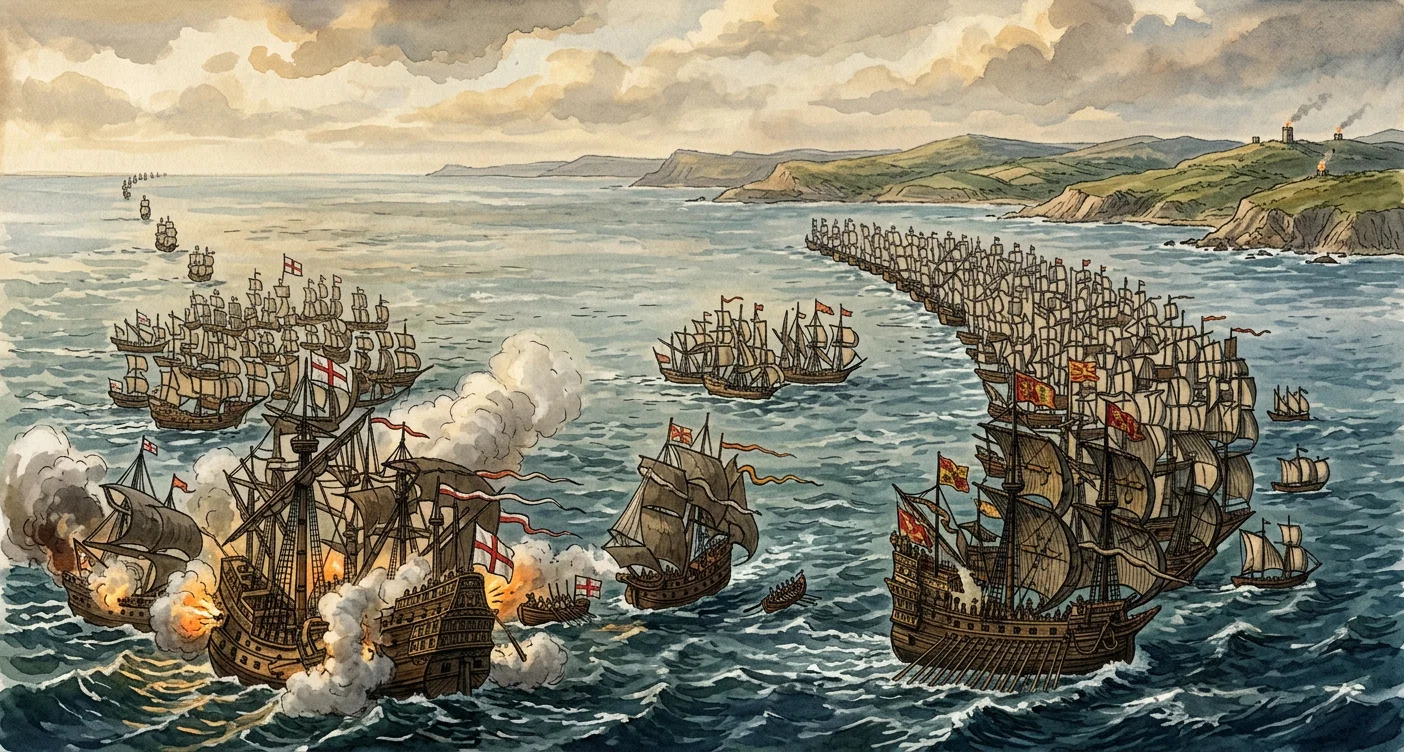
THE INVINCIBLE ARMADA

14%

S. D. A. Publishing Association · Battle Creek, Mich. · Jan 21, 1885

FromThe Youth’s Instructor, Vol. 33, No. 1.

Read the full edition

THE INVINCIBLE ARMADA.

AFTER the death of Mary, Queen of Scots, Philip the Second, King of Spain, who had been Mary’s friend, and who was a Catholic, and consequently displeased because Queen Elizabeth had restored the Protestant faith in England, threatened to bring war upon England; and if he should conquer, he declared that he would dethrone Elizabeth, and force upon her subjects the Catholic religion. These threats aroused the spirit of the queen, and she sent Sir Francis Drake with a fleet, in order, if possible, to cripple the Spanish forces beforehand. He succeeded in reaching a port of Spain, and destroyed a large number of ships; some historians put the number at one hundred, others give a smaller number.
Restored with AI
But in spite of this loss, Philip fitted out a fleet of one hundred and thirty vessels, carrying nearly twenty thousand soldiers. This fleet was called the “Invincible Armada.” Now if you look in the dictionary, you will find that “invincible” means not to be conquered, and “armada” means a fleet of armed ships. So you see the Spaniards were very boastful, and indeed they were very powerful at that time. England trembled in view of the threatened invasion; for the English navy was comparatively weak. Though at first almost dismayed, the queen determined to resist the invaders, and her subjects were no less resolute. Even the Catholics were on her side; and although she had but thirty-four war ships to begin with, the number rapidly increased; for the merchants fitted up private vessels for the occasion, and from all over the kingdom, men rallied to support the queen.
The queen herself rode along the line of her troops at Gravesend, and made a speech to encourage the men. She said that rather than have her country dishonored, she would take up arms herself, and be their leader. How the men must have loved her as she rode by on her milk-white horse, and how they cheered her as she spoke to them in words that were at once brave and womanly!
The Spanish armada must have presented a splendid appearance as it sailed into view. It was so vast that it stretched out its length for seven miles! The ships were arranged in the form of a half-moon, and they kept in line as they sailed into the English Channel. The English commanders avoided a general engagement, though they attacked any of the enemy’s ships that fell out of the line. But during the night, Sir Francis Drake sent fire ships into the midst of the fleet. Do you know what fire ships are? This is the way they managed. They chose several of their vessels which they could best afford to lose, and filled them with tar, gunpowder, and pitch, and floated them out in the rear of the Spanish fleet. Then they set fire to them; the wind carried them right into the midst of the enemy’s line, and they caused a terrible panic among the Spaniards. Many of their ships took fire, and were burned. A storm coming up scattered the fleet, and some were driven upon the rocks, and went to pieces; others were destroyed or captured by the English the next morning. Of the grand array of men and ships that sailed into the English Channel that summer’s day, only about fifty ever reached Spain again. Philip must have been disgusted with the result of his attempt to conquer England, and I have no doubt he mourned for his brave men who met their death in the effort to carry out his plans. The English commanders made preparations for defense in case the attack was renewed; but Philip seemed to have had all he cared for of English defense, and never made another attempt to invade England.
Of course there was great joy at the English court over the victory. Good Queen Bess, as she was called, rejoiced in the skill and bravery of her subjects, and rewarded the leaders with lavish generosity. Queen Elizabeth’s reign was one of the most prosperous periods of English history. Though the queen had many faults of personal character, she did many good and noble deeds, and was adored by her subjects.—The Pansy.