“Uncle George, just come and see what Sam and I have found!” exclaimed little Alfred, rushing into his uncle’s study one bright morning.
Uncle George laid down his pen with a smile.
“What have you found, Alfred?” he asked, as he rose to follow his nephew.
“Well, I don’t know exactly what it is, Uncle George,” answered the little boy, leading his uncle through the garden. “It is a great big gray ball that looks as if it was made of paper, and it is fastened on a branch of the big apple tree down at the end of the orchard. Sam and I were going to throw stones at it, but we saw some wasps crawling over it, and we were afraid to.”
“It is very well that you did not throw any stones at it,” answered his uncle. “It is a wasp’s nest; and if you had made them angry, they might have stung you very badly.”
They soon came to the tree, and Alfred pointed out the object of their curiosity to his uncle. It was an unusually large wasp’s nest, and the insects were swarming in and out, looking terrible enough to stop any one from touching their fortress.
“Didn’t you ever see a wasp’s nest before, Sam?” asked Uncle George of his youngest nephew, who was seated on the fence, viewing the wasps with curiosity mingled with a little fear.
“No, sir,” answered Sam. “Uncle George, where do they get their nest?”
“They make it,” was the answer.
Alfred and Sam looked doubtingly at the nest. It did not seem possible that an insect as small as the wasp could build such a large nest.
“Why, it’s made of paper, isn’t it?” asked Sam, at length.
“They make the paper too,” said Uncle George, smiling at the boys’ surprise.
“Let us sit down here a little while, and I will tell you how they make it. The wasps are furnished with broad, powerful pincers, and with these they tear off small pieces of woody fiber from gate posts, palings, or the bark of trees. This they mix into a soft pulp with their saliva, and with this pulp they build the nest. The inside of the nest is divided into little combs or cells, and the partition that separates these cells is generally thicker and firmer than that on the outside of the nest. As the nest is enlarged, new paper is made for the purpose, the whole nest being inclosed in the last-made covering, and the inner one is taken away to make place for more cells.
“The nests of wasps in tropical countries are sometimes very large, often six feet long, and very large families of wasps live in them.”
“How much paper those big nests must take!” exclaimed Sam, who had been deeply interested in his uncle’s account.
“Yes, paper-making is the principal trade of these little insects,” answered his uncle. “Each one of them has his own share of work to do, and so, little by little, the great nest is built.”
“What do wasps eat?” asked Alfred.
“Wasps will eat a great variety of both animal and vegetable food,” answered Uncle George. “They will eat insects, ripe fruit, sugar, and they often steal the honey from the bees. There is a Brazilian species of wasp that is known to store up honey like bees.”
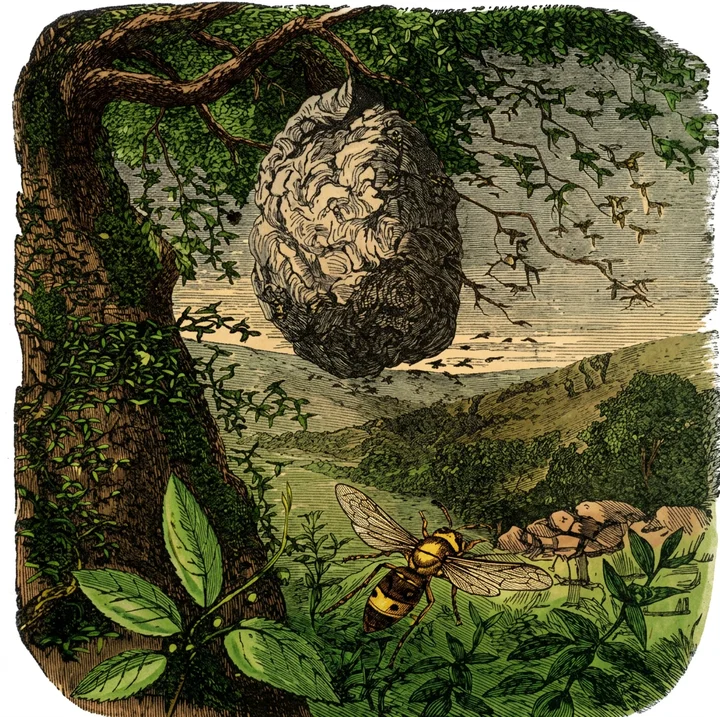
“Aren’t hornets and wasps very much alike?” asked Sam.
“Yes,” answered Uncle George. “The hornet is the largest species of wasp, and is found in the south of England.—Now, boys, I must go back to my writing. I will leave you here to watch the wasps if you want to, and there is one very useful lesson that I hope you will learn.”
“What is that, Uncle George?” asked the boys together.
“Remember that great things are made up of little ones,” answered Uncle George. “One wasp alone could not build that great nest; but by each one’s doing a little, the work is performed.”—The S. S. Visitor.