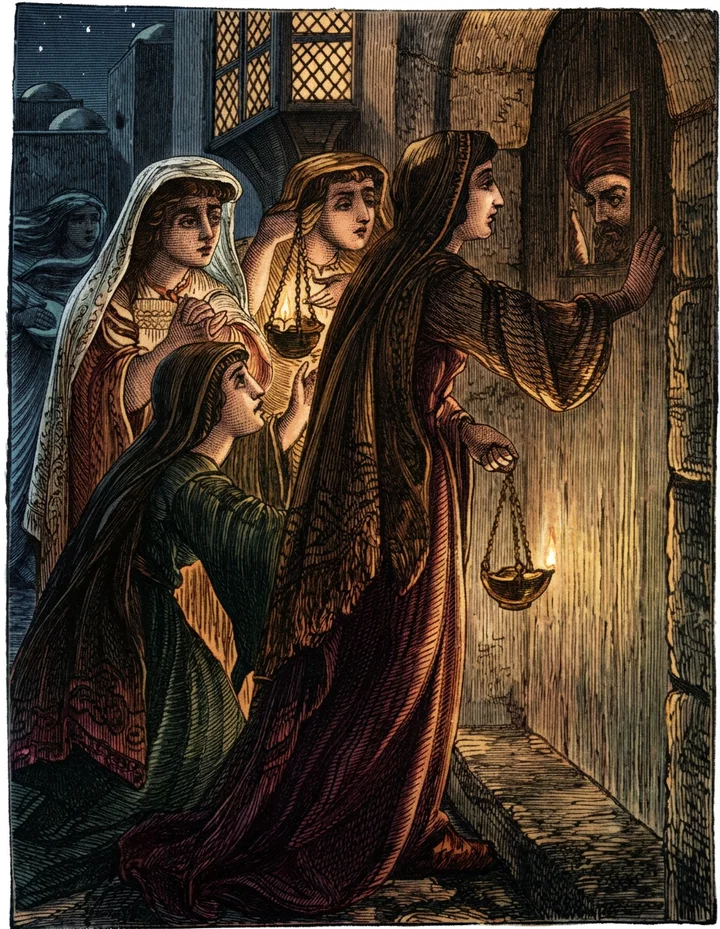
THE PARABLE OF THE TEN VIRGINS.
By M. J. C.
WHEN the Saviour began his ministry, at Jerusalem, upon the Mount of Olives, and upon the shore of the Sea of Galilee, he preached sermons to the people; but he afterward spoke to them in parables. Do you know how many parables are recorded in the Gospels? And do you know what a parable is? It has different meanings in Scripture; but our Lord’s parables are a sort of fable, or feigned story, made up from something real in life or nature, to teach us true and important things. Please take your Bibles, and read the first thirteen verses of the twenty-fifth chapter of Matthew. Here we have the parable of the ten virgins, which refers to a Jewish custom, still practiced in Eastern countries.
When a marriage takes place, the bridegroom, in company with several young men,—groomsmen, called in the Bible “children of the bride-chamber,” goes to meet the bride at her father’s house. They usually start out late in the evening, and are preceded by a band of musicians or singers.
The bride, with her bridesmaids, called in this parable the ten virgins, is anxiously expecting the arrival of the bridegroom to lead the whole party back to his father’s house. While the bridegroom tarried, they sometimes became weary in watching, and fell asleep. But the music and noise of the approaching train is heralded by some one who cries, “Behold, the bridegroom cometh! go ye out to meet him!”
Torches and lamps are always carried in these processions. Our Lord represents five of the virgins as foolishly forgetting to take any oil with them. Probably their carelessness was due to the hurry and excitement of going early to the wedding.
When the party were all in confusion, trimming their lamps and lighting those which had gone out while they were asleep, to be in readiness to meet the bridegroom upon his arrival, the foolish virgins discover that they have no oil, and say to the other virgins, “Give us of your oil; for our lamps are gone out.” But the wise virgins answer that they have none to spare; they must go and buy for themselves. While they are gone in pursuit of oil, the procession starts on its journey, and with others who join them on the way, they reach the house of the bridegroom, when, agreeably to their custom, the door is shut, and no further admittance given.
The Lord makes use of this parable to instruct his hearers upon the subject of the kingdom. Can you tell when it has its application? what is meant by the tarrying time? the midnight cry? the foolish virgins? and the door’s being shut?
In the accompanying illustration, the foolish virgins are represented as having arrived at the house of the bridegroom after the door is shut, and as pleading for admission. But alas! their appearance tells the sad tale, too late! too late!
Who is not surprised at the course of these foolish maidens,—to forget the one thing upon which they were most dependent to gain admission into the bride-chamber? Is there not danger that some of us shall marvel, and wonder, and perish, while pursuing the same course? Let us rather follow the example of the wise virgins, and make the necessary provision to be admitted with the guests. We need and should have every day the assurance that we are accepted of God, and walking according to all his requirements. Dear reader, after whom shall you pattern?
M. J. C.