Written for THE INSTRUCTOR.
WARWICK CASTLE.
In the old days, a long, long while ago, the British Isles were peopled by a bold, hardy, warlike race of savages. The different tribes were often at war with one another. But their worst enemies came from over the channel and down from the north seas, ravaging the land, destroying the crops, and burning the towns and villages. The Britons withstood them bravely, but not always successfully; for their rude weapons did poor service in a close encounter.
They soon found it necessary to build strongholds, to protect themselves from their enemies. The ruins of some of these early fortresses may still be traced. They seem to have been nothing more than two circular walls, one inside of the other, and both surrounded by a deep, broad ditch. As the people became more civilized, they made improvements in their ways of building.
When the Normans came over from Normandy, and conquered the Saxons, they seized the land, and parceled it out among their own knights and nobles. But what they got by force they had to hold by force; so they were obliged to build strong castles all over the land to keep off the angry Saxons. In the reign of King Stephen, there were over a thousand of these castles. The Normans made the Saxons their subjects, and they were all the while rising up in rebellion, and trying to get back their rightful property.
Their castles were vastly stronger than the rude ones first made by the Saxons. They were inclosed by thick, high walls, and were surrounded by a deep ditch, or moat, frequently filled with water. They usually stood on some commanding eminence, or near a lake or stream of water, so that they could be the more easily defended. Leading over the moat was a drawbridge, so hung with weights and pulleys that it could be drawn up against the castle wall. In this way all communication with the outside world could be cut off, and the enemy hindered from entering the castle. The gate was very strong, cased with iron, and made extra secure by a portcullis, or grating, that slid down in grooves from above. On either side of the gate were high towers, where the archers and stone-slingers stood to defend the entrance.
The walls were flanked with tall towers, where the besieged might fling down missiles upon their assailants. Inside this strong outer wall were other ditches and walls that had to be crossed and scaled before an entrance to the castle could be obtained. Inside of the court-yard stood the castle, or keep, in itself almost impregnable, with its thick wall, heavy doors, and strong bolts and bars.
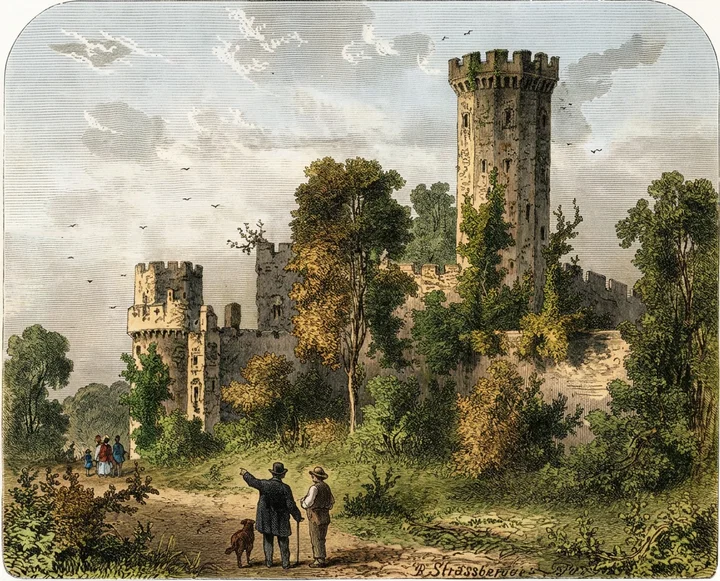
One of the oldest of these castles now in existence is found in Warwickshire. Warwick is a town beautifully situated on the banks of the River Avon. It suffered a great deal from the Danish invaders; but it was repaired afterward by Lady Ethelfleda, the daughter of good King Alfred.
The castle stands on a rocky eminence, and at its base flows the bright water. It was once the “special stronghold for the midland part of the kingdom,” and it was very necessary for the king’s peace that none but his friends should hold it. The castle and its earls have played an important part in English history.
The living rooms extend three hundred and thirty feet in length; and from the windows can be obtained an extensive and varied view of the surrounding country. In the castle may be seen fine old portraits, and the armor of lords long dead.
The most ancient portion of the building is known as Cæsar’s Tower. Guy’s house, another ancient part, was erected in 1394, and its walls of solid masonry are ten feet thick.
Sir Guy, earl of Warwick, is a famous fabulous person, supposed to have lived in the reign of the Saxon king, Athelstan, nearly a thousand years before Christ. According to a legend which probably had its origin in some Norman poet’s brain, the Danes were waging fierce war against the Saxon king. The result was to depend on a combat between two champions,—Colbran, the Danish champion, and Earl Guy, who had just returned, unknown, from a pilgrimage to the Holy Land. Guy killed the Dane, and then retired to a hermitage beside his own castle in Warwick.
“Sir Guy of Warwick, as was wreten In palmer wyse, as Colman hath it wryten; The battail toke on hym for England’s right, With the Colbrond in armes for to fight.”
Whether there ever was a Sir Guy, and whether he lived in this hermitage, we do not know; but it is certain that a hermit did live here in the reign of Henry IV.
In a room in the castle are shown what is said to be the sword, shield, and helmet of Sir Guy; and also his huge kettle of bell-metal, twenty-six feet wide, and holding one hundred and twenty gallons.
But if Sir Guy’s history adds romance to the place, the earls who came after him have made it famous. Here have lived the Newburghs, and the Beauchamps, and Richard Neville, known in history as “the king-maker;” and Sir Fulke Granville, who expended large sums of money in restoring the castle; besides many others of equal fame. It is a brave old place, moss-grown now, and mantled with rare old ivy.
“The stately homes of England! How beautiful they stand, Amidst the tall ancestral trees O’er all the pleasant land.” W. E. L.