ONE UNSELFISH ACT

6%

S. D. A. Publishing Association · Battle Creek, Mich. · Apr 22, 1885

FromThe Youth’s Instructor, Vol. 33, No. 14.

Read the full edition

ONE UNSELFISH ACT.

NORMAN DEANE had at last found a place to work. He had inquired at almost every farm-house within five miles; and though nearly everybody wished to hire a boy, Norman, who was only twelve years old, and small and puny-looking at that, was always told that he wasn’t “big enough” or “tough enough.” But he was not discouraged. He knew that on his success depended his going to school that winter, for he must earn some new books; his old ones he already knew by heart.
His mother was a poor widow. In the summer time she could support them nicely by sewing; but when the cold New England winter set in, her cough was so bad that she could do but little, and their scanty store was soon exhausted.
Norman had been kept steadily at school, and now it seemed more important than ever; for though he was hardly strong enough to do farm work, he thought he could get a place in a store if he could keep in school another term, and get through his arithmetic; but how could he get the new books?
“I can earn them; I know I can, if they’ll only give me a chance,” said he; and after he had looked three days for the “chance,” it came at last, for a man finally concluded that he might do to ride horse and pick up stones. He offered him fifty cents a week and his board, and Norman gladly accepted it.
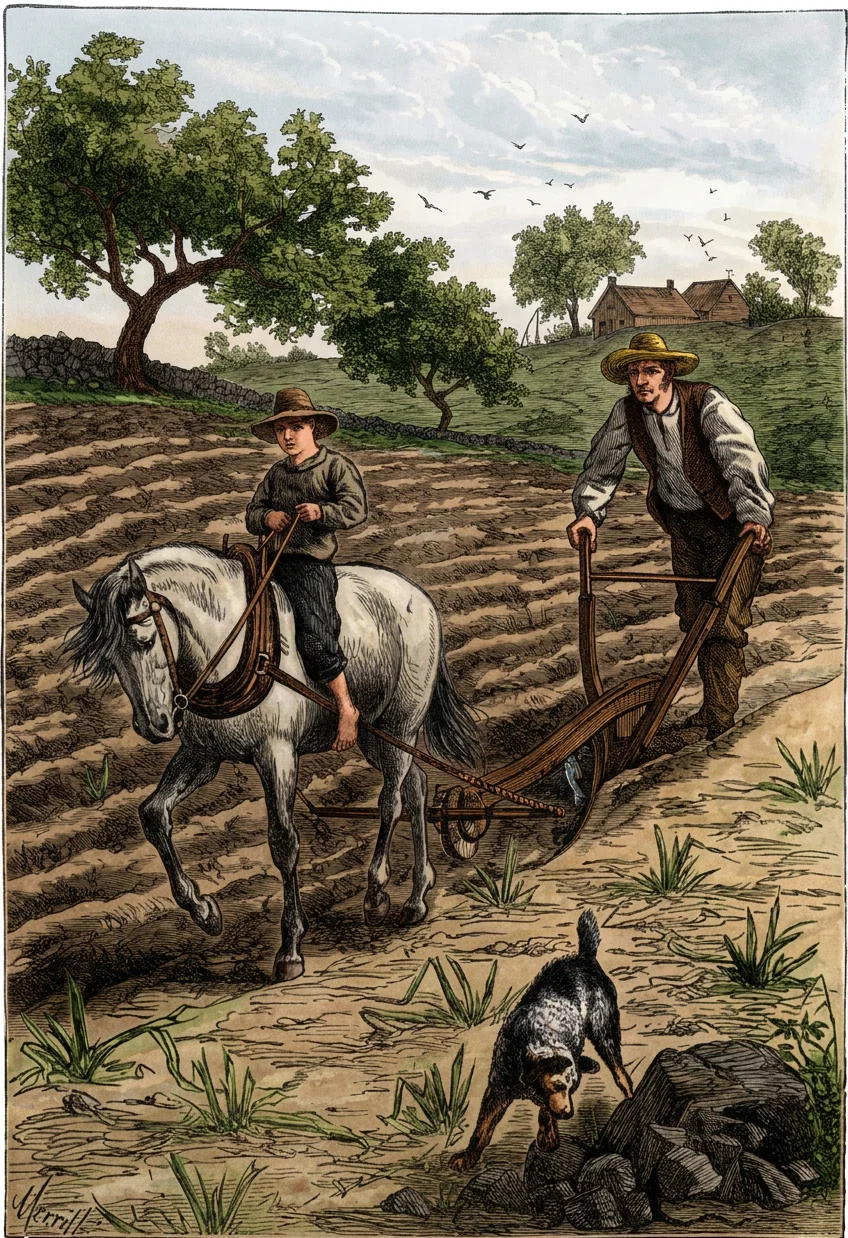
This New England farm was so hilly that it seemed necessary, when plowing, to have a small boy ride the horse, because the ground was so uneven, and so stony, that it was impossible to guide both the horse and the plow at the same time. At first this was quite a novelty to Norman; but he soon got tired of riding up and down the long furrows all day, and often he wished he might run away to the woods, and stretch his weary limbs in their cool shade. He even envied the dog, as it ran barking from one stone-pile to another, scaring out a stray toad or a little green snake; but the thought of the new books that were to be his made it easier for him.
Restored with AI
Then, while they were using the horse to drag or roll the newly plowed ground, he would pick up all the small stones scattered around, and pile them with the larger ones for the men to carry off and build a wall. Every week when he went home, he would tell his mother all about his work and how much he hoped to earn; but he never told her that sometimes he was too tired to eat the nice bowl of fresh bread and milk the farmer’s wife gave him for supper, nor how the stones bruised his feet till he could scarcely walk.
At last the plowing was all done, and he proudly trudged home the week before school commenced, with two bright, shining dollars. The doctor was just leaving, as he reached home; but he heard him say, “You’ll never get better of that cough, ma’am, unless you dress warmer than you do. Take my advice, and get some good, warm flannel to wear this winter, or I’ll not answer for the consequences.”
Norman didn’t say much, but he thought a great deal; and that afternoon, when he went to the village store, instead of walking to the counter where the books were temptingly placed, he resolutely turned to the other side, and called for two dollars’ worth of their very best flannel. As the kind-hearted store-keeper measured it off, he turned to Norman, and said pleasantly, “You’ve been at work this fall, I hear, and now I suppose you will go to school this winter?”
“No, I guess not,” answered Norman; “I’ve changed my mind, and I won’t be able to get any books, now, anyway.”
“Why, what’s the matter? Your mother was telling me just the other day how well you were doing. You haven’t been spending your money foolishly, I hope?”
“Oh no, sir,” said Norman, “but—but—”
“But what?” questioned the man; and so Norman had to tell him all about it; and though he said nothing but “Well, well,” Norman thought, as he went out, that he saw him wipe his eyes.
To say that Mrs. Deane was surprised at the appearance of Norman with a bundle of red flannel instead of books, would scarcely express it; but a greater surprise lay in store for Norman when Mr. Adams, the store-keeper, came there the next day, and said that he had been thinking of getting a boy to run on errands and go to school; and that if Norman thought he would like it, he might come, and he would give him his books and clothes, and if he got along well, and was pretty good at figures, he would take him into the store next summer.
Norman did get along well, and he is in the store yet, but not as errand boy or clerk. He owns it now, and his mother has all the red flannel she wants to wear. He says his success began with “one unselfish act.”
S. ISADORE MINER.