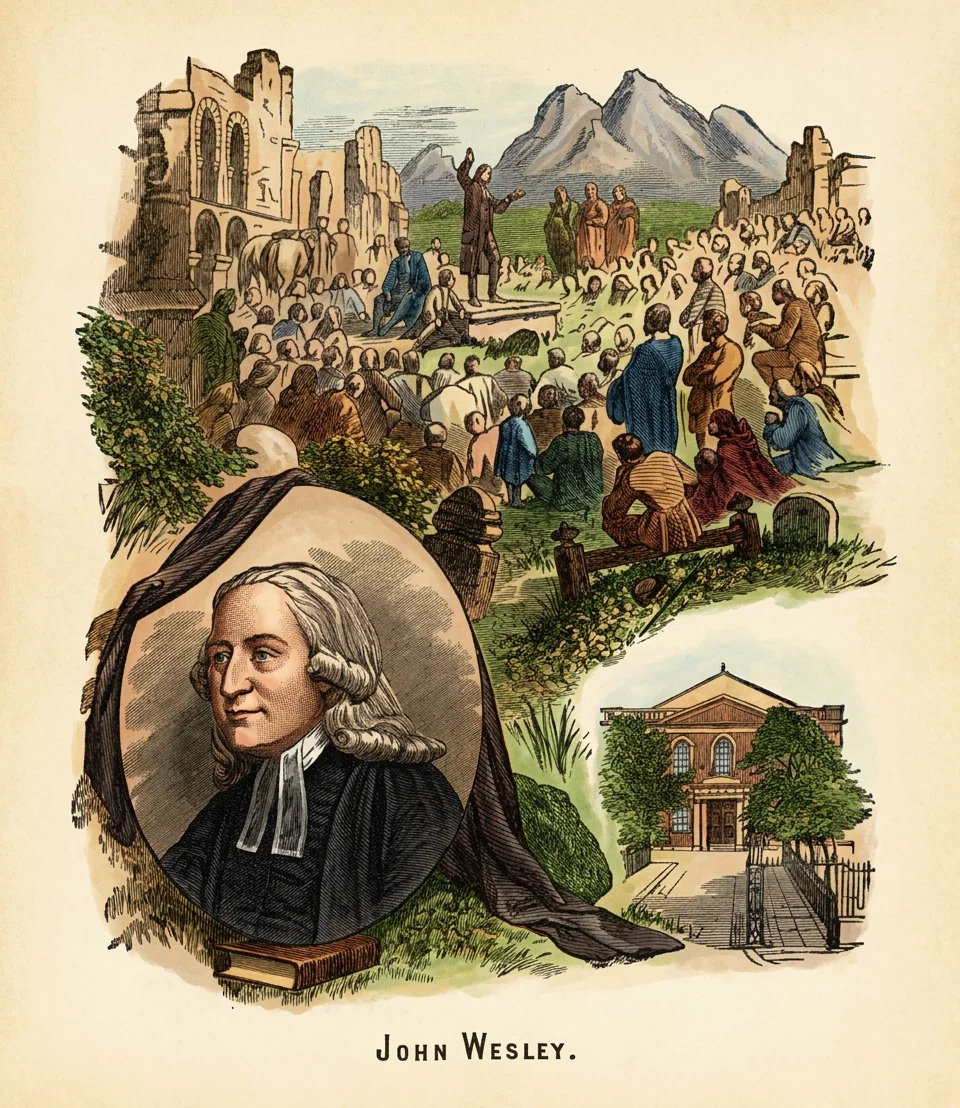
This eminent man was born at Epworth, England, June 17, 1703, and died in London, March 2, 1791, in the eighty-eighth year of his age. It is generally well known that this excellent divine was the founder of the people called Methodists. As might be inferred from the picture, Mr. Wesley was a person of genial disposition, though from his earliest youth he was of a serious turn of mind, and felt that Providence had some important work for him to do.
In early life he had the advantages of a liberal education. At the age of twenty-three he was Greek lecturer in Lincoln College; and shortly after, he graduated as master of arts. He had previously been ordained as a deacon. Not far from this time, he began to assist his father as curate; and a little later, he was regularly ordained as priest in the Church of England. Some two years after, he went to Oxford College, where he entered with great ardor into a religious association of students, his brother, Charles Wesley, and George Whitefield, being prominent members, and to whom, for their zeal and order in religious duties, the term “Methodists” began to be applied.
In 1735 Mr. Wesley came to America with General Oglethorpe, to found a mission among the Indians, and to preach to the colonists. Here he established large and flourishing congregations. While in America, he was often in straightened circumstances as to means, but not, as he says, “without peace, health, and contentment.” In going about his mission work, he had often to wade through swamps, and swim across rivers, to get to his appointments, letting his clothes dry as he traveled. After a brief stay in this country, he recrossed the Atlantic to England, which became the scene of his lifelong labors.
In the year 1739, Mr. Wesley, imitating the example of George Whitefield, began the practice of open-air preaching. It was near the same time also that he felt the Lord had revealed himself with new power to his soul, while listening to the reading of Luther’s “Preface to the Epistle to the Romans.” About this period, lay preaching was established among the people called Methodists, and the labors of Wesley and his associates began to assume the form of a schism in the church. As he was now excluded from the pulpits of the Church of England, he held divine worship in a large building at Moorsfields, among the colliers and others, which, from the fact of its having once been used as a foundery, was afterward known as “the Foundery Church.” This building was subsequently made over into a chapel, and became the center of later operations. In the cut, Wesley is seen preaching from his father’s grave in Epworth, after being refused the privilege of speaking in the state church. His text was, “The kingdom of God is not meat and drink; but righteousness, and peace, and joy in the Holy Ghost.” He says, “At six in the evening I came, and found such a congregation as I believe Epworth never saw before.”
Mr. Wesley now made long journeys to various parts of Great Britain, warning people of all classes to flee from “the wrath to come.” He usually162preached twice a day on week days, and often as many as four times a day on Sundays. At Kennington Common he once spoke to an assembly of twenty thousand persons.
This faithful servant of God devoted himself to the work of the gospel with a zeal which is almost unparalleled. It is said by his historian, Doctor Whitehead, that for fifty consecutive years not an instance can be found in which the severest weather kept him from his labors for a single day! He usually journeyed on horseback, seldom traveling less than forty miles a day. He spent sixty-five years in the ministry, going from place to place, convincing gainsayers, warning sinners, comforting the mourning ones, and building up those that believed. It is estimated that in his lifetime he traveled two hundred and seventy thousand miles, and preached over forty thousand sermons, besides his numerous addresses, exhortations, and prayers. As one has observed, “If we consider his abundant labors, we may well say that Mr. Wesley lived two or three lives.”
His industry also was unequaled, except by the apostles themselves. He usually rose at four in the morning, and worked with a will till eight at night, in preaching, reading, writing, meeting the people, traveling, and administering to the spiritual and temporal wants of the sick. His benevolence was unbounded. He literally gave away all that he had, and to the last kept his resolution to die poor. His income was not large, but it is estimated that he gave away in charity during his lifetime one hundred and fifty thousand dollars.
In his social life, Wesley was lively and agreeable. He had great talent for making himself pleasant in company. He was polite and attentive, and talked a great deal where he saw it was expected. Frequently he received invitations from the best families, who wished to show him respect, and who expected to hear him converse on various subjects, religious and otherwise. He had seen much of the world in his travels, and being a great reader, his mind was stored with an infinite number of anecdotes, which, with his agreeable manners, made his conversation very entertaining. In private life, among his friends, his manners were particularly sprightly and pleasant. And this was as conspicuous at nearly ninety years of age, as when a young man of twenty. His temperance principles he carried to great length. But while he never urged these views upon others, he insisted upon the right of being judge of what he deemed best for himself.
Mr. Wesley was a great scholar, being well read in the classics, and thoroughly conversant with the dead languages. When he was unable to quote a text from the English New Testament, he was seldom at loss to repeat it in the Greek. He was also a proficient in many modern tongues. The art of logic he studied with great care. This enabled him to reason correctly, to comprehend things clearly, and to judge truly. In reading, he made accurate notes of men and things, and transcribed them into his journal, which has often been printed. He also held frequent correspondence with the great men of his day,—with bishops, and critics, and lords.
In preaching the doctrine of free grace, Wesley was often persecuted and mobbed, but a kind providence spared his life, sometimes when in the very jaws of death itself. This persecution and injury he bore not only without anger, but without any apparent notice. Though looked upon as a schismatic by the English State Church, this holy man died in her connection, beloved by his own people, and respected by his enemies. The last four days of his earthly existence were spent in praising the Lord.