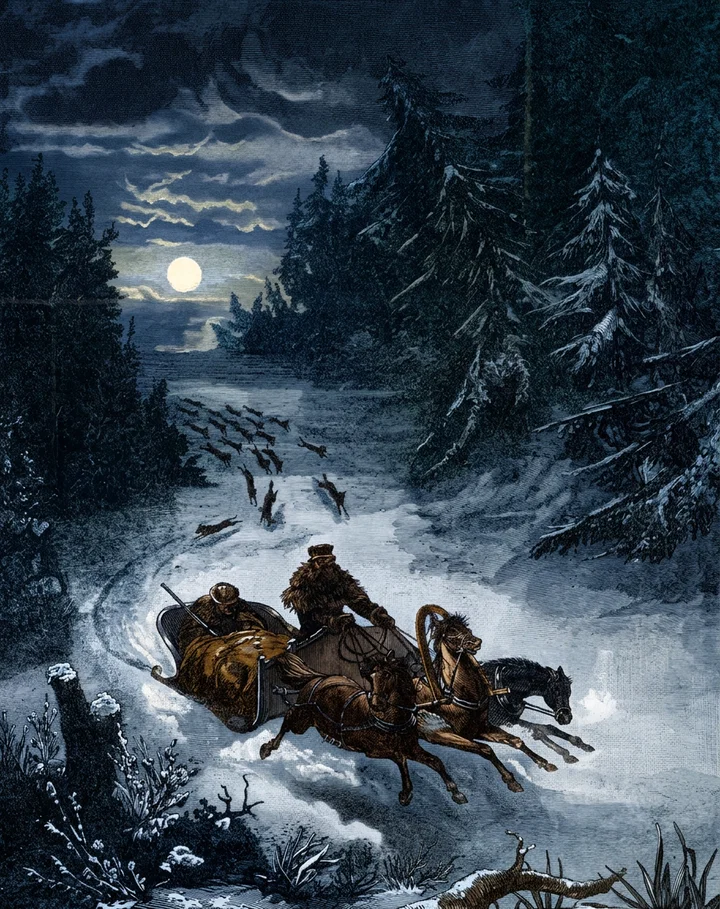
The accompanying engraving represents a Russian traveling scene. How many of our young friends can locate Russia?
Please take your maps, and see what a vast extent of territory it comprises. Beginning with the Baltic Sea and Sweden on the west, it stretches eastward 6,000 miles, quite to the Pacific Ocean; and from the Arctic Ocean on the north, it extends as far south as the Black Sea, its greatest breadth being about 2,300 miles. This includes both Russia in Europe and Russia in Asia; and together, they form the Russian Empire, the largest and most powerful empire in the world. It is equal in size to about the whole of North America.
This vast region of country affords a great variety of soil and climate. The northern half of European Russia is a land of forests and marshes, plentifully supplied with lakes and rivers, and furnishes some valuable tracts of land for tillage. The southern half is a great expanse of rich land, with occasional tracts of sand and forests. Siberian Russia consists almost entirely of marshes and steppes, or plains. With the exception of the southern and western portions, it is quite barren.
Of the early history of Russia, but little is known. It is supposed the empire was founded by Rurik, about one thousand years ago. It has for a long time been divided into “governments,” and several provinces not yet formed into governments, which comprise one hundred different nations and tribes, who speak about forty different languages.
With some exceptions, Russia is not remarkable for its fine scenery. English travelers usually visit St. Petersburg, Moscow, attend the great fair at Nizhni Novgorod, and make the voyage of the Don and Volga Rivers. But what the scenery lacks in beauty and interest is usually made up in curious traveling companions, who are always ready to engage in conversation, and impart their simple stock of knowledge. One can sometimes spend a portion of time quite profitably in the society of these good natured, common-sense peasants.
Russia has such an abundant supply of water privileges, one might think navigation would not be difficult. Although it has been much improved during the last twenty-five or thirty years, and steamboats now run on some of the larger rivers, it has many drawbacks. One is that during the long, cold season the rivers are covered with ice; another, when the snow melts, many of the villages can only be reached by boats; but the warm weather comes so suddenly that the streams, mostp. 6 of which are fed by the rains and melting snow, fall rapidly, and by the middle of summer it is difficult for the steamboat to pick its way between the sandbars. The River Neva alone has a plentiful supply of water during the dry season.
The public roads in Russia, unless in some of the central parts, are represented as the worst in existence,—no changes having been made in them in centuries, only as the ruts shift their position. When the ruts become so deep that the wheels cannot reach the bottom, the people begin a new pair, on one side or the other of the old ones, the roads being so broad as always to furnish room for others. Soon the old ruts fill up again, ready for service when needed. Winter improves the traveling by filling the ruts with ice and snow. The greatest inconvenience of winter traveling is the prevalence of strong winds when the thermometer is many degrees below zero. The severity of the climate renders thick, warm furs a necessity.
In taking an overland journey in a country where there are no railroads, the Russian makes use of a vehicle called a “tarantass,” which is usually drawn by three horses. It somewhat resembles a phaeton without springs. A useless apology for springs consists of two parallel wooden bars fastened lengthwise to the body of the tarantass. He is expected to take with him a pair of sheets, one blanket, a pillow, and towels; also his tea and sugar. His pillow is a sort of air cushion, which answers the double purpose of a pillow, and to ease the jolts of the springless vehicle. On those overland routes, the Russian would sooner think of traveling without his portmanteau than his pillow.
Regular post-stations are located every ten and twenty miles, on all the principal thoroughfares, where horses, vehicles, and drivers are kept for the accommodation of travelers. A good driver seldom uses a whip, except to flaunt it over the heads of the animals. He guides his team by talking to them as he would to a person. At one time he calls them “little doves;” at another, “cursed hounds;” and so varies his titles according to his state of mind.
Since the construction of railroads in Russia, or during the last thirty or forty years, traveling has been made very comfortable and convenient. The railway carriages are made with double windows and doors, besides being heated with iron stoves; so that even during the severity of winter, one can travel with ease.
An incident in connection with the building of the railroad between St. Petersburg and Moscow is worthy of notice here. This road extends a distance of four hundred miles, without turning to the right or left. Formerly, a person could travel fifteen hours without seeing but once what he could call a town, and scarcely a human habitation would be visible on the route. A tedious journey, surely, at their slow rate of speed! Branch roads now connect with the main line in many places. When the survey was made for this great stretch of road, the “Minister” laid a map of the proposed road before the Czar in order to explain the route. The Czar at once laid a ruler on the map, from St. Petersburg to Moscow, and drew a straight line, saying, in an authoritative tone of voice, “You will construct the road so!” and it was so built.
We can give but a few of the many interesting things concerning Russia in one short article. You may have an opportunity to read its history sometime. We will only add further that wolves frequent some portions of the country. Formerly, they were the terror of all Europe, and it was unsafe to travel during the winter and spring months; but now they are common only in the mountainous regions and those most thinly populated.
M. J. C.