WHAT a long, awkward bird this one in our picture is! He belongs to that great family of water birds known as waders. He lives near rivers and marshy sedges. And when you have learned that, you can see of what use his long, slim legs are to him. He can wade around among the tall reeds and rushes and in the deep mud, hunting for his food, where an ordinary bird could not go at all. In the same way, his long neck, that makes him look so homely, is also useful to him.
There are a good many kinds of cranes, and some of them are very odd, indeed. One of them is called the Demoiselle Crane. “Demoiselle” is the French word for “young lady.” This bird was given this name because it is slow and graceful, and also very dainty. It has a funny way of dancing about on the tips of its toes, and flapping its wings, all the time bowing its head in the most comical fashion. The Crowned Crane, a different looking bird from the Demoiselle, also has these queer ways. How odd these birds must look when dancing!
In the summer season, the cranes fly from South America, often far to the north of us. You cannot see them go, for they fly up high in the air, away out of sight. But you might hear their cry, which is loud and piercing, and sounds like the far-off blast of a trumpet. It is a strange noise. The crane could not make it if it were not for the queer music box in his throat. This music box is his windpipe, which is very long. Instead of going straight to the lungs, it passes into the breast bone, and after several twistings, reaches his lungs.
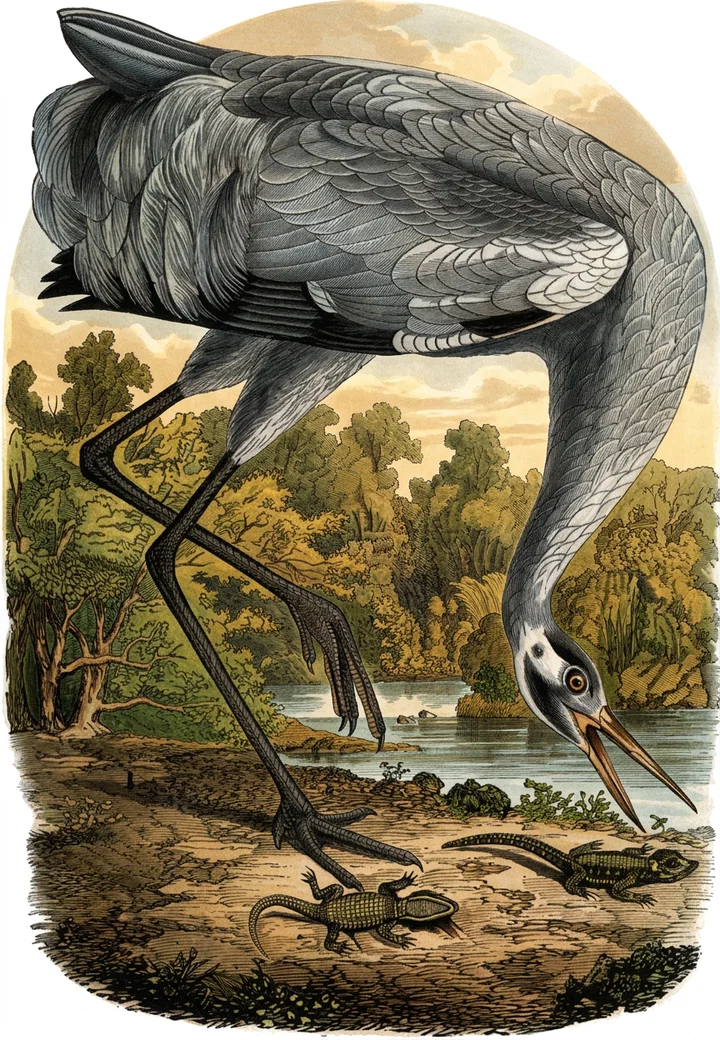
He is a shy, wary bird, and very hard to shoot. But when he is wounded, he is savage indeed, and can keep away the bravest hunter. He can fight vigorously with his sharp bill and strong wings. The great naturalist, Audubon, was once attacked by a crane that he had shot in the wing. As he came near it, the bird stretched itself up to its full height, and angrily ran toward him, with open beak, till finally Audubon was obliged to run into the river up to his neck, and wait for his boatmen to come up and kill the bird. They laughed heartily at him; yet I do not think one of them would have changed places with him, and faced the savage bird. W. E. L.