“Uncle John,” said Eddie suddenly, one afternoon, looking up from his spelling-book, “what is a mutiny?”
Uncle John, who is our “sailor uncle,” was reading a letter with a big, red seal on it, and did not at first hear the small voice. As he folded up the letter, Eddie repeated his question.
“A mutiny, my boy? mutiny? mutiny?” said Uncle John, slowly. “I’m afraid I don’t know. It must be a new word. How do you spell it?”
“Why, m-u-t, mut, i-n, in, y, mutiny,” was the confident reply.
“Ha, ha!” laughed Uncle John. “That’s a word of a very different ring. A seaman ought to know what mutiny means, for he is likely to swing at the yard-arm if he gets confused about it. A mutiny at sea, my boy, means a refusal of the sailors to obey their commanding officers, or a seizure by them of the ship, and is punishable by death. A mutiny is the most dreadful thing that can happen on board ship, outside of wreck or capture by pirates.”
“Were you ever in a mutiny, Uncle John?” said the eager little listener. “Oh, do tell us about one!”
“Yes, please do,” said Ella, who had come in just in time to hear the last question.
“No,” said Uncle John, “I am glad to say I have never been in a mutiny, or in a place where there was one. Mutinies are not very common nowadays, for sailors are much better treated than they used to be. Laws have been passed of late years which inflict severe penalties on brutal captains who maltreat their men, and so there is not so much cause for mutinies now. But in former times, things were very different, and cruel captains could do pretty much as they liked; and as they very often liked to do very mean and hateful things, it is not much wonder that sometimes sailors would rebel rather than endure ill-treatment, and take the chances of escape, though they knew that they were committing a very grave offense, and that the law would have no mercy on them if they were captured. But if you want to hear about a real mutiny, I will tell you about one, and perhaps the most famous and remarkable mutiny that ever occurred at sea. It took place on the British man-of-war, ‘Bounty,’ a good many years ago. But first you must get me your big atlas, Ella, so that we may trace our course, and see where we are sailing to.”
Ella soon returned with her atlas, and Uncle John told her to open it at the map of the world. He stuck a pin in the map at a projecting point on the southern coast of England, and another at an unnamed little black dot in the South Pacific, way off at the other side of the book; then continued:—
“In the year 1769 the Society Islands were discovered by the famous Captain Cook. The largest of these, called Tahiti, is where I have stuck the pin. It was a beautiful little island, and inhabited by a race of strong and handsome but gentle and peaceable people. An important product of the island is the bread-fruit tree, whose fruit is very nutritious, and looks and tastes somewhat like white bread. This tree furnishes the principal food of the islanders; and its thin and flexible bark supplies them with clothing.
About the year 1787, the planters of the British West Indian Islands heard of the bread-fruit tree, and petitioned the British Government to send a ship to get a load of it for them to plant. So in December, 1787, the good ship ‘Bounty’ was fitted out for the expedition, and sailed for Tahiti from Portsmouth, England, where you see I have put the other pin. She was commanded by a man by the name of Bligh, who had sailed with Captain Cook, and knew all about the South Seas; and she carried a crew of forty-four men. The voyage was a very long one. They first sailed down here by South America, and tried to round Cape Horn. But after terrible storms for over a month, they gave it up, and steered for the Cape of Good Hope, South Africa, and then way across the Indian Ocean to the Society Islands. It was nearly a year after their voyage began when they finally reached Tahiti, and they had traveled over twenty-seven thousand miles.
“But long before they had reached the island, the crew had begun to be discontented. Captain Bligh was a very stern and overbearing man, and did not treat his crew fairly. He accused them unjustly of stealing the provisions, and put them on short allowance; and when they complained that even the short allowance was not fit to be eaten, he called them all on deck, made each one say he was satisfied with the food, and swore that he would make them all eat grass, or anything else he chose to give them, before the voyage was over. Things kept getting worse and worse after they arrived at the island. Some of the crew were flogged by his orders, and he often insulted his officers. Among these officers was one by the name of Fletcher Christian, who was first mate. He was a quiet man, but very sensitive; and the captain treated him worse than any of the others.
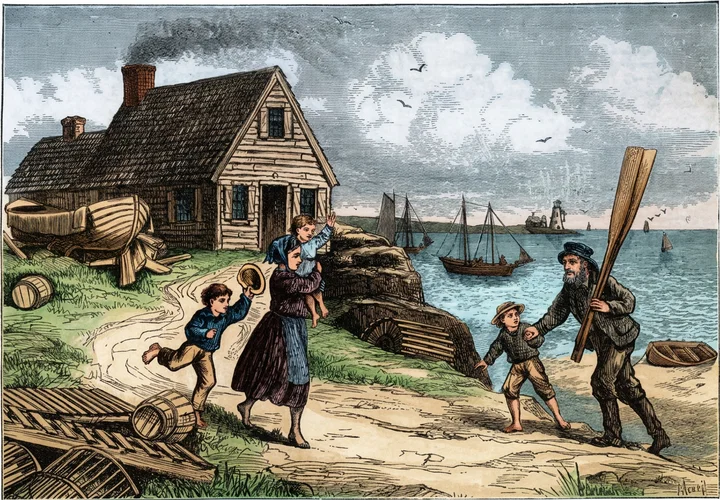
“At last, when they had been more than six months at the island, and had got their cargo of plants, they started for home. They were three hundred miles from Tahiti, when, one morning, Fletcher Christian determined to bear his lot no longer, but to seize the ship. He gathered around him some of the men who had been flogged, put arms in their hands, stationed them at the officers’ cabins, and seized and tied the captain. In a twinkling the ship was in Christian’s hands. The captain tried to win the mutineers back, but they laughed at him, and hurried him and those who would not join them over the side of the ship, and into an open boat. Nineteen men were thus crowded into a small boat, with a cask of water, a few tools, and some bags of ship-bread. They were then cast adrift on the great Pacific. However cruel Captain Bligh may have been, he could not have been more cruel than were the mutineers in abandoning a boat-load of men to the mercies of the wind and waves in the middle of a great ocean. You see, the mutineers did not reflect that they were doing just what they themselves had found so hateful.
“Christian and his comrades immediately turned the ‘Bounty’ about, and sailed for Tahiti. But it was not Christian’s intention to stay there. He knew that, even if Captain Bligh should not succeed in reaching England, a ship would be sent out to search for the missing vessel; and he determined to seek some isolated and rocky island where he would not be found, and where he could spend the remainder of his life in safety. Sixteen of the ship’sp. 154 company, however, preferred to remain at Tahiti. The rest, nine in all, with twelve Tahitian men and women, who were induced to follow their fortunes, set sail in the ‘Bounty’ for a safe haven, which they found in Pitcairn’s Island, a craggy islet five or six hundred miles from Tahiti, which at that time was not put down on any of the charts, and was far out of the course of the few vessels that ever sailed in those waters. They ran the ship on shore, and, after removing everything of value, destroyed her, that there might be nothing to attract the curiosity of any vessel that should happen to pass within sight of the island. So perished the good ship ‘Bounty.’ Not a soul except those on the island knew what became of her; and they were apparently never to leave their rocky fortress. Christian lived in a kind of stronghold in the interior of the island, where he remained, a moody, resolute man, determined to resist to the death any attempt at capture. But soon the islanders began to quarrel and fight; and in four or five years, all of the mutineers but one, including Christian himself, and all of the Tahitian men, had been killed. The one Englishman left became a very good man, and spent his time in teaching the children of the mutineers what he knew of the Christian religion, and in laboring in all ways for the welfare of the little community; so that when the island was at last visited by Europeans, it was quite a model Christian settlement. It was not till 1809, twenty years after the mutiny, that a vessel touched at the island. At that time the population had increased to thirty-four. They now number some hundreds; some of them still live on Pitcairn’s Island, but two companies of them have moved to other islands in the South Seas.
Captain Bligh, in his open boat, resolved to take the forlorn chance of reaching Timor, the nearest land inhabited by white men. For forty-one days he guided the little shell through storm and calm on the great ocean, his men half starved and half drowned all the time, and at last reached land, having sailed over 3,600 miles, and without losing a man—one of the most wonderful voyages ever made under such conditions. Some of the poor fellows died, however, after reaching shore. The rest of them finally reached England in 1790.”
“And what became of the ones who stayed at Tahiti?” asked Eddie.
“That is the saddest part of the story. A ship called the ‘Pandora’ was sent to Tahiti to retake the mutineers; and though many of those who had remained on the island had not taken any part in the mutiny, and surrendered themselves to the captain of the ‘Pandora’ as soon as she arrived, they were all put in irons, and thrown into a ‘cage’ built for them on the ship, which they jokingly called ‘Pandora’s box,’ where they were treated with the most horrible cruelty until the ‘Pandora’ was wrecked on her home voyage, when four of them, still in irons, were drowned. The remaining ten were tried for their lives in England, and seven of them were acquitted; three were hanged. Some of those who were acquitted afterward rose to distinction; but they will be best known from their connection with this famous mutiny, which peopled an island, occasioned a wonderful open-boat voyage, wrecked two vessels, created great excitement in England at the return of Captain Bligh, and the trial of the mutineers, and has been the subject of many books, and of a long poem by Lord Byron, called ‘The Island.’”—The Christian Union.