PLYMOUTH

6%

S. D. A. Publishing Association · Battle Creek, Mich. · Jul 15, 1885

FromThe Youth’s Instructor, Vol. 33, No. 26.

Read the full edition

PLYMOUTH

Ay, call it holy ground, The soil where first they trod; They have left unstained what there they found,— Freedom to worship God!"
“Plymouth,” as a traveler aptly remarks, “is the American Mecca. It does not contain the tomb of the Prophet, but the Rock of the Forefathers, their traditions, and their graves.”
Over two hundred years ago the Pilgrims first set foot on Plymouth Rock, to them the door-step into an unknown world; and with this rock for a corner-stone, they laid the foundations of our great Republic.
“God had sifted three kingdoms, to find the wheat for this planting, Then had sifted the wheat, as the living seed of a nation; So say the chronicles old, and such is the faith of the people.”
These were stout-hearted men, and brave, trustful women, who willingly faced the hardships of pioneer life, that they might have a place where they could worship God in simplicity.
How pleasant it would be if we could know more about the every-day life of these noble men and women. Before them lay an untamed wilderness; but they did not falter. In that first, terrible winter, many died; so that, as the governor touchingly wrote, “Ye well were not in any measure sufficient to tend ye sick; nor the living scarce able to burie the dead.” There was nothing but steady, hard work before them; but I fancy these stern men enjoyed it, and cared little for recreation.
But some of the new-comers were not inclined to lead so industrious a life. It was the custom for the governor to call all the able-bodied men together each morning, and lead them to their work in the fields. On Christmas day, some refused to go, saying that it was against their conscience to work on that day. Very well, the governor said; if it was against their conscience, he would leave them until they were better informed. But upon returning at noon, he found them playing ball and pitching quoits in the street. With a twinkle of fun in his eyes, the governor took away their implements, and sent them into the house, saying that it was against his conscience that they should play while others worked.
And, girls, do you know what was done to the scolds? They were gagged and set at the door for certain hours, for all comers and goers to gaze at. Undoubtedly, with such severe treatment in prospect, the shrews very prudently held their tongues, and peace reigned at the hearthstone.
All who were inclined to find fault with the government were promptly banished from the settlement. One John Oldham, who had been driven out for causing a revolt among the disaffected, dared to return. He was more contentious than before, and was put under guard until his wrath had cooled. Then he was marched between a double file of musketeers, each man giving him a “thump with ye but end of his musket.” He was then taken to a boat, and told to go and mend his manners. This may seem like severe treatment, but all the success of the little colony depended on the good-will that prevailed among its members.
Restored with AI
On the top of the hill stood the fortress and church, a “large, square house, with a flat roof, made of thick, sawn planks, stayed with oak beams.” To intimidate the Indians, there were placed upon the top six cannon,—
“Preachers that spoke to the purpose, Steady, straightforward, and strong, with irresistible logic, Orthodox, flashing conviction right into the hearts of the heathen.”
It would be a satisfaction if we might visit the ruins of this first church, but there is not a vestige left. The governor’s house, together with all the other dwellings, have been torn down. In their places stand newer ones, and this first city looks like any other New England town.
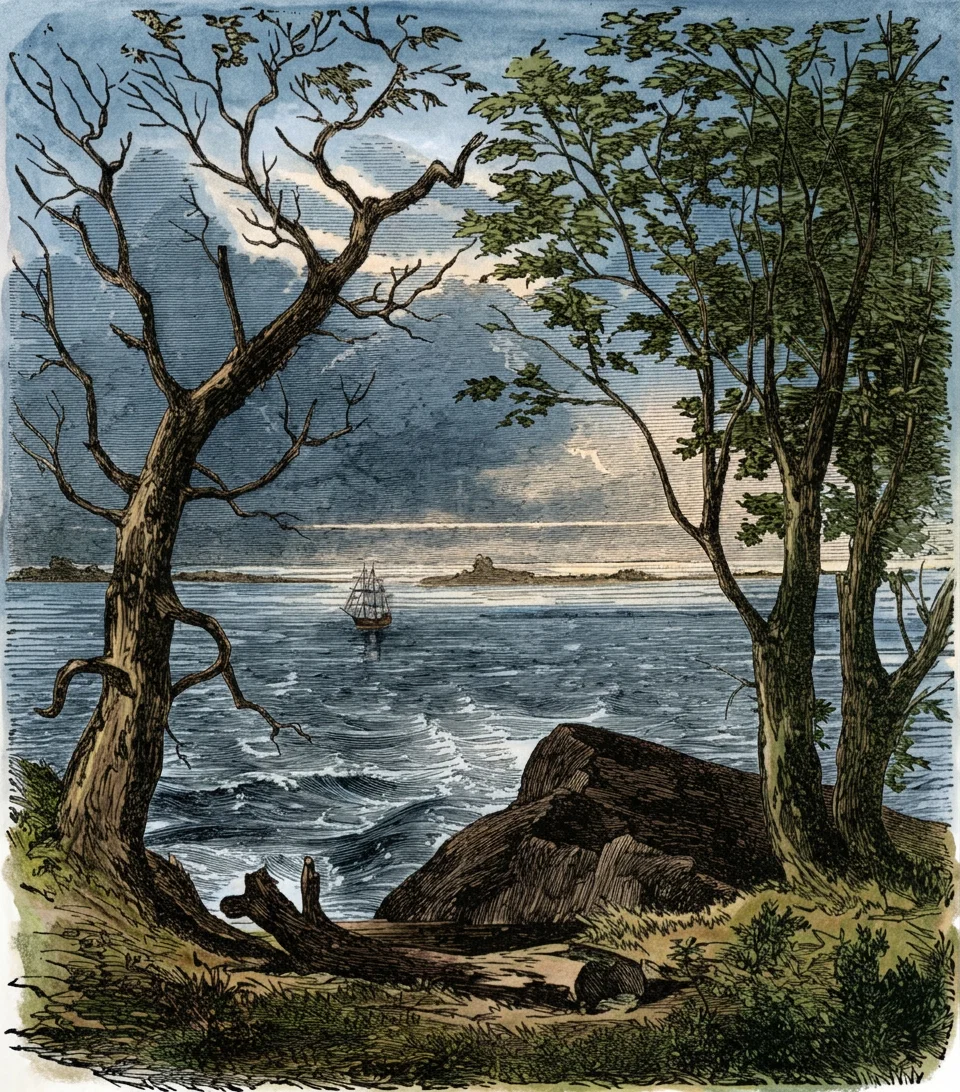
We would expect the rock to remain the same as when the Puritans set foot on it that cold December day. But here, too, there have been changes. At one time the people tried to move it to a more conspicuous place in the town; but the rock split in two. So only the top part was taken, which now lies in the yard in front of Pilgrim Hall. It is surrounded by a pailing, and on it is chiseled the date, 1620. The lower half remains where it was, but it is inclosed by a canopy. Our picture shows us Plymouth Rock as it was, and as we always imagine it to be.
But whatever changes have been made in the town, the hills are the same, and the sea; and tender memories will always cluster around them. And after all, the Forefathers need no other monument than that which may be found in the good government built upon the foundations they laid. May it long stand as a witness to their wisdom and forethought.
W. E. L.