Deep down in the sea are hidden rich treasures of pearls, corals, and sponges. Men have always coveted this wealth, but it was once very much harder to get than at the present time. The most expert divers could remain under water hardly two or three minutes at a time. If you try to hold your breath for just one minute, you will readily see what hard work it is to stay under water. Two minutes would not give time enough to explore the richly laden ships that had been wrecked at sea, and bring away the cargo.
Sometimes it was necessary to build bridges across wide, deep streams, and to clear away dangerous rocks from narrow channels, so as to make a safe passage for ships. It was very difficult to do this work, because men could not go under water to fix the foundations. “Necessity,” says the old proverb, “is the mother of invention;” and this necessity led to the invention of the diving-bell and the diving dress.
A very simple experiment will show the principle upon which the diving-bell is constructed. On plunging an inverted tumbler downward in the water, it will be found that at first the water does not rise up inside the tumbler,—that it remains empty and dry. As you plunge it down deeper, the water begins to rise a little. This is because the pressure of the water on the air that filled the glass, is so great that it condenses the air, and the water rushes in to fill the vacancy.

The first diving-bells were very simple,—nothing more than a large, air-tight, bell-shaped, wooden structure, bound with iron hoops like a barrel, and containing seats for the divers. But they could not remain long under water; for as soon as the fresh air in the bell was exhausted, they had to return to the surface, or perish.
Dr. Halley, a member of the Royal Society, who took great interest in diving and divers, set his wits to work to remedy the difficulty. In the above picture, you can readily see how this diving-bell looked, and the method employed to keep up the supply of air. The bell, you remember, was made of wood; but the artist has very accommodatingly drawn it so that we can see inside. It was lighted by heavy glass windows.
Dr. Halley incased two barrels with lead so as to make them air-tight. Over a hole in the top of the barrel he screwed a leathern hose; and he made a bung-hole in the bottom, so that the water could rush in, as the barrel was lowered, and the air condensed. There were two of these barrels, so arranged that they could be lowered alternately, like buckets in a well. The hose could be brought around under the bell, and through it the fresh air rushed. From a stop-cock in the top of the bell the foul air escaped with such force as to make the surface of the water boil. So long as the bubbles rose to the surface, those above knew that all was right down below.
Sometimes a diver, having on his head a copper helmet that has glass windows in front, went down with the bell. To his helmet was attached a leathern hose, extending up into the bell, so that he could be supplied with air.
Many improvements have been made in the diving-bell since Dr. Halley’s time; yet the general plan is the same. The air is now supplied by a force-pump, and a long rubber hose conducts the air from the pump to the top of the bell.
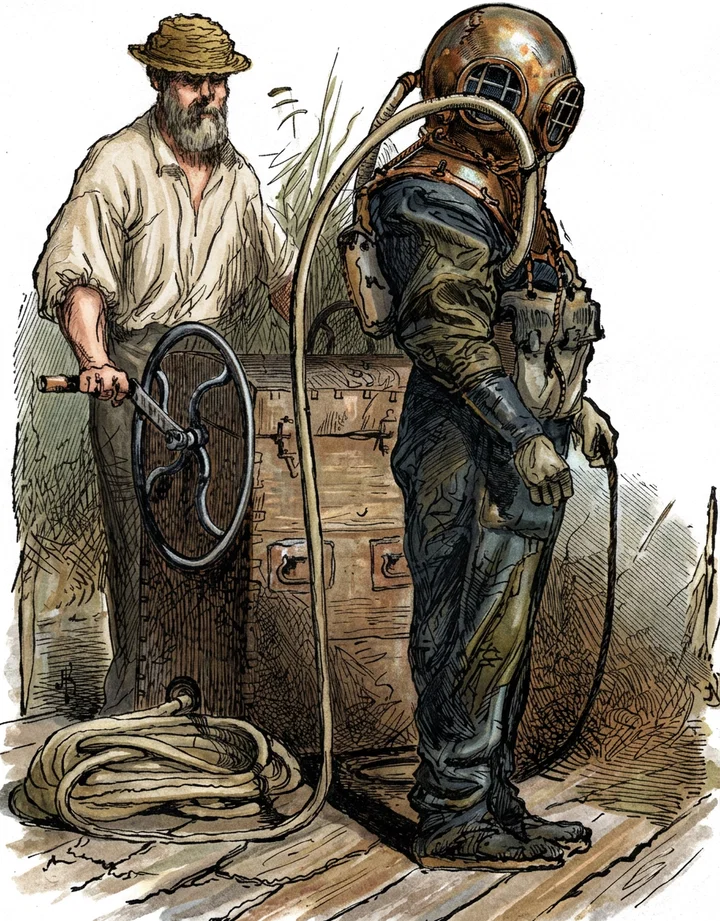
A less expensive apparatus is the diving dress, shown in the accompanying picture. The suit is made of India rubber, covered inside and out with tanned twill, to protect the rubber from injury. It is air-tight and water-tight. The helmet is made of tinned copper; the sleeves fit tight around the wrist, leaving the hands free; and to the soles of the shoes are attached heavy lead weights. Air is supplied by a force-pump, through a tube connected with the back of the helmet. There is an escape valve in the top of the helmet, the same as in the diving-bell.
Arrayed in this garb, the diver seizes the life line, and is swung off into the sea. The heavy leaden soles on his shoes carry him straight down, and help him to keep his footing while at work below. This dress does not add to the beauty of the wearer, and will probably never become fashionable, but it enables him to be eminently useful.
Diving is said to be a very profitable business, but it is attended with great danger. If the valves in the helmet should become clogged, or some careless person on shipboard should tread across the air pipe, thus cutting off the supply of air, life in the diving dress would very soon cease. It is not unfrequent to find the diver dead when he is hauled to the surface. It takes great resolution and presence of mind to become a good diver. If it were not for these brave men, who are willing to incur these risks, we would have scant knowledge of the strange life under the sea. “They that go down to the sea in ships, that do business in great waters; these see the works of the Lord, and his wonders in the deep.” W. E. L.