HILDA, BERTHA, and OTTO KARSTEN were three little German children who, with their parents, had come from that far-off land beyond the sea to find a home on our Western prairies. They had once had a dear little home in the old country, but they had lost it, and I will tell you how.
Their father had been a miller, and had owned the mill, together with the house and the few acres surrounding it. This land joined on every side the estate of a rich baron, and in fact, had once been a part of it; but it had been sold years before by the baron's ancestors to meet some reckless expenditure.
Now the baron had coveted these few acres for a long time, and had several times offered to buy them; but the sum he offered was not half the value; besides, Mr. Karsten loved his mill and his little home, and did not care to part with them. Well, as I have said, the baron coveted this land, and as he broke one commandment in doing so, it was not long before he began to lay plans how he might break another. The more he thought about it, the more he wanted it, till in his eyes it became worth more than all his vast possessions. He thought he could never be happy unless he had it; and at last he determined to steal it.
You think it would be hard work to steal land. So it would in this country, where the poor have privileges as well as the rich; but in that country, might makes right, and it was an easy matter. Let me tell you how he did it. The little stream that turned the big wheel in the mill flowed from the baron's land, and entered it again after running through the miller's; so this wicked man dug a great ditch around the poor miller's farm, connecting it at both ends with the stream, and thus drew the water all off. Then the big wheel stopped turning, and no grists could be ground. The miller did not know what to do, for he could get no work to make a living. Finally the little money he had saved was gone, and he was compelled to sell his home to the baron (no one else would care to buy it now) for whatever he pleased to give him, which was not much.
Mr. Karsten had heard of this good land of ours, and had heard that here by patient industry the poor might win homes; so one spring found the Karsten family on the rolling prairies. A farm was bought and partially paid for, and a comfortable house was built.
In a year or two the grassy plain was transformed into fields of rustling corn and waving wheat, and that in turn into shining dollars; and slowly and surely the farm became their own. “When the farm is paid for!” That was the children's idea of perfect happiness. To this end they hoarded even their pennies, and worked like little heroes, too. Barefooted and bareheaded, clad in their old-fashioned, home-spun clothes, they weeded the garden, cared for the cows and sheep, and fed the calves and chickens. When the other children laughed at their odd clothes, they only smiled at each other and said, “We'll have new clothes, too, when the farm is paid for.”
At last came the long-looked-for summer when the last dollar would be paid, if all went well. But alas! the spring was so damp and cold that the corn seed rotted in the ground; and though it was planted over and over again it became evident that the corn crop would be a perfect failure. But how the wheat grew!—as if it knew that eager eyes with anxious hearts were watching it,—as if it knew that joy or grief depended on its growing. The children measured by it. Now it was as tall as Otto; now it was over Bertha's head, and now Hilda, the eldest, could just reach the golden-turning heads by standing on her tip-toes.
“The wheat would pay for it all if I didn't have to hire some help to take care of it,” said the father, “but that will cost money, and now the corn is gone.” “O father,” cried Hilda, Bertha, and Otto all together, “we can help you take care of it, I'm sure we can. Do let us try.”
The father looked doubtful, and shook his head, but when he saw their eager faces cloud over, and tears come in their eyes, he thought again and said, “Well, you may try.” They could hardly wait till it was ripe, they were so anxious to prove that they could help; but at last the father shouldered his cradle, and went to cut it down. Then the children raked it up in bundles, and very careful they were to get every scattered stalk. Then the mother left the house to care for itself, and came out with them, and bound the bundles tight with wisps of straw. The children learned how, too, but they could bind only the small ones.
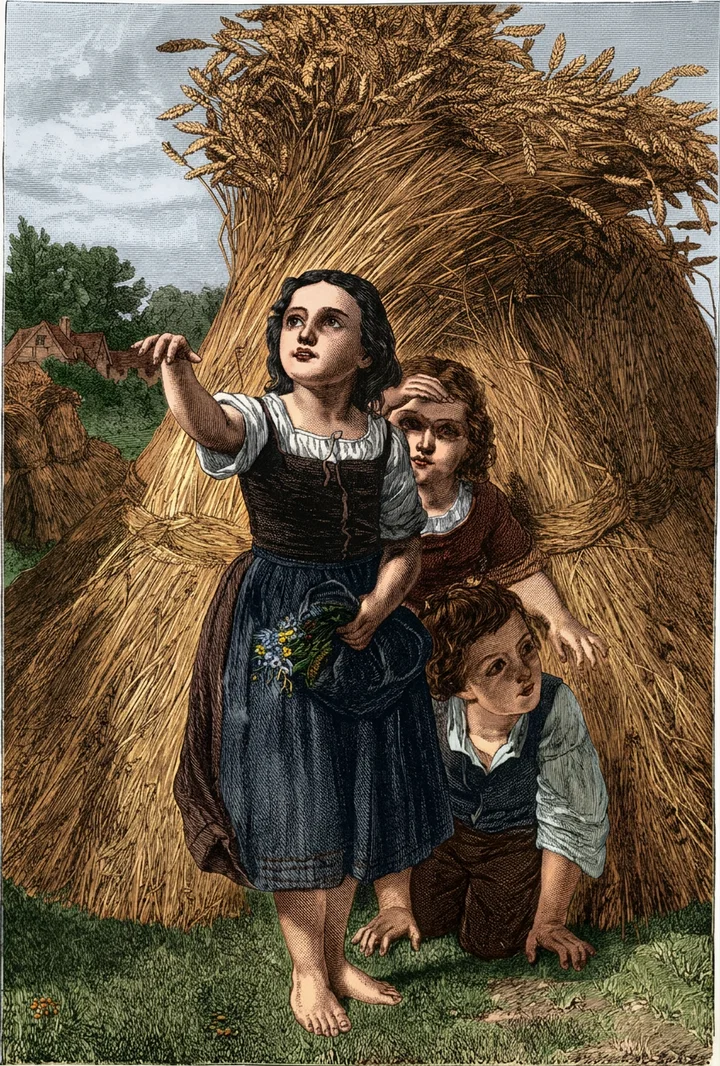
But they could set the bundles all on end in great shocks though, and thought it fun. They called it building houses. Once it rained when they were far from home, alone in a distant corner of the field. Then they built a larger house than usual, and crawled inside. It thundered and lightened, too, but they were not afraid. The shower was soon over, so that Bertha holding out her hand, could scarcely feel a falling drop. Then they crept from their safe retreat, and soon were at work again as merrily as ever.
Finally it was all cut and bound and set up. Now it must be stored in the barn. Again the father shook his head, but again they all cried, “We can do it. Try us, father.” They were not afraid to work, you see. When the great wagon was driven to the field, Otto held thep. 134 lines, and drove from shock to shock, while Hilda and Bertha laid the great bundles, as large as themselves, evenly, side by side, as fast as the father could toss them up. As proud as kings and queens in a royal chariot, they rode on the loaded wagon to the barn, and there they packed the grain in so tight that when the threshers came to thresh, they asked the father what man he had that packed the bundles so. How they stared when they were told, and how the children laughed!
But they laughed a great many times that winter when, clustered round the fire in a home now all their very own, they would recount their summer's work, and tell how they, too, had helped pay for the farm.
ISADORE S. MINER.