Written for the INSTRUCTOR.
AUSTRALIA
Directly opposite to us, and south-east from Asia, lies, between the Indian and Southern Pacific Oceans, a great island, so large that it is called a continent. This is Australia. It contains very nearly as much land as is owned by the United States. The coast line is singularly regular, and it has very few harbors; yet those it does have, on the south-eastern coast, are said to be the best in the world.
The interior and western parts of the country have not been very largely explored, but so far as anything is known concerning them, they present less attractions to colonists than the eastern and southern portions, as the land is often sterile or else swampy. Near the coast, however, the land is very fertile, and the vegetation luxuriant. Here is said to be some of the finest scenery in the world. The mountain scenery in the south-eastern part is peculiarly striking, tall, ragged cliffs rising to a great height, crowned with forests.
There are very few rivers that have a full stream of water during the whole year, so that, although the streams are innumerable, they do not irrigate the soil very well. After flowing in a full volume for a distance, many of them lose themselves in a marsh or quicksand.
The climate is hot, but dry and healthful, and is said to be favorable to Europeans. In the northern part, where there are fewer streams, the heat is oppressive; but the rainy season, lasting from November to April, redeems the country from the desert.
The flowers are brilliant, but as a rule they are not fragrant. The shrubs and trees are of kinds unknown to us. One of these curious plants is a gigantic fern that grows as large as a tree, and puts out branches ten or twelve feet long. Fruit trees, though not natives of the soil, grow here very readily, and garden produce is abundant.
The animals are as strange as the vegetation. Birds of brilliant plumage, orioles, parrots, and birds of paradise, flit in and out among the tall trees. Those animals that are best known in other countries are not found here. One of the most peculiar animals is the kangaroo. In the picture on this page we see the natives engaged in hunting it.
It is a wary animal, and difficult to approach. On hearing an unusual noise, it raises up on its hind legs, six feet in the air, and takes a survey. When frightened, in retreating from danger, it often makes surprising leaps of fifteen feet at a bound. It is not disposed to trouble others, but becomes formidable when hard pressed.
He measures seven feet from his nose to the tip of his tail, which is itself three feet long, and very large and heavy. The fore legs are short, and are used as arms. The female is very much smaller than the male, and is not so swift nor courageous. When fiercely beset, she often dies from fear. The young are not larger than a mouse; and the mother carries them around in a warm pocket, where they thrive until they are about eight months old, when they are turned out to shift for themselves.
The kangaroo is much valued for his skin and for his flesh, and a hunt is entered upon with zeal. The natives hunt him with the spear, which they are very skillful in handling, throwing it with almost unfailing accuracy at a distance of seventy or eighty yards.
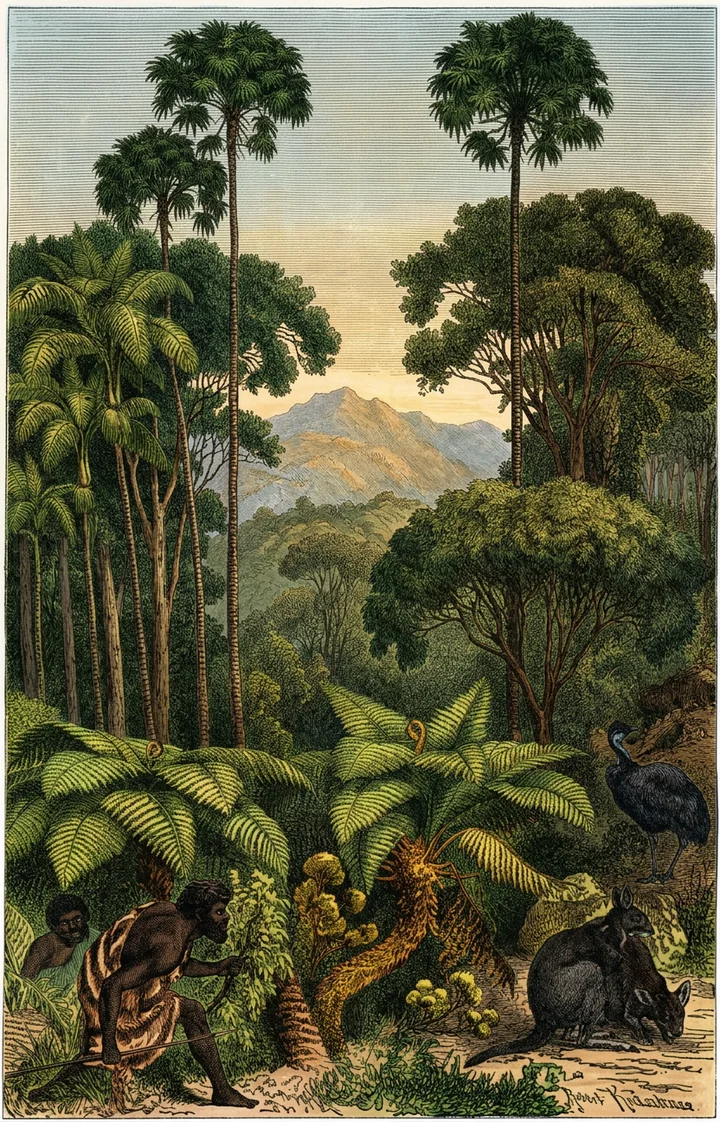
When closely pressed by dogs, the animal makes his way to the water, and wading in a short way, waits for them to come up. Seizing the first dog, he plunges him under, and holds him there until he drowns. If another one comes up before the first one is dead, he puts his large hind feet on the first one, and reaches out for the other. When no water is available, the kangaroo backs up against a tree, so as to be free from attack behind. If the dogs should come in reach of the powerful claws on the animal’s hind feet, the kangaroo would make short work of them. In desperate cases, he sometimes attacks the hunter himself. The kangaroo would more often escape than he does, if he did not look around in his flight to see what was behind him. In this way he frequently leaps against trees, causing his instant death. It seems a pity that any creature capable of manifesting so much reason as does the kangaroo in trying to defend himself, should ever be killed out of mere sport and wanton cruelty.
The natives of Australia are brown-black, with curly but not wooly hair. Their faces are broad, and their lips are less protruding than those of the negro. They are not very strong, but they have great endurance. They do not build huts, but content themselves with a strip of bark to protect themselves from the wind. Their dead are buried in exactly the spot where they died, and the place is never inhabited again by that tribe. The dead are never spoken of, and if any one living bears the same name, he is obliged to change it. They believe in a good and a bad spirit. Many efforts have been made to introduce Christianity among them, though with little success. Like all savages, they dislike regular labor of any kind. They are rapidly decreasing, and in a short time will be wholly extinct.
D. E. B.