SHOWMEN sometimes put in a cage a group of ill-assorted animals, such as a cat, rat, dog, pig, etc., and call it “a happy family.” Our young readers will think this picture shows such a family. But I cannot imagine how any family can be happy with a serpent in its midst.
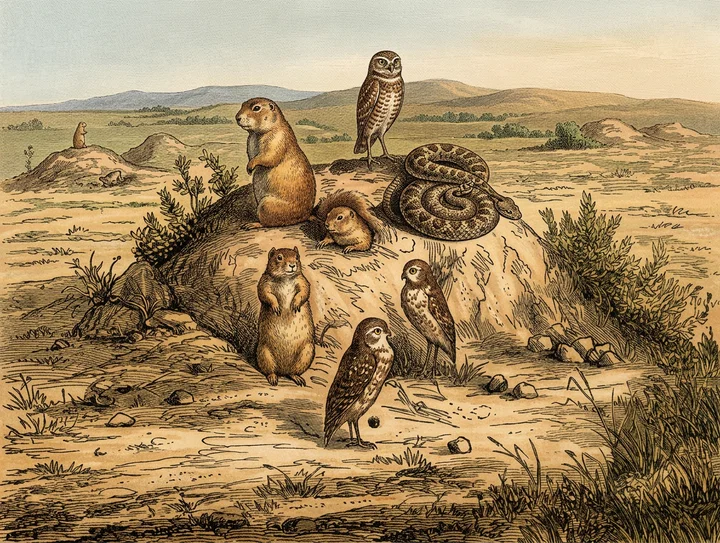
These three,—prairie dogs, owls, and rattlesnakes, are said to live together in burrows, or holes in the ground. These burrows have several entrances in the little mounds, as shown in the picture. They are found in great numbers on the plains of the “Great West;” I think in all, or nearly all, the States and Territories west of the Missouri River.
And the INSTRUCTOR invited me to write something about this scene, supposing that I had often seen the reality, as I had so many times crossed the plains. I have to confess that I never saw the like; and I do not regret it, as I am never sorry to miss the sight of a rattlesnake! I am willing to take it on credit. But I have seen many of the mounds, and I have seen many owls and prairie dogs upon them; but, strange as it may seem, I never saw the two together. And as much as I have traveled on the plains, and in the valleys, and climbed the mountains in California, I have seen but one rattlesnake west of the Mississippi. This was a large one in the Yosemite Valley; not exactly in the valley, but about one thousand feet above, on the trail toward the top of the high falls. And while I was trying to break a stick with which to kill him, he escaped in the rocks, and my pony ran off and left me.
There is something rather comical about the appearance of these owls and dogs. The owls sit bolt upright, and will suffer you to come pretty near to them before leaving their perch on the ground. Now walk around one, and see how squarely he keeps his eyes upon you. His head turns, but he seldom moves his body to keep you in sight. And still you walk around, and clear around, and still he keeps his eyes upon you. How does he do it without wringing his head off? If you have a quick eye, and have watched him very closely, you have seen him turn his head in the other direction when you got about half way around; but he does this so suddenly, and sets his eyes upon you so exactly where they were before, that the motion cannot be seen unless he is closely watched.
The prairie dog is a little fellow with short hair, and you might expect to hear him called a prairie squirrel were it not for his yelping noise, very much like the barking of a small dog. He has a round, thick body, but is quick of motion. It is laughable to see him dive into his hole. He does not crawl in, nor run in. He truly dives in, making a leap, and throwing up his hind feet in the air, as you may have seen a swimmer throw his feet in the air as he dives into the water.
If any of you ever cross the mountains, you must not expect to see everything of which you hear and read. And yet you will see many things which you never expected. If you go on the old route, the Union and Central Pacific, you will see many antelopes, perhaps some elks, and may be, but not likely, some buffaloes. It is indeed said they are never seen from the cars. But I saw a herd of buffaloes only a few years ago, in Wyoming Territory. As they were on the crest of a hill, a few miles away, and I had a good glass, I had a fine view of them. On that route, too, you have more mountain scenery than on the more southern routes. I never crossed the mountains on the Northern Pacific, and of its mountains I cannot speak. But when you have traveled the entire length of the “Picturesque Pennsylvania” route, crossed the Nevadas on the Central Pacific, and rounded “the loop” in the Tehachapi pass, then go to Yosemite, and you will feel like confessing that you never saw mountains before. You cannot imagine it, and it cannot be described. It is wonderful, and yet how small a part of the universe created by our God, our Father! J. H. WAGGONER.