In the heart of Germany lies an undulating and fertile province, a little larger than the State of Rhode Island. It is called the duchy of Nassau. This little realm is ruled over by a count, who divides the land up into farms, tilled by the peasantry.
In this province, in a battlemented and turreted old castle at Dillenburg, was born, April 25, 1533, a boy named William. His father was count of Nassau, and William, as the eldest son of the family, was heir of all these fair lands. He seems to have had no childhood, but took a long step from the cradle to manhood. He was taught the various languages necessary for one in his position to understand. He was drilled in the forms of court etiquette, and was skilled in all military and athletic exercises. He was an apt scholar, and early exhibited the sound judgment and foresight that so distinguished him in after life.
When William was only eleven years old, his cousin, the Prince of Orange, died childless, leaving his title and his rich estates to the young count, who was the next heir. As Prince of Orange, he became one of the most powerful and wealthy of the French nobles. This was wonderful fortune for such a young boy, but it does not appear that he was injured by it.
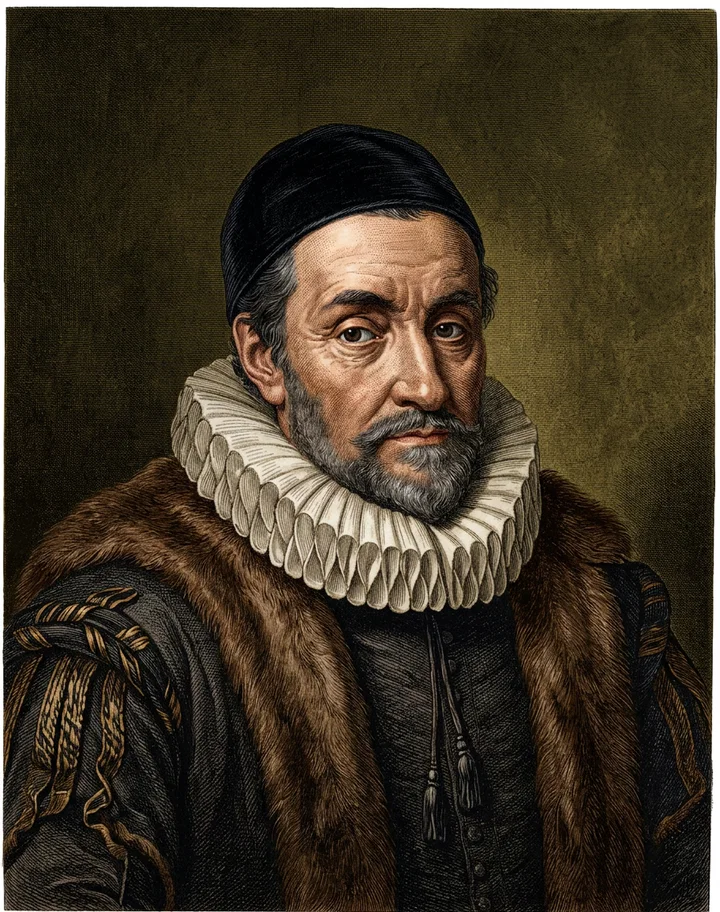
Charles V., who was king of Spain, prided himself on his ability to read character. He heard of this young noble, and thought it wise to make friends with one who would by and by be such a power in the kingdom. So he invited him to come to Brussels to the imperial palace. King Charles treated him as he would his own son. He told him all the secret plans of his administration, frequently following out the suggestions that the young prince gave him. No matter what business was to be discussed, he always wanted William present. He showed his confidence in his favorite by placing him, when only twenty years old, in command of the imperial army on the French frontier. This was a position that the most able generals in the Spanish army would have felt honored to hold.
Charles V. was now a feeble old man, threatened with insanity. He deemed it unsafe longer to bear the burdens of the empire, and resigned in favor of his son, who was known as Philip II.
Philip was jealous of the Prince; he envied his superior talents and his popularity, but he took good care not to let this be known.
The new king was a bigoted Catholic, and meant to rid his realm of all the hated Protestants. To better accomplish this object, he made peace with Henry II., king of France. William of Orange and an illustrious French noble were sent to the French court to draw up the treaty. As they set out on their journey, the king said, “The greatest service you can render me in this world is to make peace. I desire to have it at any price whatever.”
The king of France was one with the king of Spain in his hatred toward the Reformers, and he supposed that William of Orange shared these feelings in common with them. Although the Prince was a Catholic, he cherished no such bitterness toward them as rankled in the bosom of his king.
While at the French court, he one day went with the king on a hunting excursion. In the excitement of the chase, they became separated from the rest of the company, and found themselves, with wearied horses, alone in the dark forest. Riding slowly along, the king told William a secret plot between himself and the king of Spain to kill all the Protestants in France, Spain, and the Netherlands. He described minutely the whole plan of the midnight assassination. The Spanish troops were to murder the Netherlanders.
The Prince was horrified at this revelation; yet he listened in silence to all that the king said, never, by the least expression of his countenance, showing the indignation he felt. Had the king suspected his feelings, it would have proved the death of the Prince.
From this circumstance he earned the title of “William the Silent.” On returning to the palace, he joined in the court festivities as if nothing had happened. Shortly afterward he obtained permission to go to the Netherlands, where he exerted all his influence to have the Spanish troops withdrawn.
A few days after this, Henry II. died, and thus the massacre in France was indefinitely postponed. Philip II., angry because the Netherlanders petitioned for the removal of the troops, transferred his capital from Brussels to Spain. Here he persecuted the Spanish Protestants with such vigor that in a few months every trace of the Reformed religion was obliterated.
The king, who was not absolute monarch of the Netherlands, had no more right to interfere with thep. 10 laws of the provinces than the President of our own country has to make laws for the State of Michigan. Yet he continually ignored their ancient laws, and trampled on their rights. All efforts of the Prince and the Catholic nobles to obtain justice and to prevent the horrible Inquisition from gaining a foothold in the Netherlands proved unavailing, and at last he was obliged to go to Germany to save his life. With his departure, hope seemed to leave the people; for they looked to him for guidance in these troublesome times.
But there is not space in one brief article to tell of all the oppression brought to bear upon these Netherlandsers. It is estimated that up to the year 1566, fifty thousand Reformers had been put to death in the Netherlands alone, and that thirty thousand had fled to England. Nor are these all who suffered the tortures of the Inquisition.
In Germany, Prince William embraced the Reformed religion. He went from court to court, among the Protestant emperors, eloquently pleading for help for the distressed Netherlandsers. He spent all his vast income, and got deeply in debt, in raising an army to drive out the Spanish troops.
You will have to read in some history of the terrible struggle that followed, and how the people at last accomplished their object only by cutting the dikes, letting the seething ocean in, and drowning their fair meadow-lands. You will also learn that as soon as the Spanish troops had fled from the on-coming flood, a strong east wind blew, and drove the sea back to its bed.
When the people found themselves free, they wanted the Prince to rule over them; but he would not do it. So they chose the Duke of Anjou, brother of the king of France, for their sovereign. He proved traitor, and fled to France, where, after a short time, he died.
Before any steps could be taken to appoint a successor, Prince William also died. He was assassinated in his own house at Delft, July 10, 1584. The whole nation mourned for him as they would for a father. “He went through life,” says his biographer, “bearing the load of a people’s sorrows upon his shoulders, with a smiling face. Their name was the last upon his lips, save the simple affirmative, with which the soldier who had been battling for right all his lifetime, commended his soul in dying ‘to his great captain, Christ.’ . . . As long as he lived, he was the guiding star of a whole brave nation; and when he died, the little children cried in the streets.”
W. E. L.