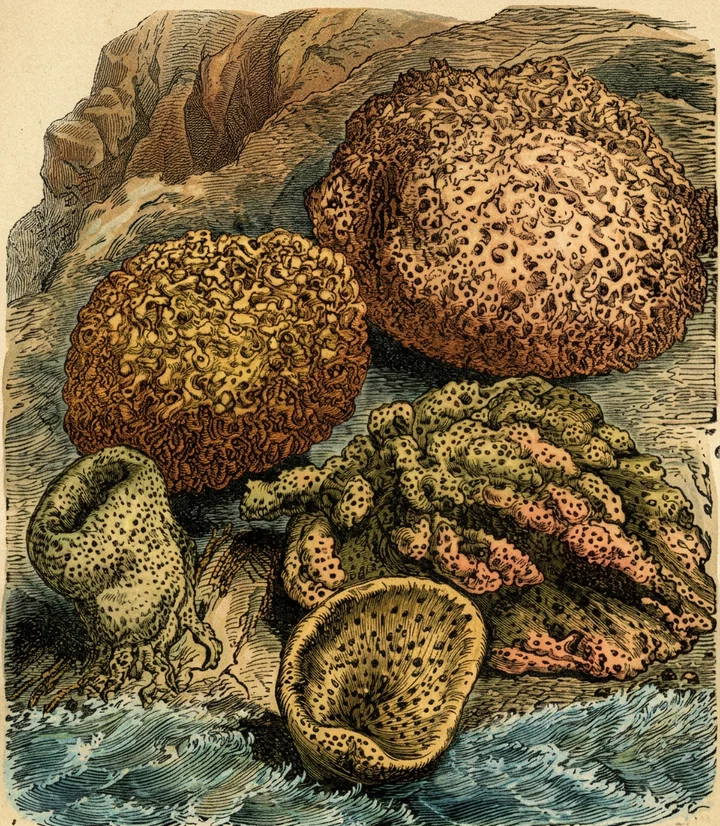
Sometimes a ship, as she sails among the islands of the Tropics, meets with a terrible danger; the little workers in the sea have been doing mischief. They have been making a great stem, or trunk, like a tree. On the top of the stem are a number of lumpy knobs, like those you see in the picture, and they are called brain stone. The brain stones are covered with a thick, flesh-like jelly, in which the polyps live.
The polyps are called madrepore polyps, and are only met with in the hot seas of the Tropics. They work so fast, and their stony houses are so strong, that it is not at all pleasant to meet with them.
They fill up many a space that had better be left open—I mean a space over which a ship is going to sail. On comes the ship, and before the captain is aware, it drives upon the rock. The rock has quite lately been built up by madrepore polyps.
Do you see how curiously the brain stone is marked? It has twisted lines, or ridges, all over its surface. The polyps have their cells between these lines, and live in them as in so many villages.
They throw out the lines, that make their cells, in thin plates like sheets of paper. These plates, or layers, are arranged in a ray-like form around the middle of the cells, so that the madrepore head has a very curious effect. But it can only be seen when the structure has been raised to the surface of the water, and the polyps and the flesh-like jelly are gone. Then the chalky, ray-like heads are clearly visible.
While the polyps are alive and at work, the madrepore rock or tree is gay with little rose-colored heads, that keep moving about, like flowers in the breeze of summer.
I must tell you that the madrepore polyps build all kinds of fantastic shapes in these warm tropical seas. Besides walls, and rocks, and trees, the structure will resemble a sheaf of corn, or a leaf, or a flower. There is no end to the strange devices of the little architects. The traveler on board a ship will often gaze at these queer forms in wonder and admiration, as they glow, in all their beauty, beneath the waters.
In the coral reef, the lumps of brain stone lie at the bottom of the reef, and help to resist the action of the waves.—The Sea and Its Wonders.