ABOUT three hundred and forty years ago, Henry VIII. was king of England. At that time a terrible persecution was carried on against the Protestants of that country, and hundreds of them were put to death by the most cruel means that wicked men could devise. To give a detailed account of the cruelties practiced upon the people who ventured to have the Bible in their houses, or to question any of the doctrines held by the Roman Catholic church, would be revolting in the extreme; but as these martyrdoms are facts in history, and furnish some noble examples of constancy and faith in the hour of trial, it is intensely interesting to read about them.
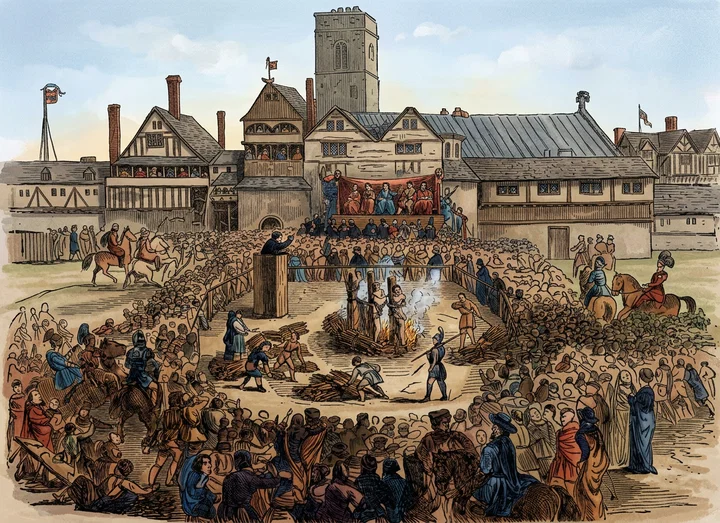
The most common method of punishing heretics, as they were called, was burning at the stake. In order to make them recant, they were made to suffer all the tortures which it would seem possible for any one to endure and live. Some were fastened upon a horrible machine called a rack, and their joints pulled apart. Others were suspended by their thumbs, and left hanging until almost dead with agony. And in every conceivable way that human fiends could invent, they were tortured; but if they still continued firm, they were taken to a place inclosed by a railing to prevent the crowds from coming too close, chained to a large stake, and burned to death.
One of the most foolish doctrines held by the Romish church, was the idea that the bread and wine used in the communion service were the literal body and blood of Christ; and a great many people lost their lives in consequence of renouncing this doctrine.
Among others who were burned at the stake because they would not accept this theory, was Mrs. Anne Askew, a woman of noble parentage, and of superior education. Her husband was a violent papist; and when he found that she favored the Reformation, he drove her out of his house. So she came to London, where charges of heresy were made against her, and she was put in prison. After an examination by the bishop of London, she was made to recant somewhat from what she had said, and was set at liberty. The bishop was not satisfied with her confession, in which she stated that she believed everything according to the Catholic faith, and not otherwise.
Shortly after, she was again brought before the king's council, then at Greenwich, where she seemed very indifferent as to what they should do with her. She answered them in such a way that they could charge nothing against her. She was then sent to Newgate. Nicholas Shaxton, bishop of Salisbury, who had been imprisoned on the same charge with herself, but had recanted when threatened with torture, was sent to Newgate for the purpose of prevailing upon her to recant. Instead of yielding, she charged his cowardice back upon him.
Finally, in order to extort a confession from her, she was sent to the Tower, and laid upon the rack; but she would confess nothing. Then the lord chancellor commanded the lieutenant of the Tower to stretch her more, but he positively refused to do it. At that the lord chancellor threw off his gown, and drew the rack so severely that he almost tore her body asunder; yet he could draw nothing from her, for she endured it with unusual courage. When the king heard this, he blamed the lord chancellor for his cruelty; yet her condition awoke no pity in the heart of the king, for he left her to be dealt with according to the sentence.
She was carried in a chair to Smithfield a little after that, being unable to stand alone on account of the suffering she had endured from the rack.
She was then tied with a chain to the stake. The coward Shaxton crowned his apostasy by preaching a sermon at the place of execution, Anne Askew listening, and confirming what he said that was true, but telling him that he spoke without the book, when he made a misstatement.
When the sermon was finished, the martyrs standing there, tied at three several stakes, were sent an offer of the king's pardon if they would recant. Anne Askew refused even to look at the messenger who brought the offer, saying that she did not come there to deny her Lord and Master. At this the lord mayor commanded fire to be put to the fagots, at the same time crying with a loud voice, “Let justice be done.”
Although the three who perished with her were men, it is said that the courage and fortitude which she manifested, and the words of encouragement which she gave them while the flames were raging about her, was all that enabled them to endure the fiery ordeal.
They loved not their lives unto the death, and gave themselves up, a sacrifice by fire unto God. But those terrible scenes are not now enacted. The rack, the thumb-screw, and the stake, together with all the other horrible modes of torture, are not now resorted to, and every one has the liberty to study the word of God as much as he chooses. Yet I have often wondered if the people of the present time are as familiar with the Bible as they were when it cost them their lives to become so.
E. L.