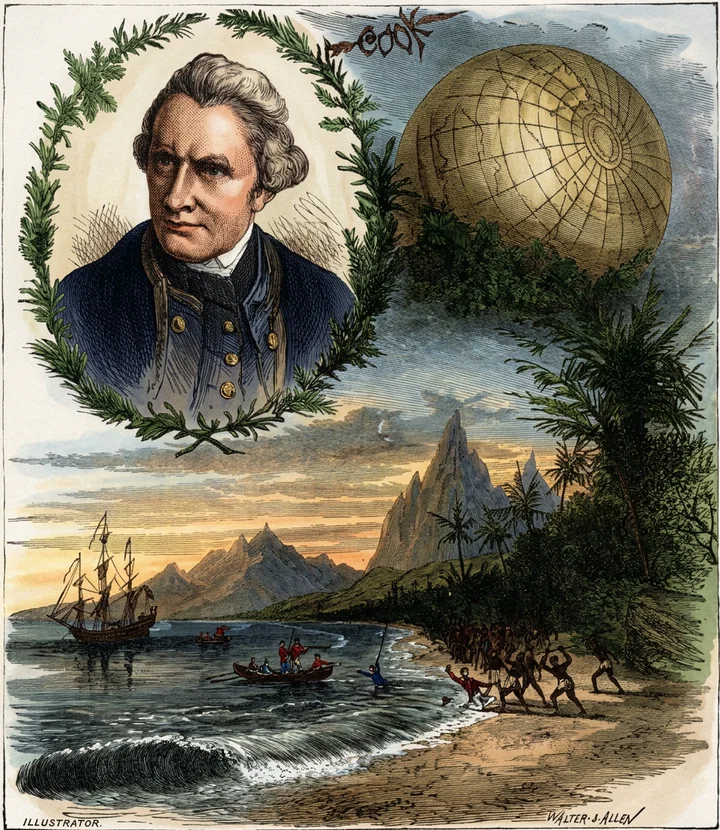
It was in a very humble home that Captain James Cook first saw the light of day. In a little mud house in the village of Marton, Yorkshire, he was born, October 27, 1728. His father was a poor farm-laborer. But you must not imagine that he led so free and independent a life as do the farmers in our country. There all the land is owned by the lords, who hire the poor people to till it for them. Mr. Cook was an industrious and upright man, who did faithfully the work assigned him. He so well pleased his employer, that he was appointed overseer on the farm where he worked.
The owner of the farm sent James to a day-school, where he was taught to read and write and cipher. He did not stay in school a great while. Before he was thirteen, he was apprenticed to a shopkeeper at Straits, a good-sized fishing town. James had always wanted to go to sea, and it did not lessen his desire any to live among fishermen. Undoubtedly he found it very irksome to sell ribbons and lace, and pins and thread. I imagine he found it easy to quarrel with his master, who soon gave him his discharge papers.
As soon as he was free, he bound himself out for seven years to some Quaker ship owners. Most of this time he spent on board a coal ship. Shortly after his time was out, he was appointed mate of one of these ships.
In the year 1755, when England was at war with France, young Cook happened one time to be in the Thames River, with the ship to which he belonged. His Majesty compelled every seaman on whom he could lay hands to enter his service in the navy. Young Cook at first thought he would hide, and so escape being pressed into service; but he finally concluded to go to war, and voluntarily offered himself to the royal navy.
There is not space to tell of all the good service he did his country and the world. He made two voyages to the Southern seas, and discovered many things. When he came home from his second voyage, he was made a post-captain; he was also appointed captain of the Greenwich hospital, and was made a member of the Royal Society.
This was quite a high position for a humble farm-laborer's boy to have risen to. Yet no man was more deserving of such honors than he. And he gained it all by his sagacity, firmness, and perseverance. No one would have thought, when he was a common sailor on the coal ships, that he would have risen above that position. Yet he was “diligent in business,” anxious to learn, and quick to improve every opportunity as soon as it presented itself; and success in some way or other was sure to come. His humanity and sympathy made him a great favorite with his crews.
When we read of a man who has so heroically given up all home comforts, endured every hardship, and faced great danger, all that he might help people to know more of the great world in which they live, we at least hope that he may be allowed to live a good old age, and die surroundedp. 30 by the familiar faces of friends. But Providence seems to have ordered otherwise for Captain Cook.
In his last voyage he sailed into the Pacific Ocean up to Behring’s Straits to discover a passage from the Pacific through the Northern seas to the Atlantic. But he found the straits so blocked with ice that it was impossible to proceed; so he turned back to winter in the Sandwich Islands. These islands he had discovered and named while on his way north. He now explored the coast line more carefully, and discovered two more islands in this group.
The natives treated him with the greatest kindness, furnishing him with an abundance of fresh provisions, and in every way showing him tokens of great respect. Everything passed along smoothly, until one night the natives stole one of the ship’s long boats. In a voyage of discovery, in unknown seas, such a loss was irreparable.
Captain Cook determined to have his boat back; but he had no way to get it except by seizing the king and keeping him until the stolen property was returned. When he went on shore with a small company of marines, to get the king, the natives surrounded them, and with horrid yells, drove the sailors back into the water with long spears and great stones. The Captain, always looking out for the safety of his men before he did for his own, was the last one to leave the beach. The natives surrounded him; but as the boat’s crew were unable to assist him, he soon fell a victim to their barbarity. Thus he found a grave February 14, 1779, in this savage land, far from home, and all his heart held dear.
W. E. L.