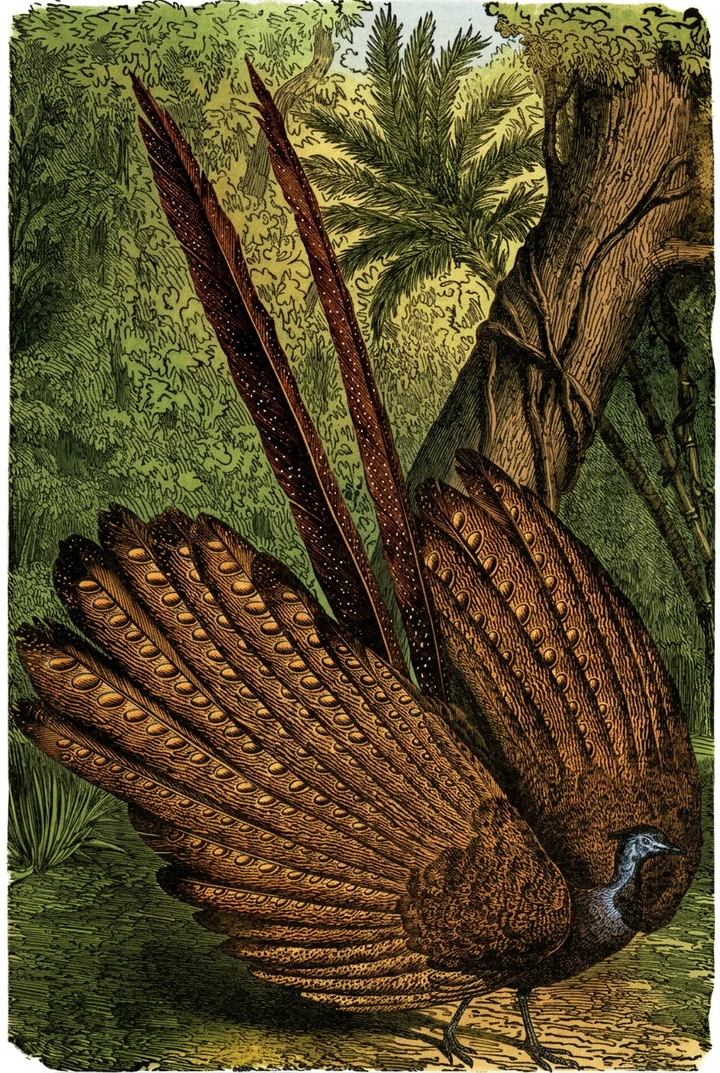
Have you ever seen a peacock, with its gaudy tail spread wide, strutting about as though he was king of the birds? Well, this is not the picture of a peacock, but of one of its cousins. And see how nearly like the peacock he tries to show off his fine feathers, which are covered with spots very like those on the peacock’s tail.
There is a large family of birds called the pheasant family. It includes the peacock, the turkey, the Guinea fowls, and ever so many kinds of real pheasants, more than we can tell you about now. The most beautiful of the pheasants are the Reeves, the golden, the silver, and the Argus. It is the Argus pheasant which is shown in the picture.
Any little boy or girl who has seen the golden robin that sings so sweetly, knows that it is its color that gives it the name of golden robin. The golden pheasant is named for its color, too; and so is the silver pheasant. These birds have other very bright colors besides the silver and gold, which make them very showy; but the most grand, the most stately of the pheasants is the Argus.
This bird’s body is about the size of a common fowl, but its two middle tail feathers are between three and four feet long, so that the bird measures about five feet. Some of its wing feathers are three feet long, so long that the bird cannot fly very well; but its wings, when spread, act as sails do to a boat, and help it to run very fast.
The under side of the bird is a reddish brown, spotted with black; the back is pale yellow, with black and brown spots. The two long tail feathers are a dark chestnut, and are covered with white spots inside a black ring.
We haven’t room to tell you all about its pretty wings. Some of the feathers are so curiously marked with jetty black; deep rich brown, orange, fawn, olive and white, that one cannot describe them. In some feathers there will be as many as seventeen large eyes, surrounded by rings of jetty black.
Probably you have never seen the Argus pheasant; for its home is very far away, and but few persons take the trouble to raise it here. When you travel around the world, if you will call at the East India Islands, south of Asia, you may see this bird in all its glory. How many of you can tell whether these islands are in a hot or a cold climate? Is there anything in the picture by which you can tell?

You don’t know why this bird is called the Argus pheasant, do you? Well, the heathen, who don’t know the true God, do not understand his wonderful works, and so they imagine a great many strange things. One of their imaginary stories is something as follows:—
There was once a very wonderful man, whose name was Argus. He had a hundred eyes, and only two of them slept at one time. His eyes were all over his body, and so the goddess Juno set him to watch over a certain priestess called Io. The god Mercury put Argus to sleep with the songs he played to him on his harp, and then slew him. Afterward Juno took the eyes of Argus to adorn the peacock’s tail.
Now this is only a fable, a heathen imagination; but the Argus pheasant was named from it.
M. J. C.