No portion of the Scriptures is so interesting, so full of instruction in all that is great and generous, beautiful and good, as that which records the wonderful works of our Saviour. The record of the first thirty years of his life is brief, simply giving his birth in Bethlehem, the flight into Egypt and the return to Israel, and his quiet life in Nazareth with his parents, to whom he was subject; and, with the exception of the incident which occurred when he, at the age of twelve years, accompanied his parents to Jerusalem, nothing remarkable is related of him until he was baptized of John in the Jordan. The last three years of his life, however, beginning with his ministry, were crowded with events of the most thrilling character.
Soon after his baptism, the Saviour began his public labors in Nazareth; but the Jews rejected his message, and tried to take his life. Escaping from them, he took up his abode in Capernaum, another city of Galilee, or, rather, he made that place his headquarters; and from this time it is recorded that “Jesus went about all Galilee, teaching in their synagogues, and preaching the gospel of the kingdom, and healing all manner of disease among the people. And his fame spread throughout all Syria.” And they brought people that were sick with every sort of disease, and lunatics, and those possessed with devils, “and he healed them.”
Although Jesus went about all that country teaching and doing his mighty works, no place was more honored with his labors and presence than Capernaum, the city chosen as his home. Probably the people here were more ready to listen to his teachings. It was in this vicinity that the wonderful sermon on the mount was delivered, and where he uttered a number of his parables. Here, too, he performed many miracles of healing, and raised the daughter of Jairus to life.
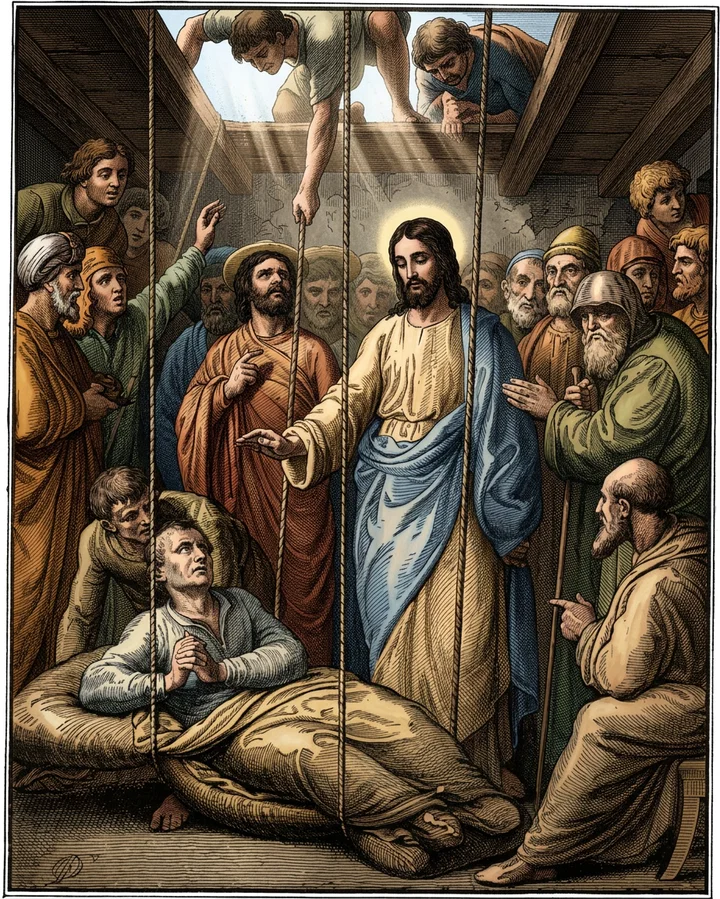
Such crowds followed the Saviour in the streets of Capernaum, wherever he went, that it was often difficult for the afflicted to get access to him. Upon one occasion, it is recorded that the only way a sick man could be taken into his presence, was by letting him down through an opening in the roof of the house, an illustration of which is shown upon this page.
Do any of our young friends query how they could let a person down through the roof, on a bed, they must bring to mind what has been told them a number of times in the INSTRUCTOR,—that Eastern house-roofs are flat, and are covered with material which can be readily removed and replaced again; also the bed upon which the sick man lay was a thick quilt or mattress, which could be easily folded up and carried. You remember that after this palsied man was healed, the Lord said to him, “Arise, take up thy bed, and go unto thine house”! His walking off with his bed was sufficient evidence that the man was cured.
How natural for us all to feel, Oh, if I could have been upon the earth when the Saviour performed his miracles, how easily I could have believed! But how was it with those cities of Galilee, where he did those mighty works? Hear the Saviour’s own words: “Woe unto thee, Chorazin! woe unto thee, Bethsaida! for if the mighty works, which were done in you, had been done in Tyre and Sidon, they would have repented long ago in sackcloth and ashes.” “It shall be more tolerable for Tyre and Sidon at the day of Judgment than for you.” “And thou Capernaum, which art exalted to heaven, shalt be brought down to hell; for if the mighty works, which have been done in thee, had been done in Sodom, it would have remained until this day.”
We have the accumulated evidence of the preceding ages that those mighty works were wrought of God; shall we wait for further light, and perish, as did those ancient cities? or shall we believe and be saved? M. J. C.