The origin of the art of weaving is not now definitely known. The weaving of reeds, of thongs of hides, and of rude fibers, was without doubt practiced before the preparation of fibers for the loom by spinning had been thought of. The Egyptians possessed a knowledge of the art; and although their looms were very simple, the fabrics produced in them were often elegant and costly. Specimens of these fabrics are seen in the mummy cloths found in the ancient tombs.
Weaving was also known and practiced in very early times in Greece, both as a domestic employment and as a distinct trade. In the writings of Homer we find a description of certain products of Creüsa’s shuttle,—a figure-woven pattern, in which appeared a gorgon and dragons.
In more modern times, the people of Italy and of the Netherlands appear first to have become famed for their textile manufactures, and from these countries the trade passed to England and France, though just at what period is uncertain.
Until within about two centuries, the looms were operated by hand and foot; but about that time the first power loom was invented by M. de Gennes, a French naval officer of some distinction. He communicated his plan to the French academy of sciences in 1678; but although possessing superior advantages, his loom was not brought into use. During the century which followed, several English inventors brought out power looms, none of which were generally adopted. The first successful power loom was the invention of the Rev. Edmund Cartwright, in 1785-7.
Improvements in the various machines for weaving have constantly been going on, until, as one watches their marvelous movements, they seem almost possessed of life and intelligence, and their productions truly wonderful. Among the more recent of these improvements is the “electric loom,” in which various parts of the machine are operated by electricity. This loom was constructed by M. Bonelli, a gentleman well known in connection with recent electrical investigations.
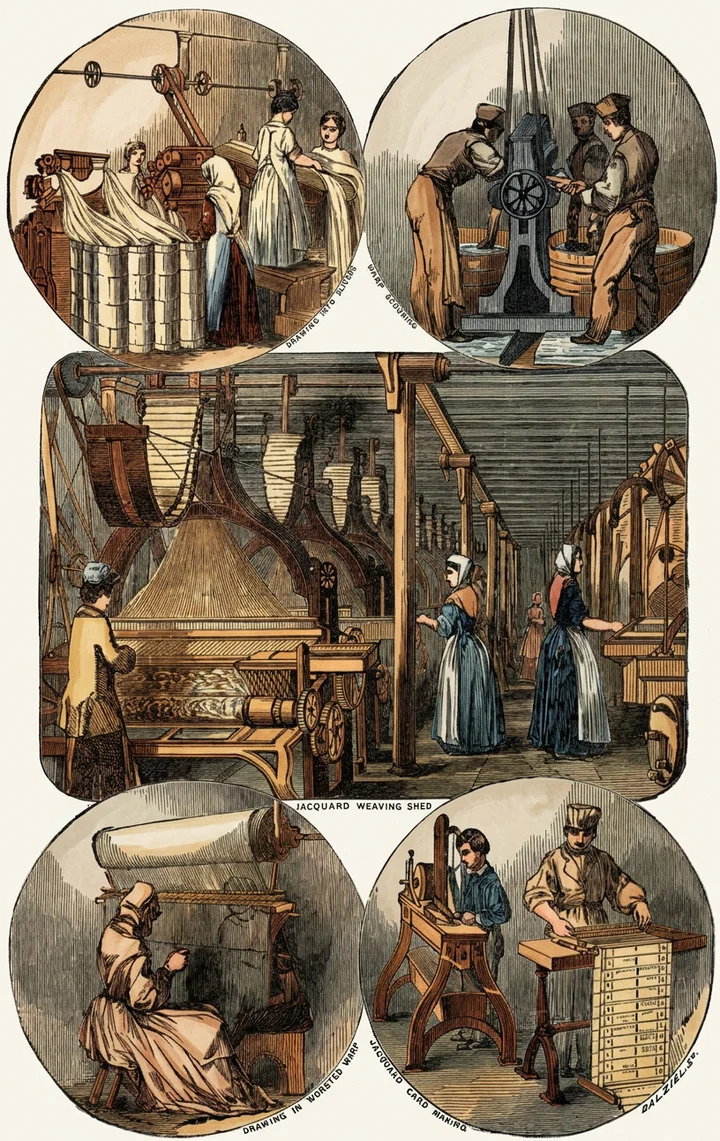
We have not space to give anything of a description of the many methods of weaving various fabrics. Our engraving gives a faint idea of thep. 178 machinery for weaving, as invented by Joseph Marie Jacquard, a French mechanician, born in Lyons, July 7, 1752. His father was a weaver, and the proprietor of a loom. At the age of twelve, Joseph succeeded, upon the death of his father, to his shop and two looms, and commenced business as a weaver. He made various improvements in the machinery for weaving. For this he was assailed with open abuse and violence by those whom the introduction of his apparatus had temporarily thrown out of employment; and he was denounced as the man who was reducing families to ruin and starvation. His house was entered by a mob, and one of his looms was broken to pieces. On several occasions he barely escaped with his life. But these scenes soon ended, when his invention was purchased by the government, in accordance with an imperial decree, and made public property. He received the cross of the legion of honor, and in 1840 a statue of him was erected in Lyons. J. W. B.