When Dr. Luther, in his work of reform, attacked the errors of the Romish church, and the corrupt example of the priests and monks, all Germany was shaken to its center. Many of the learned men adopted his views, and many others became his bitterest enemies.
There were two men who did more, perhaps, than any others in preparing the way for the work that Luther had to do. One of these was Reuchlin, a gray-haired doctor of divinity when Luther was a young man. The only Bible then in use was the Latin Vulgate, a work translated by the monks of Rome, and full of errors; and in all the land there were only a few copies of these. Reuchlin was a good Hebrew and Greek scholar, and did very much to get the study of these languages introduced into the universities. He was the first man to publish in Germany a Hebrew dictionary, so that the learned men could find out for themselves what the Old Testament taught, without having to take the word of the priests and the pope for it. He also wrote a Greek grammar that was a great improvement over the one then in use.
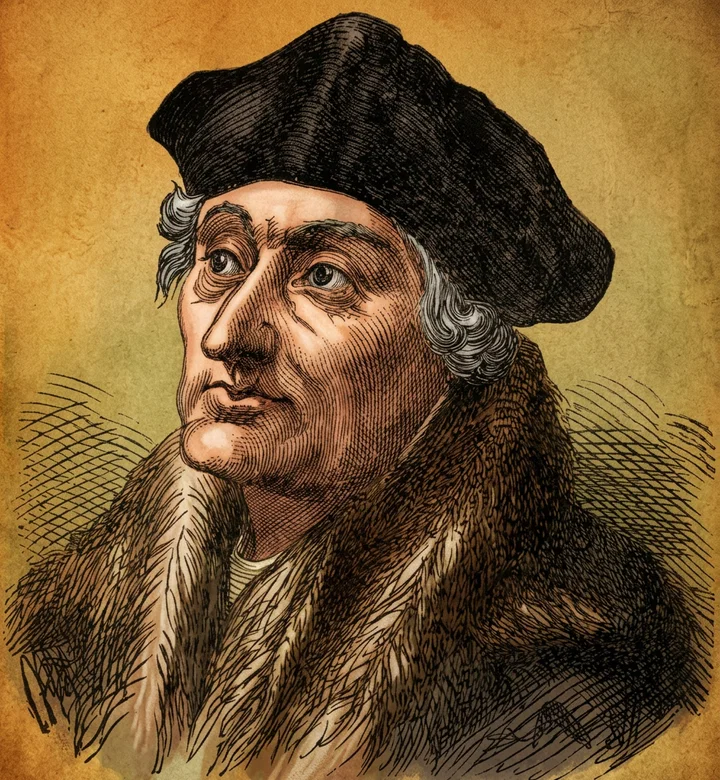
The other man was Erasmus, whose picture is shown on this page. His real name was Gerard; but, according to the fashion of the times, he translated it into Latin and Greek, calling himself Desiderius Erasmus.
The father of Erasmus, yielding to the urgent entreaties of his relatives, deserted the boy’s mother, and entered a monastery at Rome. So Erasmus never knew a father’s care. When he was about four years old, his father returned to Holland, and placed him in a school. He was a bright boy, witty and clever, and made rapid progress in his studies. One day, when he had done unusually well, his teacher embraced him, exclaiming with rapture, “This child will attain the highest pinnacle of learning.” The teacher’s words were literally fulfilled, and the child was known in after years as “the sage of Rotterdam.”
When he was thirteen years old, his mother died; and his father, bitterly repenting of his past course, and broken-hearted at the loss of his gentle Margaret, soon followed her. Erasmus was now thrown upon his own resources. His friends urged him to enter the cloister; but he had a great dislike for monastic life, probably remembering what sore trouble it had caused in his father’s family. However, he studied for awhile in several monasteries, and at length worked his way to Paris, where he entered the university. He studied incessantly, and at last graduated with high honors. Pupils from all quarters trooped to him for instruction, and he was recognized as the foremost writer and scholar of his time.
Princes were eager to have this illustrious young man at their courts; but to all their invitations he had a never-ending supply of excuses. He preferred a more quiet life, and got his living from the sale of his many writings.
He was a “fair little” man, whose half-closed blue eyes keenly observed all that was passing, on whose lips was ever a slight sarcastic smile, whose manner was timid and embarrassed, and whom it seemed that a puff of wind would blow down.” He was so afraid of dying that he took the most extraordinary care of his health, sparing no pains to remove from a place where a contagious disease was raging.
So you see he could not have made a very good reformer, because he did not have the courage to say always just what he thought. When people would ask him his opinion, he would give them an answer that could be taken both ways.
But he did some good with his pen. What Reuchlin did for the Old Testament, Erasmus did for the New, by writing a critical Greek text of the New Testament; for that part of the Bible, you will remember, was written in the Greek. “Would to God,” said he, as he finished writing it, “that this work may bear as much fruit to Christianity as it has cost me toil and application.”
This was his greatest work toward helping on the Reformation. Besides this book, he wrote countless works exposing the ignorance and vice of the monks. He was keen, witty, and bitingly sarcastic, and his words cut like a knife, when he chose to have them. But he stopped right here. He did not have Luther’s grand courage, and so was unfitted for any work of reform. He would not study theology for fear of finding out the truth and being condemned as a heretic. He studied every way to avoid bringing on him the frowns of the church of Rome. “A disadvantageous peace,” he was often heard to say, “is better than the most righteous war.”
Erasmus knew that he was a coward, and very freely owned it. “If the corrupted morals of Rome,” he wrote, “call for a prompt and vigorous remedy, that is no business of mine, nor of those who are like me. Let others aspire to martyrdom; I do not think myself worthy of such honor. I fear that if any disturbance should arise, I should imitate Peter in his fall.” And that is just what he did.
When the great storm-cloud of the Reformation burst, Erasmus trembled at the tempest which he himself had been such a great means of causing. About this time, King Henry VIII. asked Erasmus to write a pamphlet against Luther and the work of the reformers. Erasmus was flattered at this notice from the king of England, and basely deserting Luther, who had been his friend, he wrote a very bitter and sarcastic pamphlet. Luther was very much incensed at his course, and taking up his pen, wrote a reply that in the minds of all candid persons refuted every argument that Erasmus brought forth.
Erasmus knew that Luther had the better of the argument, but he would not own it. Luther’s reply so cut his pride that “he poured forth invectives with a broken voice and hoary hair.” His medium course, as such a course always does, brought down upon him the displeasure of both parties; while he attempted to please all, he pleased none. How much more noble he would have appeared had he, like Luther, stood firmly for the truth, regardless of what might come! W. E. L.