By antipodes, you know, we mean those people who live on the other side of the globe, and whose feet are opposite to ours. They are our opposites, not only in their position on the globe, but also in their customs. In reading, it would seem strange to us to begin on the last page of our books and read the lines backward; yet this is the way all Chinese books are written. The spoken language and the written language are entirely different, so that it takes a man nearly a lifetime to become a skillful reader and writer.
When Americans meet on the streets, they clasp each other's hands; when a Chinaman meets a friend, he shakes his own hands. The men wear their hair in long braids down their backs; and if any fop wants his cue to look particularly fine, he braids in false hair or silk thread to make it hang down to his heels. The women comb their hair straight back, and do it up as tight as possible. I suppose the closely cropped hair of the men and the bangs and frizzes of the women of our own country must look as strange to them as their cues do to us.
The small feet of the women form another contrast. After the little children have learned to walk, their feet are bandaged, and not allowed to grow any more, so that most of the ladies among the higher classes have feet only about three inches long. This is a very cruel custom; yet the Chinese ladies do not think it so bad as the habit of compressing all the life-giving organs of the body in tight clothing. Of course, you wouldn't like to own it, but really, girls, don't you, in your inmost heart, think the Chinese have the best of the argument!
They do not have that aversion to coffins that we have. These are usually bought at the undertakers. But often the coffin is made at the house, where the person for whom it is intended can have it fixed to suit himself. When finished, it is stood up in some conspicuous place, where the visitors can examine it, and make all the remarks they choose.
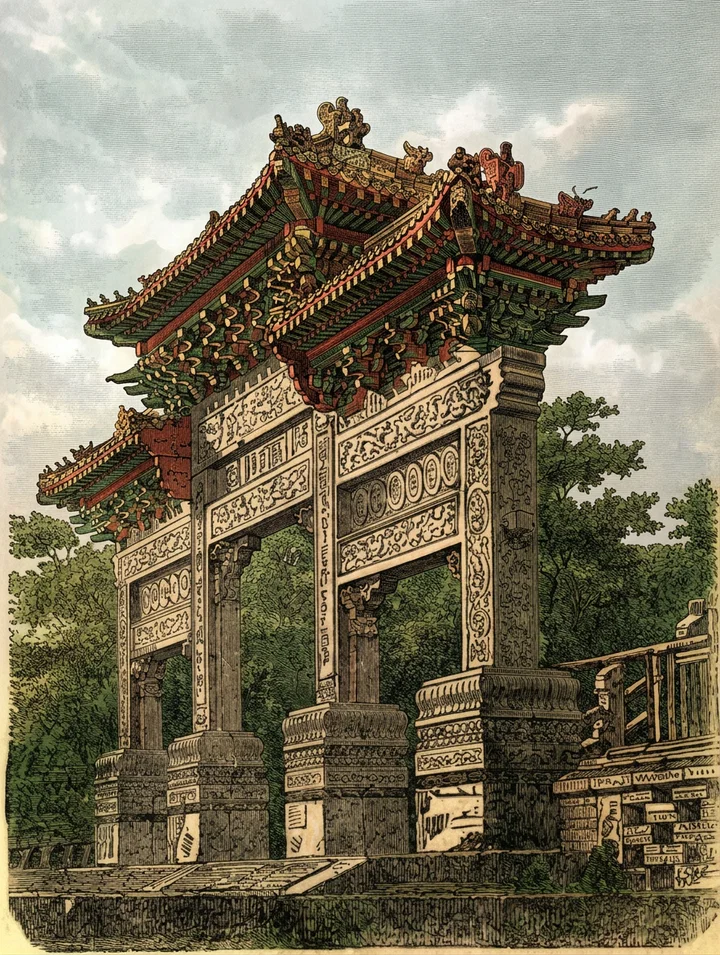
It is thought very praiseworthy for a widow to commit suicide when her husband dies. Oftentimes a splendid monument, in the form of a gateway, is erected to her memory. Such a one is seen in the picture on this page. The emperor sends some money toward it, and the relatives furnish the rest. On it are inscriptions setting forth the virtues of the widow. When the monument is finished, a mandarin goes to worship before it, thus giving the highest earthly sanction to a wicked custom.
But for all their oddities, the Chinese are really very intelligent. They have a reliable history of their country, reaching back for thirty centuries; and they have many valuable and well-written books in their language. The art of printing was understood and practiced by them hundreds of years before Claxton invented his printing press. But their wisdom lacks the “one thing needful”—they have no knowledge of the true God; and without this, all wisdom is foolishness.
W. E. L.