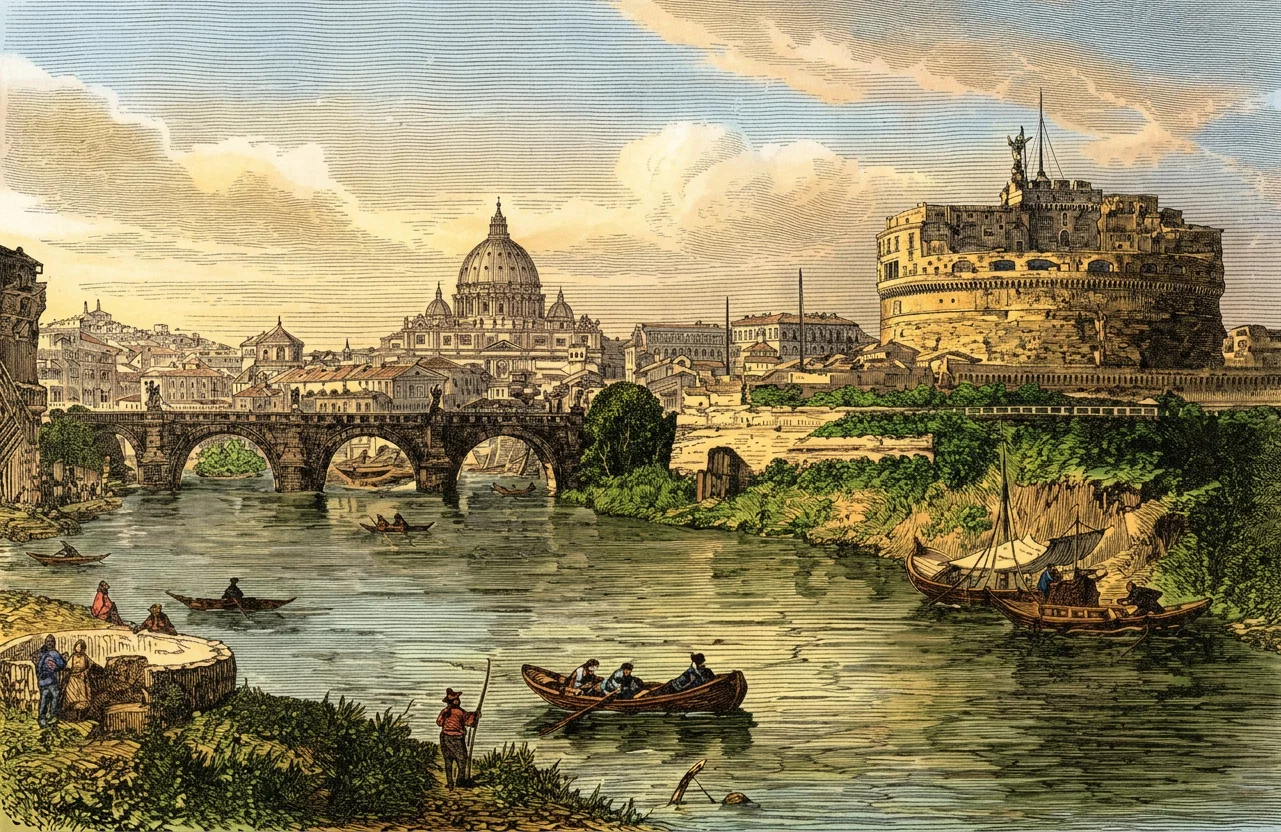
SAINT PETER'S AT ROME

7%

S. D. A. Publishing Association · Battle Creek, Mich. · Aug 19, 1885

FromThe Youth’s Instructor, Vol. 33, No. 31.

Read the full edition

SAINT PETER'S AT ROME.

In the engraving we have presented a view of the famous church of Saint Peter's at Rome, the bridge across the River Tiber, and the castle of St. Angelo, as it is usually called. The picture could not, in the nature of things, present all the points of interest. These edifices are situated on the right bank of the river. The city was anciently upon the other side. As we cross the river from the city, we pass directly under the walls of the castle to the left, and soon pass into the great open court of St. Peter's, the high building with the large dome, somewhat to the left of the castle as seen in the picture. At the right of the great cathedral, and closely connected with it, is the great palace of the Vatican, the present abode of the pope, one of the largest, most costly, and best furnished palaces in the world. It contains many of the costliest works of art and one of the greatest and most ancient libraries in the world. There is a covered way from the palace to the castle, so that when there are popular uprisings in the city, and the pope's life is in danger, he can hie away to the castle for safety. The Vatican makes but a small appearance in the picture, though it is an immense building.
The grand court in front of the cathedral is very fine and extensive. It is in length one thousand one hundred and ten feet, in breadth seven hundred and eighty feet, in the form of an ellipse. In the center of the court is a large obelisk brought from Egypt centuries ago. At equal distances on each side is a most beautiful fountain. The outside of the court is bordered by imposing colonnades in the form of a semi-circle, and supported by four series of huge columns forming three passages underneath the roof, the middle one will permit two carriages to drive abreast. The paving of the court is very fine. The grand church of St. Peter's rises in massiveness at the further side of the court opposite the opening. We ascend quite a flight of stone steps before we enter the porch.
The outside of the church does not make such a fine appearance as we should expect, considering it is such a large building; for the front part of the porch is made so high and large that when one stands anywhere near it, the view of the immense dome is obstructed. But when it is entered, then we are lost in wonder and admiration. It will be impossible to give the INSTRUCTOR family any clear idea of the magnificence and beauty of this largest church in the world.
Restored with AI
Let us notice some of the dimensions of this mammoth temple. Its length, including the portico, is six hundred and ninety-six feet. Length of the church proper inside, six hundred and two feet. So its total length is over forty rods, or more than one-eighth of a mile. It is built in the form of a cross. Its greatest width is four hundred and fifty feet. The height of the nave, that is, the main central part, is one hundred and fifty feet; its width seventy-seven to eighty-nine feet. There are side aisles leading from the central part all the way along on each side. The great central dome, from the pavement to the base of the great lantern, is four hundred and three feet, and to the summit of the cross is four hundred and thirty-five feet. The diameter of the cupola is one hundred and ninety-three feet. The circumference of the pillars which support the dome is two hundred and thirty-two feet. The dome is encircled and strengthened by six bands of iron. Leading to the roof is a stairway, broad and easy enough to permit a loaded horse to ascend to the top. The church contains twenty-nine altars and one hundred and forty-eight columns.
It is not so much its size which strikes the beholder with astonishment, as it is the richness and magnificence of everything within. One is astonished at the immense amount of statuary. Angels, good and bad, saints and popes almost without number, in marble pure and white, meet you at every turn. In all directions may be seen magnificent altars, where the pious devotees can worship; so that more than a score of meetings can be carried on at the same time, and yet be entirely separated from each other.
Confessionals are scattered in all parts of the church. Many of the INSTRUCTOR family will not know what these are, so I will explain. They are little stalls, or boxes, tall enough and large enough for a single man to stand up inside. On one side is a small opening, perhaps a foot square. Rich and poor Catholics alike, in short, all good Catholics, are expected to come and confess their sins to the priest. Here he is snugly ensconced in the confessional. They are expected to confess all their bad sayings and doings to him; and he claims to have power from God to forgive these sins. Of course he wants a fee of a little money to help the thing through just right. These confessionals have printed on them in many cases, the kind of language to be used; for you must recollect that St. Peter's is the great central church of the Catholic world. And at Rome nearly all nations are represented. So of course if a Russian Catholic, or a Spanish or a Chinese devotee wanted to confess his sins when at Rome, he would want to know to what little stall to go to find a priest who could understand him.
In the center, under the great dome, is an imposing bronze canopy borne up by four richly gilded, spiral columns. It is ninety-five feet in height, and weighs about ninety-three tons. Under this is the high altar, where only the pope reads high mass on great festival occasions. Under it is said to be the tomb of St. Peter and St. Paul, which is reached by descending a flight of marble steps. A gilded door opens into a small, most richly furnished apartment, where, in a little gilt box, the ashes of these two great apostles are said to rest. Just outside the little door, the marble statue of a pope, with wonderful flowing robes, kneels, his hands clasped in the attitude of prayer invoking the aid of the apostles, whose ashes repose in the little box. On the heads of all the statues of the popes is placed the three-fold crown, and “Pontific Maximus,” (Supreme Pontiff) is seen written in all directions. St. Peter's is a grand temple, made to exalt the popes almost to the position of God, and no effort is spared to produce this effect.
A few steps from this wonderful altar stands a dingy bronze image, with a little crown on its head. Its feet stand about half one's height from the pavement. Standing there a few moments, the visitor sees a long-robed priest, with a very sanctimonious countenance, approach this image. He makes the sign of the cross, bows down, and kisses the foot of the statue. Then comes in, perhaps a poor laboring man, and does the same. Then comes a very fashionable lady, dressed in her silks and satins. She takes her handkerchief, wipes the same foot, and imprints upon it a very sacred kiss. Then comes another priest, and does the same. In five or ten minutes, you may see ten or fifteen pious kisses bestowed upon the bronze foot. Actually, the surface of the foot is considerably worn away by the contact of human lips. The Catholics tell us this is the image of St. Peter. But history seems to show that it is an old heathen statue of Jupiter Olympus. It matters very little which it is.
The pictures in various parts of the church are wonderful. They are called mosaics, that is, they are made of small pieces of stone of various colors, perhaps a quarter of an inch square, and so blended as to appear at a little distance like a beautifully painted picture. They represent scenes in the life of Christ and his apostles. They last for ages without change. They are polished smooth. Many pictures are as much as twenty feet by twelve. Think of the immense cost of one such picture! There are many hundreds of square feet of such pictures in St. Peter's.
The floor of the church is all of smooth stone, laid in beautiful squares. The cathedral cost over fifty millions of dollars. The cost of keeping it in repair every year is about thirty thousand dollars.
Its history is said to be as follows: Anacletus, bishop of Rome, said to have been ordained by St. Peter himself, erected an “oratory” (or place of prayer) over the spot where St. Peter was buried. In A. D. 306, Constantine erected a “basilica” (a church) upon the spot. In 1450 Nicholas V. commenced a large building there. Popes Paul II. and Julius II. secured the services of a great architect to build a large cathedral worthy of St. Peter's memory. In 1514 Leo X. continued the work under other competent architects, among whom was the famous Raphael. Other popes followed in the same work. The great Michael Angelo took charge of the work in his seventy-second year. He is perhaps the most famous architect of modern times. He formed the plan of the church substantially as it now exists. The drum of the great dome was completed before he died, in 1563. The dome was finished in 1590, the nave in 1612, and the portico in 1614. It was dedicated by pope Urban VIII., on Nov. 18, 1626. The colonnade was finished 1667. So it was really about two hundred and fifty years in being completed. Thirty or forty different popes reigned during this time.
Had it been built for the glory of God, it might have been well. But its great design is to glorify popery. One feels sad to see religion as revealed in the Holy Scriptures so misrepresented. But Catholicism is a mixture of heathenism with Christianity, and the heathen element greatly preponderates in St. Peter's. UNCLE IDE.