For a long time people could not make up their minds whether the sponge was a plant or an animal. It has neither sense nor motion, so that there is not much about it to remind us of an animal. Still it has a kind of animal life, and naturalists have placed it in the lowest rank of the animal kingdom.
I will tell you what a sponge is like when it lives in the sea. It has a horny or stony net-work of a body, a skeleton, if you like to call it so. This net-work is full of passages, or holes, and is covered with a slimy matter, which is really the living sponge.
The way of life which the sponge practices is as simple as can be. It does not move. It remains, all the days, in the place to which it is attached under the water. All it does, is to draw water through its pores, or holes, and let it flow out again. This is the means of nourishing it, for the water is full of particles on which the sponge may be said to feed. You see what a feeble kind of life it has.
The passages, which branch about in the horny skeleton of the sponge, have often little points, or buds, sticking to the sides. These are the little sponges beginning to grow. As they get larger, they are clothed with hairs, or cilia, and at last break away from the parent sponge. They move about in the water a few days, their cilia helping them along.
At length the little sponge reaches a place where it can fix itself. Then it fastens one end of its body to the rock or stone where it means to live. Its cilia keep on moving very fast; but when the sponge has fairly settled itself, they become quiet. Indeed, they never move again.
The little sponge is a mere drop of jelly at present; but soon a change begins to take place. Little spots are seen on its body, which grow into fibers. These fibers are made of three materials—silex, or flint, lime, and horn. All these materials exist in the sea. The cilia have been sucking them up into the body of the sponge, to make the fibers of.
The fibers keep on growing, and become a kind of net-work, or skeleton. The jelly-like body keeps on growing too. It fills up all the holes and passages in the framework, and surrounds it as well. This animal part can never be taken hold of, though many people have tried to do so. It turns directly to a kind of oily substance, and dries up.
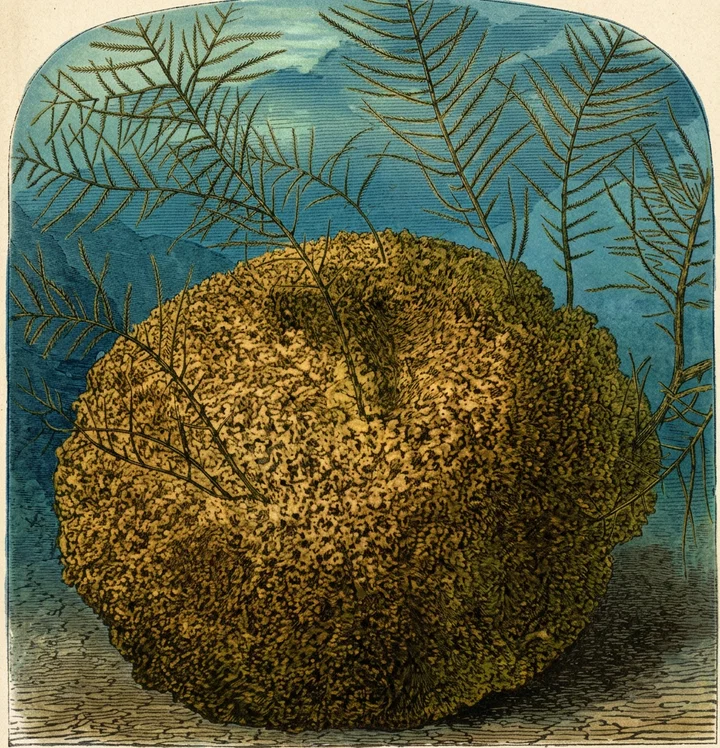
The sponge grows in all manner of different shapes and colors. It makes part of the beautiful gardens and shrubberies under the water. It will be like a vase, a trumpet, or a globe, or like the branch of a tree. There is one very curious sponge which is called “Neptune’s Glove.”
The sponge we use is not very handsome to look at when alive. It is dull black above, and a dirty white beneath. It grows to rocks deep in the sea, and has to be cut off with a knife. Men dive down to get it as they dive for coral.
There is a large, coarse sponge, which is much easier to obtain. It grows along the coast, and can be drawn out of the water by a kind of fork, or prong. The man who is fishing for it, sticks the fork into the sponge, and so carries it away. But this kind of sponge is not of much value.
The better and finer sponges would be spoiled by any such process. And these are by far the most valuable, and cost the most money.
When the sponge is brought out of the water, its living, jelly-like body drips away and is gone. The skeleton is dried, and becomes an article of commerce.
Sponges are found in the Red Sea, the Indian Ocean, the Mediterranean Sea, the Gulf of Mexico, and nearly all parts of the world. Fifty kinds of sponge grow on the British coast, but they are not used in commerce.—The Sea and its Wonders.