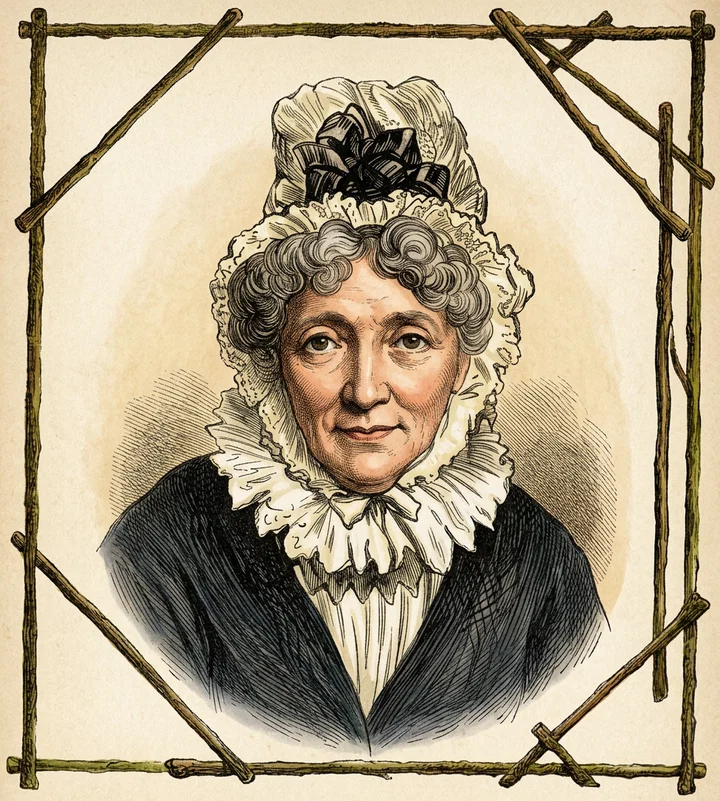
HANNAH MORE was born in a pleasant rural home in Stapleton, England, February 2, 1745. She was the fourth of five girls. Her father, a well-educated man, was at one time wealthy; but he lost all his property in a suit at law. He then taught the parish school in Stapleton, and here Hannah was born. Mr. More was very proud of his five daughters, and took great pains to give them a classical education, and to arrange a select course of reading for them. This, you see, was over a hundred years ago, when women, as a general thing, were considered educated if they were well versed in the external accomplishments of the day. The girls were, indeed, fortunate in having such a good chance to get an education.
The three oldest girls opened a school in Bristol. When twelve years old, Hannah was sent to this school. She was a brilliant scholar, and attracted the attention of the best cultivated people in the city. She afterward became the intimate friend of the most learned and scholarly men of that age. Her writings met with great favor, and her books sold rapidly. She was admired, praised, and petted in a way that would have turned many another person’s head. But she does not seem to have been affected by it. She was always simple and natural.
The more she mingled with the fashionable society of that day, the less she cared for it; and she at last made up her mind to move out of town into a home of her own. She bought a little cottage in Cowslip Green, ten miles from Bristol, and here she began her life’s great work.
She now wrote almost wholly on religious subjects, and in this way exerted a great influence upon the people. Her writings met with an unusually large sale.
The French Revolution had at this time affected to a great degree the minds of the English people. Under the name of reform, the social as well as the civil institutions of the country were threatened with ruin. People trembled for the safety of the realm. Just then a little work called “Village Politics, by Will Chip,” appeared. Everybody bought it and read it, and recommended everybody else to get it. In a little while, no less than one hundred thousand copies were sold. It was a book written for the people by one of the people, and it did more to quiet down the rising rebellion than anything else could have done. After a time, it was found that “Village Politics” was written by a woman. That woman was Hannah More.
But she was something more than a literary woman. She was a philanthropist. Ten miles from Cowslip Green rose the tall, romantic limestone cliffs of Cheddar, one of the most picturesque spots in England. The mountainous region itself was rocky and barren, but the plain around was rich and fertile. It was not the beauty of the place, however, that engaged the attention of Hannah More. The inhabitants were in sad need of missionary labor. In a letter to a friend, she writes: “We found more than two thousand people in the parish, almost all very poor; no gentry; a dozen wealthy farmers, hard, brutal, and ignorant. We saw but one Bible in all the parish, and that was used to prop a flower-pot. No clergyman had resided in it for forty years. One rode over, three miles from Wells, to preach once on a Sunday, but no weekly duty was done, or sick persons visited; and children were often buried without any funeral service. Eight persons in the morning, and twenty in the afternoon, were considered a good congregation.”
Twelve times she visited this neglected region before she could get the land-holders and the people to consent to have a Sunday-school. At last she succeeded in conquering their prejudice. Her youngest sister, Patty, was not a whit behind her in this good work. Together they visited other neglected parishes, and started other schools. By and by, day schools were held. Noble Christian women joined them, and great good was accomplished. Hannah often rode thirty miles a Sunday, usually visiting three parishes.
No good work was ever carried forward without meeting opposition. And these women did not have an easy time. One school was broken up in the height of its usefulness, because its leader, Mr. Bere, encouraged extemporaneous praying and speaking in a meeting of ten or twelve neighbors. This, the clergy thought, was encouraging Methodism; and as the Methodists were then a new sect, little known, and despised, no opportunity was lost to cast contempt upon them.
They were not content with breaking up the school, but went so far as to post bills against the sisters in the public highway. The following is a fair specimen of these bills: “Just imported from Barbary, by Baron Munchausen, a large collection of strange beasts, which the Baron has had the honor of exhibiting before the Bishop of London and his party with great applause, and may be seen at any time of the day at a new-built caravanp. 194 at the sign of the Green Cowslip, in the parish of Wrington, at 13½ pence each. The collection consists of five female savages [the Misses More] of the most desperate kind, one black bear, [Mr. Bere,] which they wounded with a poisoned dart while he was guarding his little ones.”
All this was very hard to bear, but they did not give up their work. Miss More writes to a friend, “In Blagdon is ‘still a voice heard, lamentation and mourning,’ and at Cowslip ‘Rachel is still weeping for her children, and refuses to be comforted because they are not ‘instructed.’ This heavy blow has almost bowed me to the ground. . . . Patty behaves nobly, and only works the harder for these attacks.”
She had made quite a fortune by her writings, and so had her sisters in their work of teaching. At last they all came to dwell together in an estate that they had purchased near Wrington. Here they lived to a beautiful old age. Lovely and pleasant were they in their lives, and in death they were not divided.
They lie side by side beneath a yew and a willow in the churchyard at Wrington; and above them is placed a stone, bearing their names and the simple inscription, “All these died in faith, accepted in the Beloved.”
W. E. L.