PERHAPS in no part of Palestine are so many places of historical interest crowded together, as in the mountainous country of Galilee. Near the Sea of Gennesaret lie Chorazin and Bethsaida, where Christ performed so many mighty miracles, and Capernaum, where he at one time dwelt. Just south of the Sea rise the mountains of Tabor and Gilboa, famous for the battles that have occurred on their slopes. Near them lie Nain, Endor, Shunem, and Jezreel; and farther toward the north and west, Cana, the scene of Christ's first miracle.
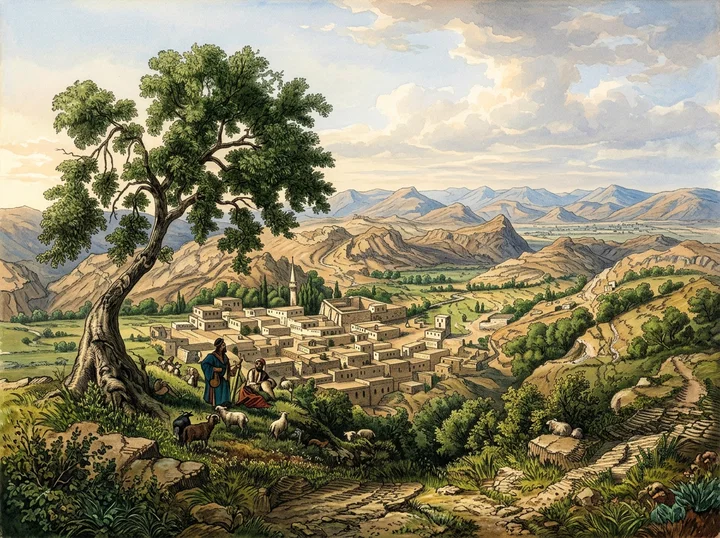
But the most interesting place of all is Nazareth, where Christ spent thirty of the thirty-three years of his earthly life. It lies in a little valley about a mile long and a quarter of a mile wide, and shut in from all the busy world without by a circle of rounded hills. The little village clings to the hillside, while out before it spreads a green valley. A spot better fitted for prayerful meditation it would be hard to find. Christ must often have wandered among the glens in the hills, that then, as now, were filled with the beautiful creations of his Father's hand. Upon these hills he often walked at evening, viewing in the heavens those greater works of the Creator, and lifting his heart in prayer to his Father for help in the coming years.
We are not told much of his boyhood, only that he dwelt at Nazareth with his parents, and “was subject unto them.” So brief is the record that I fear the children sometimes forget he left an example of perfect obedience for them to follow. He knows every step of the way from boyhood up to manhood; he met with all its temptations, and overcame them.
Among the many places of interest which the Nazarites show to the travelers who visit their town, is a kitchen, where they say Mary, the mother of Jesus, toiled, and a carpenter's shop fitted with tools, where Joseph and Jesus worked. But of course this is not true, for the oldest houses in the town have not stood more than a hundred years. But there is one place we may be certain about, and that is the fountain just outside of the town. Springs are slow to change their places, and we may be sure that to this very fountain Mary and Jesus often came, with their water-jars, as do the women and children of the present day.
The houses of Nazareth are solidly built of yellowish limestone, with flat roofs. The gardens around the houses give the town a fresh, inviting look. But the streets are like all Syrian streets, narrow and ill-paved, with a gutter in the middle.
Here rises the tall minaret of a Mahometan mosque, but there are Protestant churches in Nazareth as well. It is estimated that out of the six thousand inhabitants, four thousand are Protestants. Nazareth has a Protestant orphanage for girls, and also a Protestant hospital. Christianity has left its stamp on the inhabitants. The women have an air of freedom, intelligence, and self-respect unseen elsewhere in Palestine, unless we except the village of Bethlehem, the birth-place of the Saviour.
One of the finest sights in Nazareth is the view obtained from the top of the high hill on which the town is built. “This is one of the views,” says a traveler, “which may be coveted. The eye sweeps slowly around the horizon, longing to rest at every point, yet eager to turn to the next. Mountains and plains replete with sacred history are about you—Hermon, Tabor, Gilboa, Gilead, Esdraelon, and Jezreel. And off to the west glitters in the sunlight the ‘Great Sea,’ in a wide, extended surface, whilst purple Carmel runs out to bathe its feet in the blue waters. From the base of Carmel a long sandspit seems to form the Bay of Acre, on whose smooth waters the sails of vessels float like winged water-fowl. Jesus must often have looked out upon this scene; and from this spot, up from earth to heaven. Oh, how blessed were it if we might ever look at the world through the eyes of the sinless Christ!”
W. E. L.