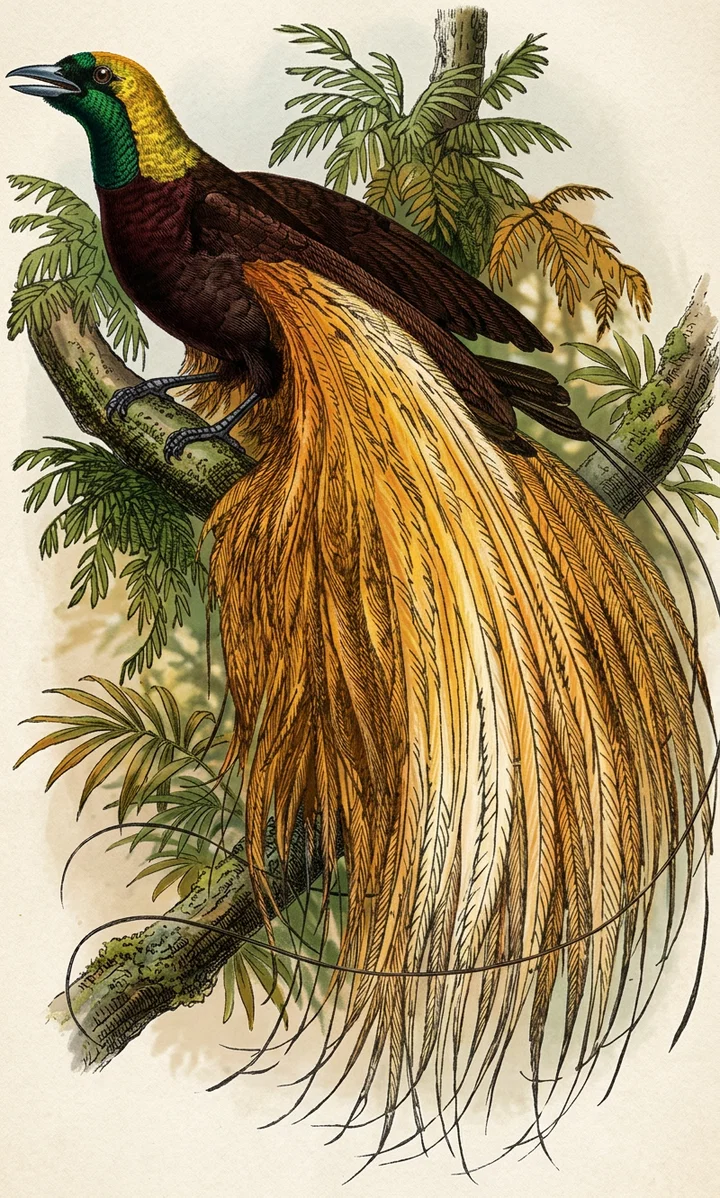
In the warm countries to the south, where the cold snow never falls, but it is summer time all the year round, live many very beautiful birds, such as you never see in your northern homes. You cannot begin to imagine how beautiful they are, with their feathers of flaming scarlet, and green, and orange. We have nothing like them, unless it is the tiny little humming-bird.
In our picture, you can see one of the most gorgeous birds to be found anywhere. It is the emerald bird of paradise. Its feathers are dark brown, rich green, and yellow. But the most wonderful part of its plumage is the long, drooping feathers along its sides. It can throw these feathers out into a beautiful plume nearly over its head. A long, long time ago, people used to think this bird had no legs and feet, but that it floated around in the air, buoyed up by its fairy-like plumes; and that when it took a rest, it hung itself up on a limb a little while by its tail feathers. So they gave it the name of paradisea apoda, which means footless bird of paradise. But it had feet, as well as any bird; the trouble was that the natives who caught this shy bird, always cut off its legs before they stuffed it, and sent it to the learned men in Europe.
It is a very dainty bird, and proud of its fine feathers. It takes great pains to keep every speck of dirt from its plumes, and always flies or sits facing the wind, so that its gay dress will not get ruffled. You think you would like to see such gay birds flitting in and out among our trees? Yet when I tell you that the best music they can make is only a shrill caw,—a sort of he! hi! ho! haw! ending up with a loud noise that sounds like whock! whock! whock! I do not believe that you would change one of the little brown singers that make our spring time so sweet, for all the gay feathers in the world.
The paradise bird is very hard to catch. All day long it hides in the tops of the tall teak trees, venturing forth only at sunrise or sunset for its food. It will not come forth if it hears any unusual noise. So the hunter takes his stand at early dawn under one of these trees, and watches silently for the bird to come out for its breakfast.
For all they are so hard to get, great numbers of them are killed every year, because their beautiful skins bring a high price. Does it not seem dreadful to kill these little creatures? Yet many people think their hats and bonnets look really fine when they have fastened a little bird on the front. The birds have as good a right to life as you or I, and it seems like the meanest kind of cruelty to shoot the pretty things just to gratify somebody’s pride. I have no doubt that if people did not wear the little birds, the hunters would soon leave them to enjoy the life God gave them.
W. E. L.