The traveler in foreign lands finds many things of deep historic interest,—places whose names have been made famous by the thrilling scenes that have occurred within them, but which have been sadly used by the hand of time, and now lie in ruins. Others, equally famous long years ago, are still teeming with busy inhabitants, eagerly employed in the various branches of industry. Everywhere are seen remarkable buildings which have withstood the assaults of storms and arms for centuries, and with whose histories are connected many remarkable and interesting events.
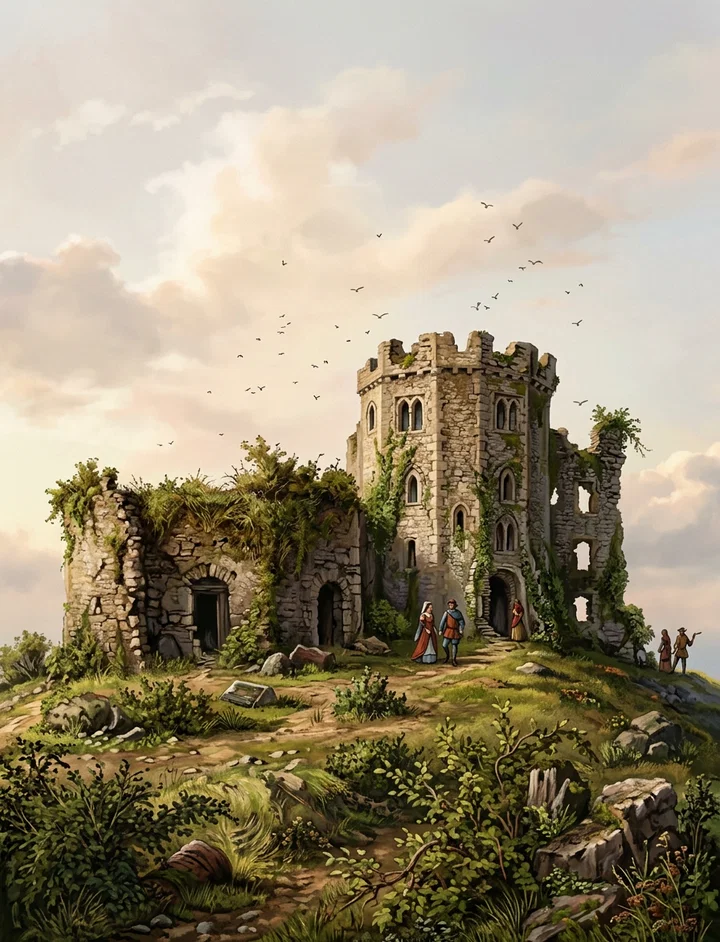
Cardiff (the “Caer,” or Castle on the Taff) is a municipal and parliamentary borough in the county of Glamorgan, one hundred and seventy miles from London. Its population, according to the census of 1871, was about 57,000. It is the chief emporium of the coal and iron trade of South Wales. In these products the neighboring hills are remarkably rich. Originally, its streets were narrow and dirty, but under the spirit of modern times, great improvements are seen in the wide thoroughfares and new houses in the new quarters of the town. Historically, Cardiff is well known. Many changes have occurred within it, but some of its most remarkable objects still remain. Among others is an ancient castle, as shown in the accompanying engraving. Many curious legends are connected with its history. From its position between the rivers Taff and Rhymney, and also between the mountains and the sea, it was marked out probably by the Romans, and also the Normans, as a fortified station.
In this castle, in the year 1108, Henry I., having taken prisoner his brother Robert, Duke of Normandy, imprisoned him for twenty-six years, until his death in 1134. Although kept a prisoner, it is probable that he was treated with kindness, and at times permitted to change his abode. Many fierce battles have thundered around its walls, where kings have been dethroned, and their crowns have fallen from their heads; and the changeful history of this famous old castle is full of the succession of ownerships, until the Lordship of Glamorgan passed, by marriage, to the Bute family, to whom Cardiff is mainly indebted for its prosperity. The area inclosed within the walls of this old castle was ten acres, and that within the moat surrounding it, thirteen acres.
This castle was once of enormous strength, and was so constructed as to resist the incursions of the Welsh. But under its later owners, extensive repairs and alterations are being made. Among other changes is a new clock tower which is said to be a “gorgeous example of thorough ornamentation.” On the side of the Taff, opposite to the castle grounds, are the beautiful Sophia Gardens, given to the town by the late marchioness of Bute.
There is a great deal of activity and public spirit in Cardiff. It is provided with excellent gas, water, and sanitary arrangements; also a public library, and an infirmary. Its exports are almost entirely iron and coal. Originally, coal was brought down from the mountains on the backs of mules. Iron was brought down in wagons of about two tons. These minerals were brought down mostly in the summer, and deposited on the docks, whence they were taken by ships to Bristol and other ports. From its coal-mines is dug the celebrated smokeless coal, which is used extensively in all the great navies of the world. Now there is a complete net-work of railways about the docks, giving direct and quick communication with every part of the kingdom. In the American war, cannon were made here, and deposited upon the primitive quay, which long retained the name of Cannon Wharf. Many millions of dollars have been invested in the construction of railways and docks, and in otherwise improving the harbor to accommodate the rapidly-growing commerce; and the scene upon its wharves is said to be very stirring.
There are several villages in the neighborhood of Cardiff, the most interesting of which is Llandaff, practically a portion of the city of Cardiff. Its remarkable cathedral, the seat of the earliest English bishopric, gives the tiniest city in Britain its title. For more than a hundred years the cathedral was left to neglect and decay. The aisles were roofless, grass grew in the nave, the ivy came through the windows, and storms were constantly laying it waste. At a great expense it was finally repaired, and an opening took place in 1869. The cathedral is nobly situated near the Taff, where it is broad and wooded, and almost entirely screened by the ridges.
J. W. B.