A LONG time ago, in the year 1717, there occurred an incident in Hermannsburg, Germany, which a preacher by the name of Stock relates. This incident happened during the great Turkish war in which the brave general, Prince Eugene, won such glorious victories over the Turks. Troops from all parts of Germany were assisting the Emperor’s army, and a few from our country had gone with them. From our village went Count von Staffhorst with two servitors,—Peter Paash and Hans Puffel.
In the great battle near Belgrade, where the Germans were victorious, Hans Puffel lost his life while rescuing his master from the hands of the Turks. In storming the town, Count von Staffhorst fell, having already forced his way into the city. Peter Paash, full of grief at the death of his beloved master, was so abstractedly following the Turks that when he reached the outside of the city, he was surrounded and taken prisoner. Tying him to his horse’s tail, a Turk mounted the horse; and Paash, naked and barefooted, had to run beside them, for they had taken everything away from him.
Restored with AI
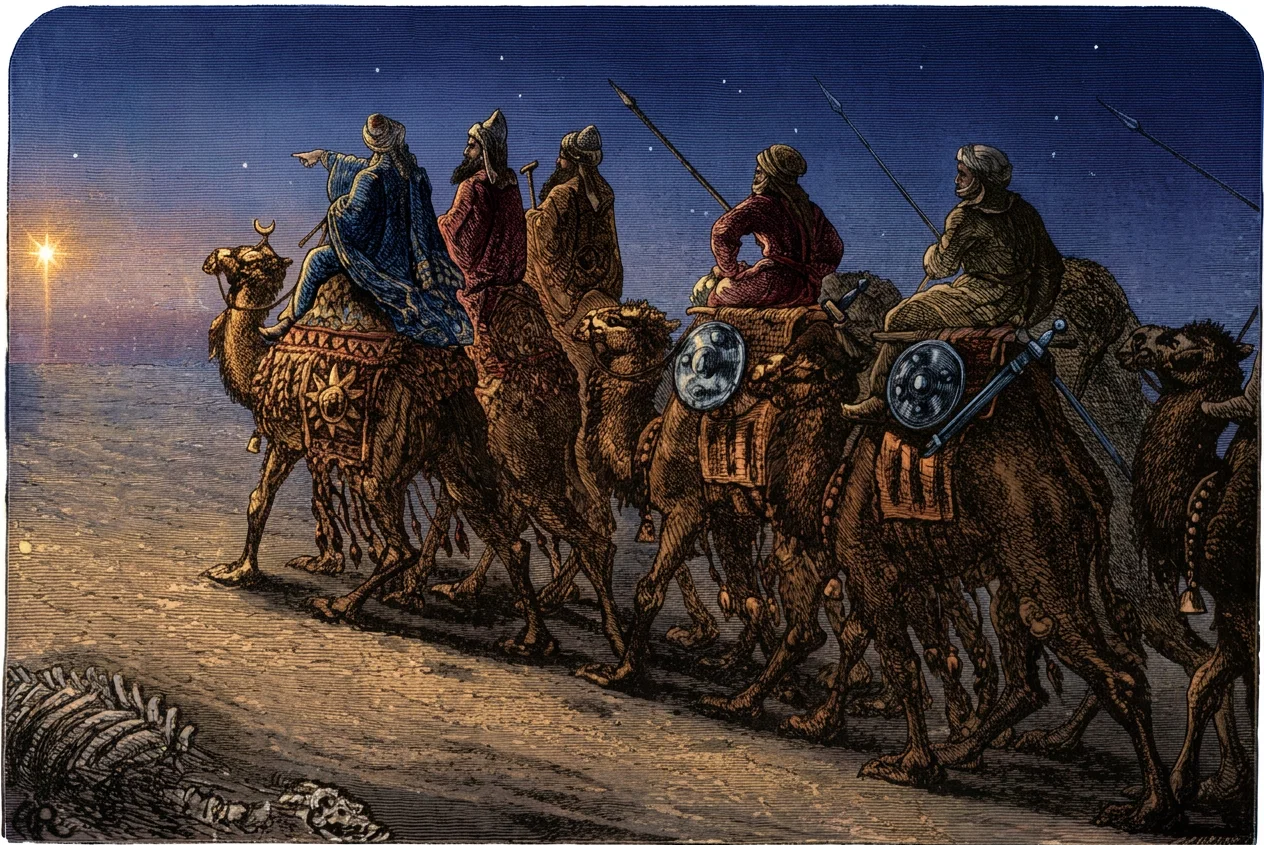
“We have seen his star in the east, and are come to worship him.” Matt. 2: 2.
Late in the evening they entered a forest. Believing themselves secure from the interference of all Christians, they thought they would wreak their vengeance on Paash for hewing down their comrades in battle. Placing two sticks in the form of a cross, they all spit at it, and tried, by whippings and torture, to make their prisoner do the same. But Paash, from whom they no longer expected any resistance, boldly hit on the head every Turk that spit at the symbol of his religion. They now tied his hands and feet; and piercing him with knives and daggers, tried to force him to repeat the indignity. These efforts proving unavailing, they put both his hands together over his head and nailed them to a tree, and by whipping and otherwise wounding him, tried to make him pronounce the name of Mohammed; but as often as they said Mohammed, he said Jesus Christ. Then the enemies of Christ kindled a fire under his feet, intending to make him deny Christ or die by the fire.
As Paash now saw that death was near, he prayed, with a devout voice, the Lord’s prayer, and repeated the articles of faith; and the Lord gave the brave soldier such peace that he was enabled to pray even for his enemies, as the Lord and Stephen had done. Scarcely had he finished praying, when his heart was filled with such heavenly joy that he could not refrain from singing in a loud voice that glorious old Passion hymn, “O innocent Lamb of God, thou hast died for us on the cross.” As he sung the third verse, and was finishing with the words, “Give us thy peace, O Jesus, amen!” the clear notes of a trumpet sounded forth, and German horsemen dashed into the forest. The Turks scattered in every direction.
With astonishment the soldiers beheld Paash nailed to the tree, with a slow fire at his feet. They quickly loosed him, and he fell fainting into their arms. After they had dressed his wounds, and cared for him, he recovered his senses; and his first question was, “How did you come to be sent at just the right time?”
Then the horsemen answered, “We were sent out to pursue the Turks, and heard some one singing in the forest, ‘O innocent Lamb of God.’ ‘That,’ cried we, ‘is a Christian.’ The God in whom thou hast trusted hath saved thee.”
The horsemen brought Paash to Belgrade. When the affair came to the ears of the brave Prince Eugene, he took pains that the best care should be given to the poor soldier. He visited him several times himself, and rejoiced at his child-like, innocent faith; and since Paash was no longer fit for war service, he sent him back to his fatherland.
Paash lived for ten years on the paternal farm in the community of Bonstorf. And he wore on his body the marks of the wounds, like those of the Lord Jesus, to the strengthening of the community in the faith. He died in the year 1728, as he was singing, “O innocent Lamb of God.”
May the Lord impress us all with this verse: “Whosoever, therefore, will confess me before men, him will I also confess before my Father which is in heaven.”