AWAY to the far, far north, where the nights are long and cold, live some very happy and contented people. You can see one of them in the picture. I am afraid that if you lived there, you would find it hard to be as contented as he is.
His house is nothing but a tent, and not a very good one at that. To build it he sets up some poles in a circle so that their tops will meet together at the center. His floor is not more than six feet wide, or eighteen feet all the way around it. He covers the poles with coarse cloth in the summer; and in the winter he spreads on another covering of skins. The floor is carpeted with reindeer skins, and in the center is a stone hearth where he builds his fire. The smoke goes out at the open place in the top of the tent; and there, too, the rain, wind, and snow come in. I wonder if he gets cross when a flurry of snow almost puts out the fire, and sends the smoke into his eyes. All around the sides of the tent, hang bowls and kettles, and everything used about the cooking.
The Laplander's pantry is in a queer place. It is on a shelf way up between two tall trees. There he keeps the milk, curds, cheese, and dried reindeer's meat. You wonder how he ever gets at the things? He has a tall tree pole, full of cross sticks, that he uses for a ladder. He is obliged to have his pantry in this airy place, or else the dogs and wolves would eat up his food. I suppose he would build a better house, with a pantry in it, if he ever stayed long in one place.
All a Laplander's wealth lies in his reindeer. If he has a thousand or more reindeer, he is thought to be a wealthy man; all the poor Lapps look up to him, and respect him very much. If he has five hundred, he is respectable; but if he has no more than fifty, he is a very poor Lapp indeed, and gladly serves his wealthy neighbor.
The reindeer live on the lichens that grow on the cold, gray rocks. The lichens are not very plentiful; so when the reindeer have eaten up all there are in one place, the Lapps have to move to another. They hardly ever stay more than two weeks in a place. As it takes the lichens a long while to grow, it may be years before the Lapps will come that way again.
The people have long skidders, or skates, made of fir-wood, and covered with young reindeer's skins. These skidders are as long as the Laplander himself. It would be hard to travel in the winter without them. With them he can run as fast as the wild beasts. He has a long pole, with a knob near the end of it, so that it will not sink deep in the snow, and with this he stops himself when he wants to rest.
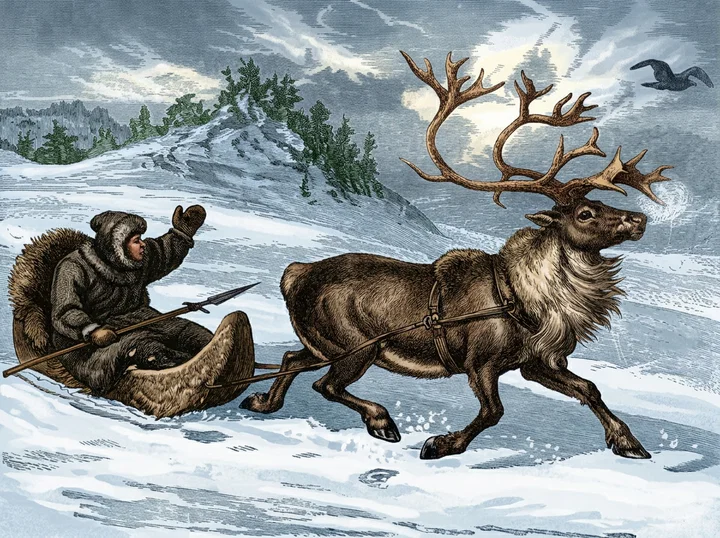
He also has a small sledge, or “pulka,” which he hitches to the reindeer, as you see in the picture. The sledge is rounded on the bottom, and he has to be very careful, or he will fall out.
The Lapp lives in a beautiful country in the summertime. Then the sun hardly goes to bed at all. For days his round face is to be seen above the horizon, except for a few short hours when he dodges behind the mountains to take a short nap. Beautiful streams of clear cold water flow down the mountains to the sea, and the land is clothed in green.
But when the short summer is over, then comes the long cold winter. For days the sun hardly glances above the horizon. Now the Lapps move away from the sea-shore to the forest. The long, dark nights are lit up by the gay northern lights, that flame and dance in the sky like fire-works. You could not get a Lapp to change his wild, cold country for any other in the world.
W. E. L.