THERE is, among the feathered tribe, a very large family known as Warblers (Sylviadæ), a class of birds in which, it is said, “the genera, when taken together, number more members than do those of any other family.” The most attractive of the group are the Song Warblers (Sylviæ), whose many subfamilies are each named from some trait or mark peculiar to itself; as, Spectacled Warbler, from a white ring around its eyes; Fire-eyed Warbler, from its bare and brightly colored eyelids; etc., etc.
The song warblers are all small, with soft, silky plumage of a light gray color, variously intermixed with different shades of red and brown. They live mostly in wooded tracts of country, preferring low trees and shrubs to large forests; but they avoid the mountains, even when covered with their favorite shrubs. Their diet consists of insects, worms, and larvæ; but in the fall of the year, their principal food is berries and fruits.
Most of the Song-Warbler family are good songsters, but one of the most gifted of them is the Capirote, or Black Cap, so called from the black tuft on the head of the male. The female has a tuft on its head also, but it is dark brown instead of black. The general appearance and habits of the Capirote are very like those of the other song warblers; but in song, Mr. Mudie says “it has the mildest and most witching notes of all our warblers.” He says also, “It is true it has not the volume and variety of the nightingale, neither the ineffably sweet chant of the garden warbler; but its notes take one by surprise, and the changes and trills are finer than those of any other bird. The song, when the bird is at rest, appears to be like the songs of several birds; but it transposes them into a lower or rather a minor key, and finishes off with variations of its own.”
Bolle mentions a tame Capirote “kept by a lady in Cindal de los Palmas, the chief town of the Canaries, that was the wonder and admiration of the whole neighborhood, on account of the extraordinary clearness with which it had learned to repeat the words mi nino chiceritito (my darling little pet), a phrase daily employed by its mistress as she gave her favorite its food. Large sums were offered by several persons in the hope of obtaining so great a curiosity as a singing bird which could speak; but his owner was not inclined to part with her treasure. After several years, however, this lady had the misfortune to lose her pet by poison, administered, it is supposed, by some one whose offers had been refused.”
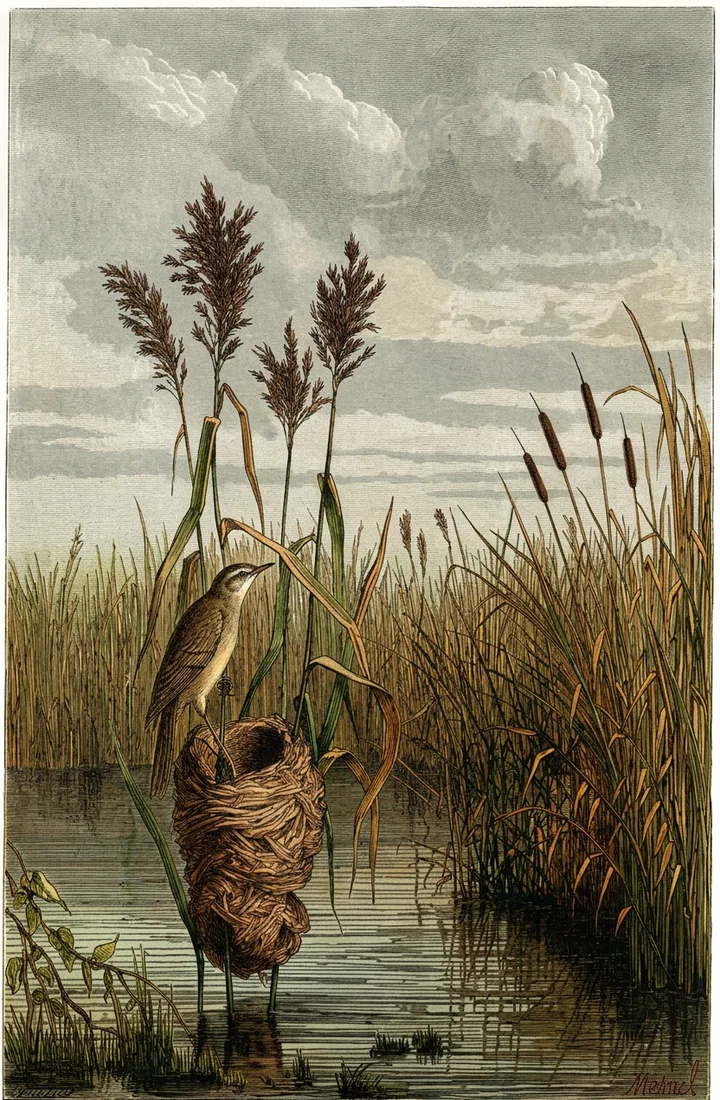
In the great warbler family are many groups besides the song warblers,—the tree warbler, garden, marsh, reed, sedge, grasshopper, etc., nearly every group having its subfamily. Our picture is a representation of the Reed Warbler, so called because it lives among the reeds, in marshy places. It is never seen in the mountains or woods, nor even upon trees that grow near its favorite dwelling place.
The true Reed Warbler is about eight inches long; the wing measures three and one-half inches, and the tail four inches and a quarter. It is yellowish gray on the upper side, and reddish white on the under side, shaded with gray upon its throat.
These birds may be found most all over Europe; and in Northern and Southern Africa are species very nearly similar. They begin to migrate in September, and wander as far as Central Africa, but they never linger in any but marshy places. After their return in the spring, their loud, echoing voices may be heard, not only all day, but frequently all through the night. In Cassell’s description of birds it is said that “their song is a strange combination of a great variety of harsh, quavering notes, more nearly resembling the croaking of the frogs whose domain they share, than the notes of any of the feathered creation.” Also, “while singing, the males usually perch upon a reed, with drooping wing, outspread tail, inflated throat, and open beak, and go through their noisy performance with an energetic desire to rival every bird around them; such is the evident satisfaction they exhibit at the result of their efforts, as to make the listener overlook the want of vocal talent, in his amusement at the concert of the self-complacent songsters.”
They begin their nests in June. As you see in the picture, they are long in shape, turned inward at the top, to prevent their young from falling, or being blown out. They are made of stalks, grasses, fibers, etc., lined with some soft materials. Their nests are fastened securely to the reeds by drawing four or five together and interweaving the building material among them. They lay about four or five eggs, which they hatch in two weeks. They are very attentive to their young, until they are fully fledged.
Dr. Bennett says, “One species of the Reed Warbler (Acrocephalus Australis) is very numerous about the sedgy localities of the Nepean River, Australia; and although it has been denied that any of the Australian birds are endowed with a musical voice, this bird has a very loud, pleasing song, enlivening the places it frequents.”
There is also a large Reed Warbler in India, similar to the European species.
M. J. C.