ON the banks of the Tigris stands an old, old town. For over a thousand years the hot sun has shone down on its glittering domes and tall minarets. Generations have trod its narrow streets, and trafficked in its thoroughfares; and having lived their allotted time, they have in turn given place to those who came after them.
Powerful monarchies have crumbled into dust, and new ones have risen, since the foundation walls of this old city were laid. Great caravans have passed, and still do pass, through this place, laden with the spices and balms of the orient. All the wealth and luxury of the east combined to make the city one of the most magnificent of its day.
Through the midst of the city flows the great Tigris River, spanned by a bridge of boats. Above the bridge, on the left side of the river, stands the palace of the Pasha, a building more noted for its great size than for its magnificence.
The old Mahometans seem to have built their houses wherever their fancy led, and then to have laid out their streets afterward; for there is not the slightest regard to regularity. The streets are unpaved, and so narrow that two horsemen can with difficulty pass each other.
Restored with AI
Like a truly oriental town, the houses of Bagdad have but few windows facing the public thoroughfares and the doors are small and low; so that from the street only gloomy walls are seen. But the space between the houses is turned into beautiful gardens of pomegranates, figs, olives, grapes, and date palms, and at a distance the town looks as if it rose from the midst of trees.
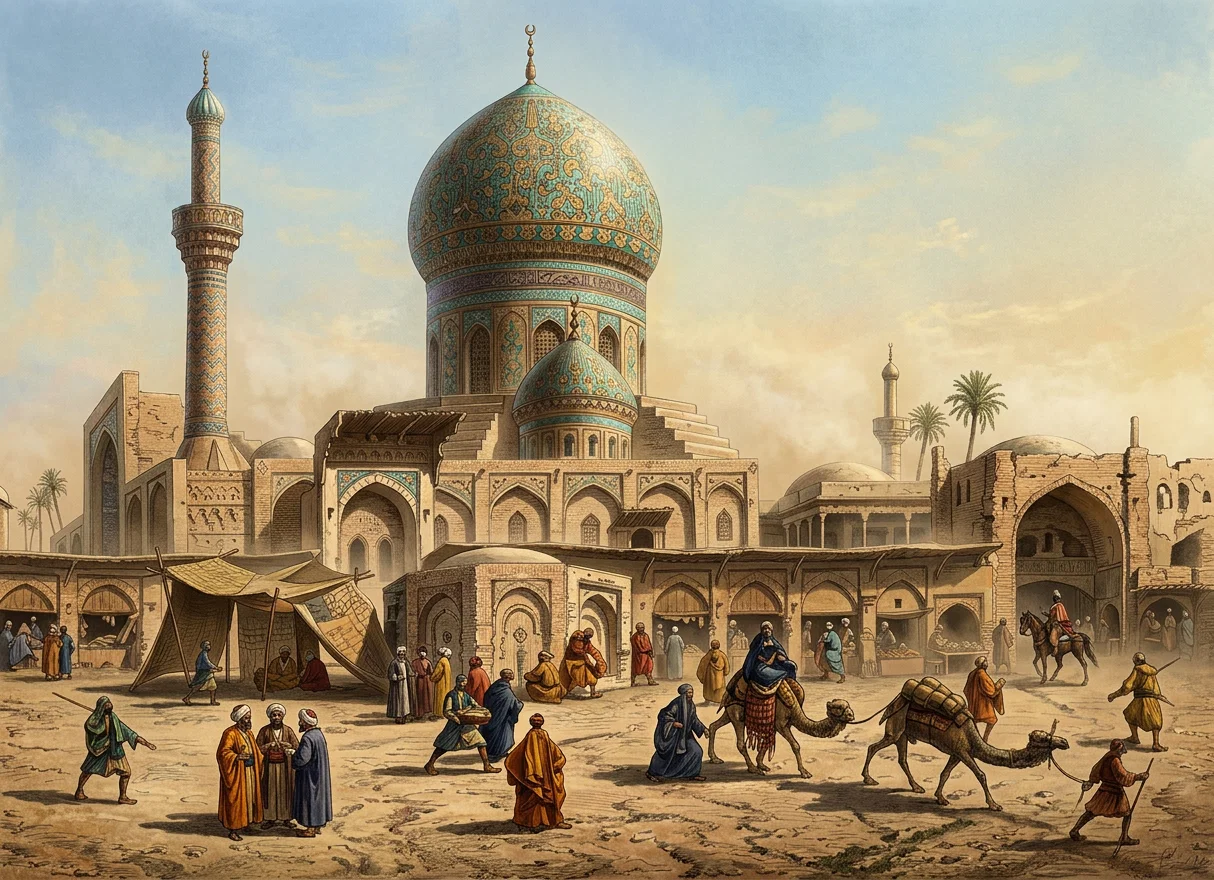
In our picture is given a view of the market place. Here in their stalls the merchant-men sit among their goods, smoking their long pipes, and driving hard bargains with their customers.
Five times a day, from the tall minarets of the mosques, the muzein calls the faithful to their devotions. The close bargaining is suddenly interrupted, although no more than half completed at the sound of that call, and all true believers, wherever they may be, offer up their petitions. The scene is very impressive.
The city is inclosed with strong walls, shutting it in from the great desert lying all around. Three gates open into it, one on the southeast, one on the northeast, and one on the northwest. All around the outside of the wall is a deep, dry ditch.
Perhaps one of the most interesting portions of the town is the old burying-ground. The most prominent object in this old cemetery is the tomb of Zobeide, the favorite wife of Haroun el Raschid, who was one of the greatest and wisest of caliphs. The tomb is a high, octagonal building, surmounted by a lofty, cone-shaped structure. This burying-ground extends over a large portion of the land once occupied by city streets. So does26death ever tread on the footsteps of life. In such a place one is forcibly reminded that the numbers of the dead are much greater than those of the living.