Here we have the picture of a pretty lake, with a marshy border of reeds and fens, and some of the birds that live among them. Most any of you can point out the ducks and cranes; but the group of strange-looking birds in the forefront of the picture, you may not know so well.
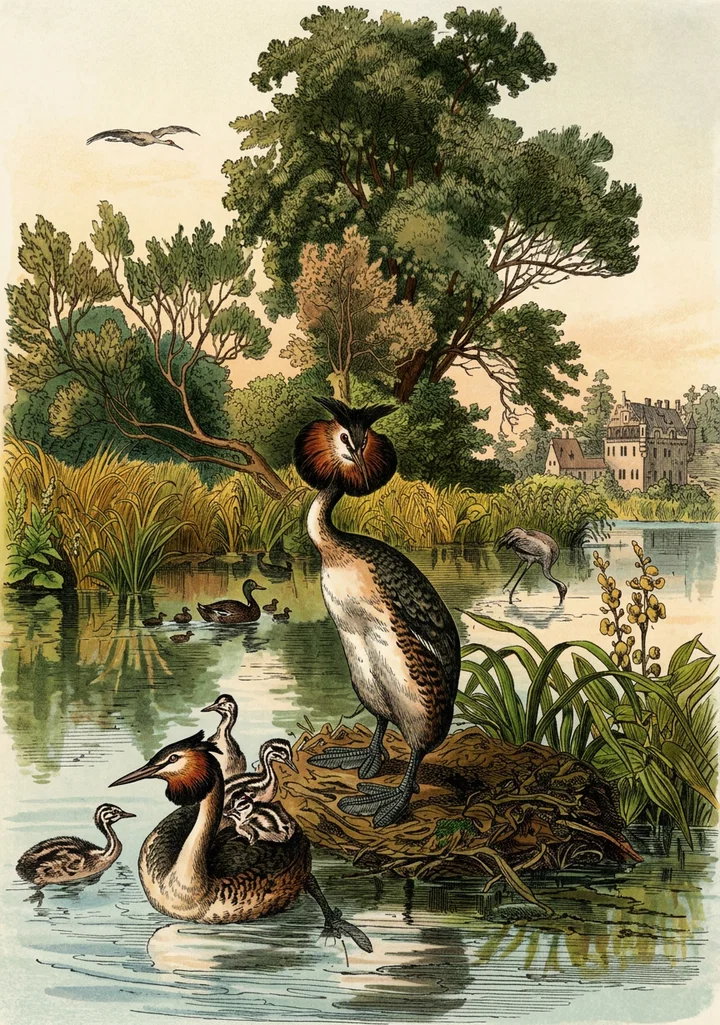
The three smallest of the group look like ducks, only that their bills are so sharp-pointed. But a look at the parent birds, more particularly the male bird, or the one which stands upon the edge of the nest, will satisfy you that they are not ducks.
What gives the parent birds such an odd look, is the ruffle of feathers about the neck, and the large crest, or comb, upon the head; and from this crest the bird is named the grebe, the word meaning crest, or comb.
There are more than twenty species of the grebe in the northern parts of Europe and America. They all have long necks, small heads, and long, sharp bills; and their eyes are close to their bills. Most of the species have short wings and legs; and their legs grow out of their bodies so far back that it makes it difficult for them to walk, so they do not try to walk very often. When they come on land, they have to stand upright, or they would lose their balance, and topple over.
Do you notice what queer-looking feet they have? Each foot has three divisions, or lobes, united by a web, or thin skin, just before joining the leg. The lobes are flat, and are covered with scales. The whole foot looks something like a horse-chestnut leaf with three lobes. You can examine a leaf sometime, and see for yourselves.
Being a water bird, the grebe makes its home on the borders of fresh-water lakes and rivers, and the sea-shore. There it can swim and dive to get its food, which consists of fish and such animals and plants as it can find in the water and among the reeds.
It builds its nest of weeds and roots, lining it with down, and fastens it to the fens, or leaves it to float upon the water. And although it builds so close to the water that its nest is nearly always wet, it does not seem to suffer any harm from its damp bed.
The grebe flies very rapidly, but only at short distances, save when he goes to a warmer climate; then he flies high, and a long time without rest. He is an excellent swimmer and diver, and dives to great depths; and if at any time he becomes frightened, he will dive quickly under the water, leaving only his bill above, until the danger is over.
The crested grebe is the largest of the American species. The upper part of its head and body are a blackish brown, with a reddish brown ruff, tipped with black. The forepart and sides of the neck are reddish brown, and the remainder of the body is silvery white.
The horned grebe has been known to carry its young upon its back, and even to dive with them when it was frightened.
The smallest and most active of the grebe family is the little grebe, or dab-chick. Its home is in Europe. This lively little bird will sometimes sink into the water as suddenly as though jerked by something under it; and it will as quickly rise to the surface. It has been seen to thus dive and pop out of the water, until it was really amusing.
Their flesh is not pleasant for food; but because the bird is so active, both on and under the water, grebe-shooting from boats is a favorite amusement upon Lake Geneva, in Switzerland. Besides boats and guns, telescopes are used by the hunters; but they have to understand the habits of the birds, and know their direction after diving, to outdo them.
Don't you suppose that He who notices the sparrow's fall notices also the destruction of these innocent birds by the hand of the cruel hunter? Are you all kind to the birds? M. J. C.