If you had been walking about the narrow, crooked streets of Boston over a hundred and sixty years ago, you might have come across the workshop of a candle and soap maker. And had you peeped within the door of this humble house, you might have seen, dipping the wicks in and out of the tallow, a young lad with a very discontented look on his face. He did not like to do this work; he wanted to go to school. But his father was poor, and had a large family to provide for; so Benjamin, as this lad was called, had to do his share toward earning a living.
Ben had a great many excellent qualities, that in after years he turned to good account in helping his country. But sometimes these same good qualities, when not guided by sound judgment, led him into a vast deal of mischief. In all sports he was the leader among the boys of the town. In the vicinity there was a mill-pond bordered by a salt marsh; and thither the boys resorted to fish for minnows. Constant tramping had rendered the marsh a veritable quagmire, affording insecure footing to the juvenile fishermen. Ben, as usual, set his wits to work to remedy the evil. Seeing at a distance a pile of stones that had just been hauled for a new house, he and his companions set to work after the men had left the place at night, and carried all the stones, big and little, over to the pond to make a pier of. Next morning the workmen came to lay the wall, and found their stones missing. When the mischief-makers were found out, their stern New England fathers severely corrected them, and made them carry the stones back. Ben then learned a lesson which was to last him all through life,—a lesson all boys should early learn,—that wrong means are not justifiable even in a good cause, and that what is not honest cannot be truly useful.
As the days and weeks went by, Ben grew more and more uneasy, and dissatisfied with his work, until his father was seriously afraid he would run away to sea, as one of his brothers had done. Noticing the boy's fondness for books, his father thought the printer's trade would be best suited to his taste; and he accordingly made arrangements with Ben's brother James to take him into his office and teach him the trade. Ben was to work for him nine years, or until he was twenty-one, and during the last year he was to have pay for what he did. He liked the trade, and soon became a good workman. But he found it as hard work as ever to get books to read; for he had no money to buy with. At last he persuaded his brother to give him half the money he paid for his board; and he managed to board himself comfortably on half of what his brother gave him, spending the rest for books. As he says himself: “I had another advantage in it. My brother and the rest going from the printing house to their meals, I remained there alone, and dispatching presently my light repast (which was often no more than a biscuit, or a slice of bread, a handful of raisins or a tart from the pastry cook's, and a glass of water), had the rest of the time, till their return, for study; in which I made greater progress from that greater clearness of head, and quicker apprehension, which generally attend temperance in eating and drinking.”
But Ben had a hard master in his brother, who was a hasty, passionate man, and often beat him soundly when he displeased him. Ben did not receive such treatment very pleasantly. By and by they had an open quarrel; whereupon he left his brother and went to Philadelphia, which was to be his home for the rest of his life. You no doubt remember of reading how, poor, friendless, and homeless, he wandered through the streets of the city, eating a roll that he had just bought at a bakery. He must have presented a ludicrous appearance, with his pockets stuffed out with soiled clothes, and a roll of bread under each arm. But those who were so ready to laugh at him then, were glad to pay him all respect in later years.
Ben, or Franklin as he was now called, soon found a place to work; and by his steady, industrious habits and studious turn of mind, made a good reputation. In about seven years he was able to run a printing house on his own account, and from that time forward his life was one of continued success.
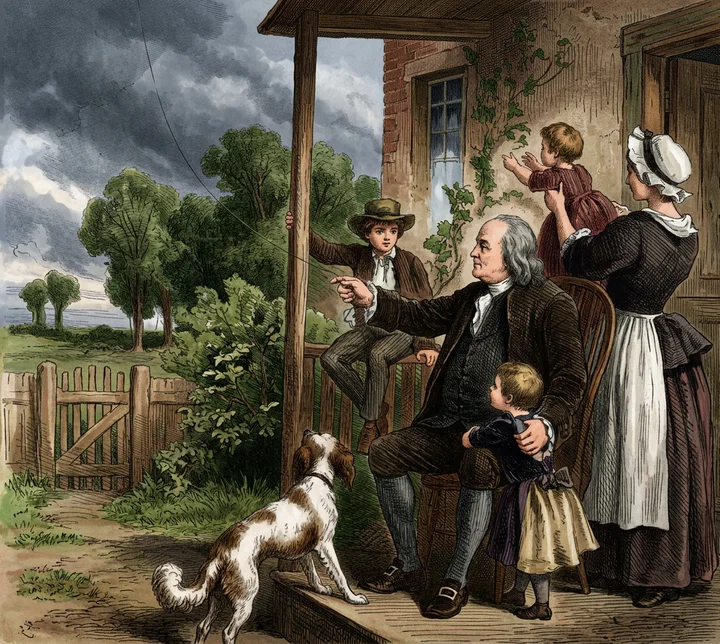
But there is hardly room to tell you of all the honors that he enjoyed in the latter part of his life, and of all the projects he set afoot for the benefit of the people. He was the first to organize a fire company in Philadelphia. He made many experiments in science, and discovered the similarity between lightning and electricity by his famous experiment with the kite in a thunder-storm. The knowledge that he gained through this experiment he turned to practical account in the invention of the lightning-rod.
His wise counsel and sound judgment were much valued, and led the people to elect him a member of the General Assembly. In later years he visited England and France, where he did very effective service for the American colonies.
You may like to know by what means a lad of poor and obscure parentage was enabled to gain such success. Outside of his natural abilities, which were of great advantage to him, I think the key-note may be found in this passage of scripture, which his father so frequently quoted to him when a boy: “Seest thou a man diligent in his calling, he shall stand before kings, he shall not stand before mean men.” “The industry of that Franklin,” said an old townsman, “is superior to anything I ever saw of the kind; I see him still at work when I go home from club, and he is at work again before his neighbors are out of bed.” And Franklin himself says: “I considered industry as a means of obtaining wealth and distinction: though I did not think I should ever literally stand before kings, which, however, has since happened; for I have stood before five, and even had the honor of sitting down with one, the king of Denmark, to dinner.” And again, “I have always thought that one man of tolerable abilities, may work great changes, and accomplish great affairs among mankind, if he first forms a good plan; and cutting off all amusements or other employments that would divert his attention, makes the execution of that same plan his sole study and business.” W. E. L.