Cold winters, deep snows, and biting winds, often make us long for a milder climate. Our grains, our fruits, our vegetables, and even our grasses, have to be planted, cared for, harvested, and stored away for use during the cold season. We have but one harvest in a year, and we have to gather enough then to last until the next is ripe. All this requires much toil and care.
In most of the hot countries of the earth the case is far different. In the islands and peninsulas of the Indian Ocean one can go out at any time of the year, and help himself to the richest of fruits growing wild in the jungles. Indeed there is no autumn or winter in those countries, but one perpetual spring and summer. The trees and other plants are always in blossom, and yet always loaded with ripe fruit. New leaves are continually bursting from the bud, and the breeze is ever laden with sweet odors. No food has to be laid by for winter, no warm clothing has to be made, and the houses are very light, being needed only as a shelter from sun and rain. The days and nights are of equal length the year round.
Such a country as this would seem to be an Eden; but since sin came into the world, there is no perfection here. These delightful tropical regions literally swarm with poisonous insects and troublesome vermin. Lizards, scorpions, huge spiders, and venomous snakes are almost everywhere, even in the houses. Fierce wild beasts infest the jungles, and make it unsafe to venture out alone, especially after nightfall. The dwellings have to be set up in the air on tall posts, and look as though they were on stilts. On the small island of Singapore, which lies close to the southern point of the Malay peninsula, it is estimated that the tigers kill more than three hundred people every year. They cannot be hunted off; for they keep swimming over from the main-land, which is in some places not more than a quarter of a mile distant. English hunters, with natives to help them, often go in pursuit of these dangerous creatures. A brief account of one of these hunts will give you some idea of the power of these fierce animals.
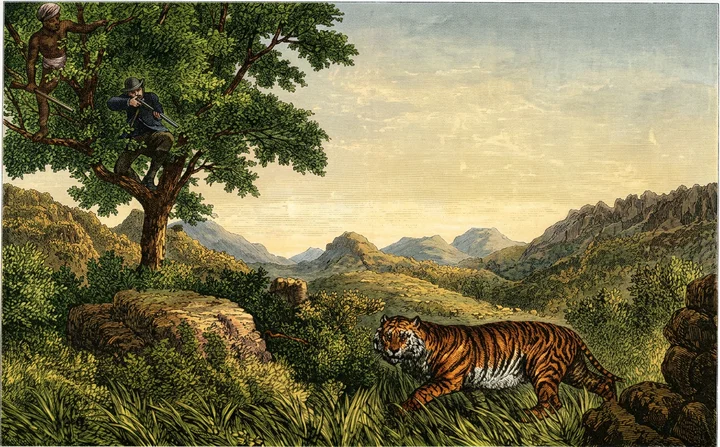
It was sometime in the summer of 1882 that this hunt took place. There seemed to be signs that a tiger of unusual strength and boldness had made his lair in the jungle not far from the town. Several persons had mysteriously disappeared. The last victim was a woman who had been missed from the outskirts of the city.
Six native men, called beaters, were secured to hunt up and follow the trail of the beast. They soon found a place where there had been a struggle, in which the little clothing worn by the woman had been torn from her. The weight of his burden had caused the tiger’s fore paws to sink so deeply into the sand that there was no difficulty in tracking him. Now and then a lock of the woman’s hair showed where her head had been thrust against a thorny bush in passing. Once the tiger had laid her down, and here the finger marks she made in the soil showed that she was still alive.
So the hunters and their men went on for two miles or more. The jungle grew thicker, and the track more winding; but the trail was very distinct. Finally they thought they must be very near the tiger’s den. The strongest and most experienced beater was now sent on a little ahead of the rest of the company. He had nothing but a large knife to defend himself with. As silently as possible they pushed on into the jungle, the beater keeping a short distance in advance. In spite of all their caution, however, the wary animal scented them, and came boldly forward. They had not expected this, and were taken by surprise. Suddenly the tiger sprang from the thicket. A crashing sound was heard, and a terrific scream pierced the deep recesses of the jungle. The brave leader was dashed down in a moment; but scarcely had he touched the ground when the report of a gun was heard, and before the fierce beast could bury his teeth in the flesh of his victim, a bullet, sent by the sure aim of one of the hunters, had pierced his brain. Slowly the powerful creature rolled off, straightened out, quivered a moment, and was dead. The daring native, though stunned and terribly bruised, was not killed. Presently he struggled to his feet, and pointing to his knife, showed that, in spite of being taken by surprise, he had buried it to the hilt in the chest of the tiger.
A few rods farther on in the jungle the hunters came to a small open spot surrounded by a very thick growth of bushes and vines. It was fully three miles from the nearest settlement; but many a poor victim had been brought all that distance by the gaunt monster, and devoured at his leisure in this almost impenetrable retreat. Nothing but the skeleton was left of the poor woman last captured by his royal highness. Piles of human bones lay scattered around. His majesty had dined chiefly on women, as was proved by the abundance of bangles, nose and ear ornaments, etc., that were picked up. Imagine how these gewgaws must have looked in such a place. What a lesson on vain show, and the foolish decorations so often employed!
G. H. BELL.