ONE of the most humane and worthy institutions supported by the governments of the world, is the life-saving service of the ocean. Along the coasts are many dangerous, rocky reefs and shoals, on which the storm-driven vessels are ever liable to be wrecked. And notwithstanding the utmost endeavors put forth to prevent it, many lives and vessels are annually lost by shipwreck upon these dangerous rocks and shoals.
Various methods are employed to give warning of danger to the mariner, and thus prevent the fatal accidents that are ever liable to occur when overtaken and driven by the fierce, blinding storm. The most noteworthy of these methods of warning and prevention, are the lighthouses, light vessels, fog signals, buoys, and beacons. According to the statistics of the treasury department of the U. S. government for 1873, there were upon the different sea and lake coasts of our country six hundred and forty-one light stations; of these, six hundred and twenty were light-houses, and twenty-one, light vessels. The government expended for the maintenance of these in one year, $1,889,017.50. The number of buoys and beacons in the United States, is nearly five thousand. In all governments except that of the United States, commerce is directly or indirectly made to pay the cost of maintaining these light-house establishments. In Great Britain a tax is levied upon every vessel, domestic or foreign, that uses any particular light that is to be supported. France has a similar tax, or harbor due, from the proceeds of which the expenses are paid.
Notwithstanding all these grand and expensive means for the prevention of shipwreck, vessels are frequently driven by the storms upon the rocks and wrecked. And thus it becomes necessary that some means should be maintained close by these dangerous points, by which the poor sailors can be saved from a watery grave, and property on board the vessel can be rescued from destruction by the dashing waves.
For this purpose the government has erected at certain intervals all along our sea and lake coasts, life-saving stations. These are neat, substantial frame buildings, one and a half stories high, forty feet long, and twenty wide. They afford ample room for the boats, wagons for carrying the boats, lines, and all the other necessary apparatus. They are also provided with comfortable apartments for those who have the care of them, and also for those who may at any time be rescued from a wreck. At each of these stations six experienced surfmen are kept constantly on duty during the winter months; and these are in charge of a competent keeper, who is regularly appointed by the secretary of the treasury. From the first of December to the first of April, these men are required to patrol the beach day and night, watching for any wreck that may occur. If a wreck is discovered, information is immediately sent from one station to another by a system of signals, consisting of flags by day, and colored lights at night. When the signal is raised, all haste is made to the scene of disaster, and every means employed to rescue the poor unfortunates. If possible to do so, the life-boats are launched and manned by the daring surfmen, who dash out upon the boiling, tumbling waves, and pull with might and main for the ship, where the people are taken on board, and conveyed in safety to the shore. This is very often an extremely hazardous undertaking, but these noble men, thinking only of saving the lives of their fellow men, fearlessly risk their own in the performance of duty. It would certainly be an ungrateful people and government that failed to recognize and show their appreciation of these labors by a liberal reward.
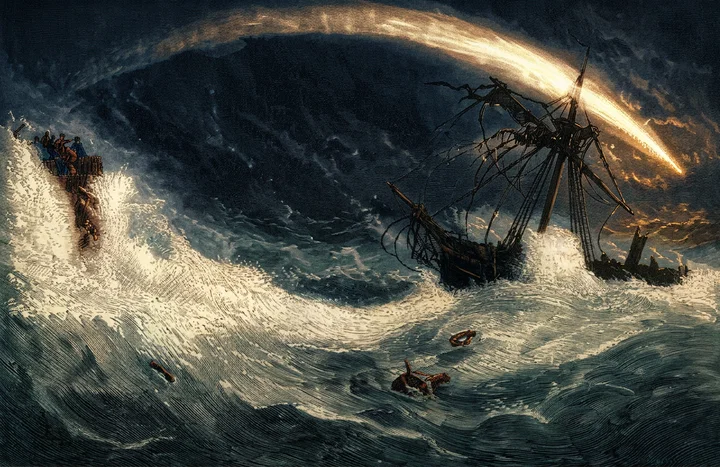
Frequently it is impossible for the men to reach the ship with the boats, and then some other means must be employed. One of these methods is shown in our engraving. Here we see a vessel driven upon the jagged rocks, where it is impossible to reach it with the life-boats. For such emergencies these stations are provided with a small cannon, or mortar, of five and one-half inches calibre, from which is thrown an iron ball weighing about twenty pounds. To this ball is attached a line, one inch in diameter, by means of a spiral spring to take up the jerk. The line is coiled in a peculiar manner in a box or on the ground, and when the shot has been successfully thrown over the wreck, a larger line, two inches in diameter, is then attached to the shore end of the smaller line, and is hauled off by the people on the wreck; and by means of this line a four-inch hawser is then hauled on board and made fast. This is then made taut by the men on shore, and fastened by means of tackles, anchors, etc. By means of the second, or hauling line, various appliances are hauled back and forth, until the people are saved.
The life-car is often attached to the large hawser. This is a covered, metallic boat, capable of holding four grown persons or eight small children. It is so constructed as to be water-tight, and by means of it persons are frequently transferred from the ship to the shore without being wet. So rapidly is all this done, that it is said the time usually occupied in arranging the lines and sending off the car after firing the mortar, is about thirty minutes. The life-car was introduced into the United States service in 1849, and in the following year two hundred and one lives were saved by it from the British emigrant ship, Ayrshire, which was wrecked on Squam Beach, N. J., during a fearful snowstorm.
The history of this noble enterprise is an exceedingly interesting one, and worth the study of every individual. Our space admits of but a brief mention of a few interesting points concerning it. It had its origin in the Old World, and was at first supported by voluntary contributions. Humane societies, having similar objects in view, afterward became interested in it, and it was by them supported and enlarged. The first step in this direction in our country, was in the beginning of the present century, when the Humane Society of Massachusetts was established. Its huts of refuge and its volunteer life boat-men were of almost incalculable service to the unfortunate mariners who were stranded upon that rocky coast. This first effort received the aid of Congress, which on March 3, 1847, initiated the establishment of the present life-saving service. An examination of the records shows that on that date Congress appropriated $5,000 for providing lighthouses “on the Atlantic coast, with means of rendering assistance to shipwrecked mariners.” The following year the sum of $10,000 was appropriated for providing the necessary apparatus for the service, such as boats, lines, rockets, cannonades, etc.
In December of the same year, Congress authorized the regular organization of the life-saving service, and fifty-four stations were established on the coast of Long Island and New Jersey. In 1871 the liberal appropriation of $200,000 was granted for increasing and improving the stationsp. 22 on the above coasts; and by the aid of subsequent appropriations, these stations have been established on all our dangerous coasts.
Although the returns are incomplete, the records of the treasury department of our government show that during the twenty-five years preceding 1872, 5,604 lives have been saved, and property rescued to the amount of $1,116,000; and according to a recent report of the royal national life-boat institution of Great Britain, 22,153 lives were saved from 1824 to 1873, or during the forty-nine years of its existence.
Every year appropriations are granted, and every effort made, to make this service still more effective. The government has long ago come to see its great value, and with a noble liberality it bestows its money for its extension and maintenance. J. W. B.