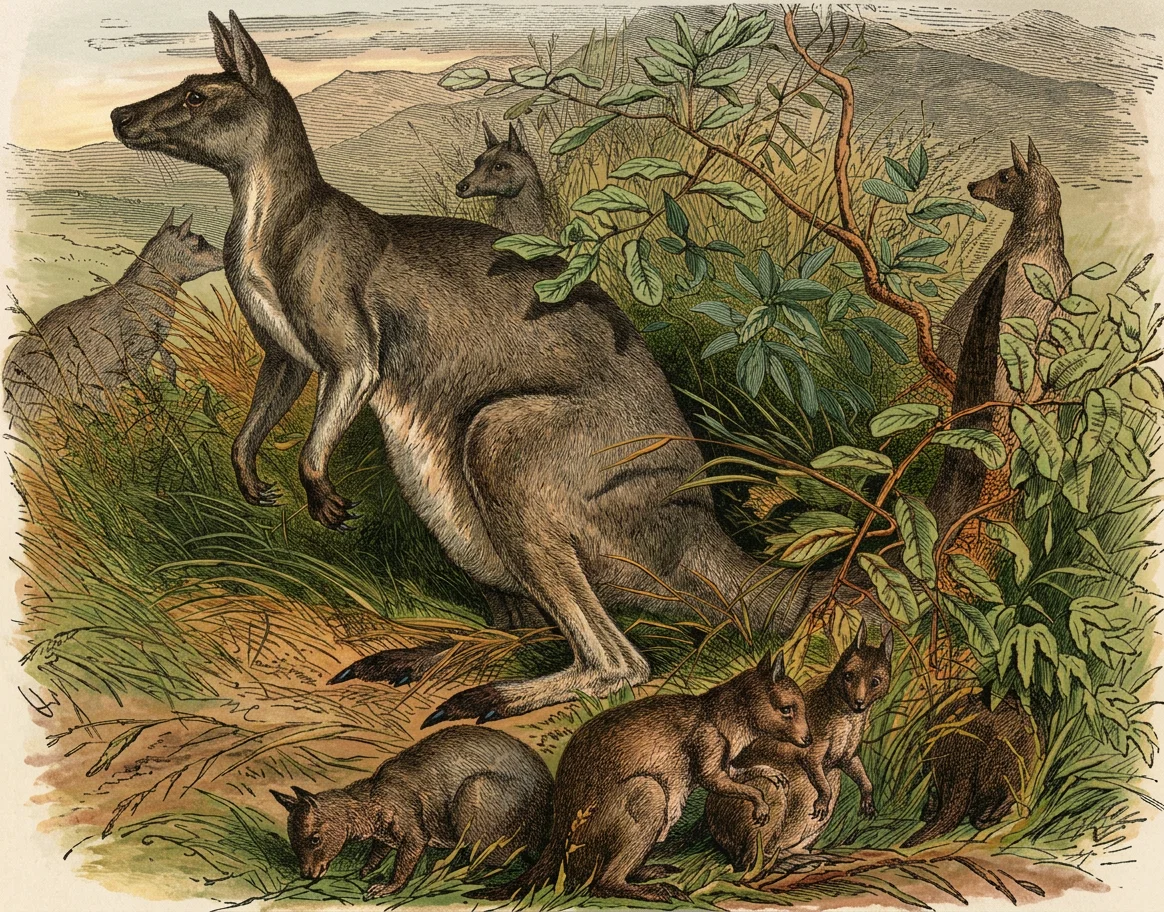
THE KANGAROO

7%

S. D. A. Publishing Association · Battle Creek, Mich. · Feb 10, 1886

FromThe Youth’s Instructor, Vol. 34, No. 6.

Read the full edition

THE KANGAROO.

SHOULD we visit the wilds of Australia or some of the adjoining islands, we might in our rambles come suddenly upon a large, long-legged kangaroo sitting upon his haunches, and eating perhaps berries or fruits from his forepaws, as the squirrels do; or if he heard our footsteps, he might be standing on his hind toes, with his head six feet high in the air, listening and looking for us. I think we should be quite willing by that time to take ourselves away in a hurry; but as the kangaroo will not trouble people if they let him alone, we may stop and examine the creature at leisure.
Restored with AI
His whole body is covered with a short, brown hair mingled with gray, and his forepaws and the end of his tail are black. From his nose to the tip of his tail he measures more than seven feet; the tail itself is three feet long, and quite large and heavy. The hind legs are exceedingly long, and were given him more for jumping than for walking; and they often send him, when frightened, fifteen feet at each leap. The front legs, as you see, are short, and resemble arms, and as arms he uses them; still they answer a very good purpose when he jumps. His nose is sharp and long, his ears erect, and his eyes large, soft, and quite beautiful.
The young of the kangaroo, when first born, are soft and helpless, and not larger than a young mouse; and were they exposed like other animals, they would soon perish. But the mother has a pouch under her stomach, into which she puts her little one to board; and there, living on warm milk and not having any change in the atmosphere, it thrives and grows. After about eight months, when it has sufficient strength, and its curiosity is developed, it crawls up and pokes its head out to take a peep at the world, and get a breath of fresh air. Presently it ventures out upon the ground, and takes a few nips at the tender herbage which grows at its feet. But if it becomes weary, or is frightened at the strange objects it sees around, it hurries back into the mother's warm pocket, and is quite contented and safe. When it weighs about ten pounds, she considers it too large for her to carry any longer, and ever after it depends upon itself.
The natives of Australia call the male kangaroo “boomer,” perhaps on account of his size, for he weighs, when full grown, one hundred and sixty pounds or more.
These animals do not go in droves, like the buffalo, yet a few generally keep in the neighborhood of each other, where each takes care of himself in his own way. They are hunted for their skins, which are valuable for many purposes. The flesh is also prized by the hunter, and is roasted and eaten in the field with great satisfaction.
A kangaroo hunt is entered into with zeal; a party go forth with dogs and spears, and scour the country to start up their prey, which is surrounded, and speared by the one who first gets a chance at the affrighted animal.
If they can manage to come upon a kangaroo without being heard, the spear is thrust into him, when a long and exciting fight follows; for the creature will not give up the life his Maker has given him, without a hard struggle.
It is said that when the kangaroo is closely pressed by the dogs, he makes his way, if possible, to the water, and wading in a short way, waits for his tormentors to come up. The first that reaches him, he seizes with his paws, and plunging him into the water, holds him under to drown him. If another dog arrives before he thinks it safe to let go the one he has, he puts one of his large hind feet upon the first, while he reaches out to catch and drown another.
When no water can be reached, and the kangaroo finds that he must be overpowered, he places his back against a tree, that the dogs may not reach him from behind, and then waits for them to come up. The first dog which comes near, is sure to feel the long claws of the kangaroo's great hind foot, and it is often the last thing the dog ever does feel, for it kills him at once. Sometimes in his desperation, the kangaroo rushes through the dogs, and makes a bold attack upon the hunter. If the kangaroo, when running, did not have the habit of looking behind him occasionally, he would escape more frequently than he does, as he is likely to run against trees or other obstacles, and cause his own death.
The female kangaroo is very much smaller than the male, and unless young, displays none of the swiftness and daring courage of the male. Indeed it is said that if she is fiercely attacked by men and dogs, and sees no possible way of escape, she is often terrified to such a degree that she lies down at once and dies of fear.
Sometimes she plunges into brushwood out of sight, and then, with a powerful effort, leaps to one side, where she lies perfectly still, while the dogs rush past her. When they are far ahead, she crawls cautiously out, and hurries off in another direction.
Thus God has given these poor creatures an instinct for their own preservation, which, if exercised by us, would be called thought and reason. All animals were made to enjoy their lives, and it is a pity and a sin that they should be killed out of mere sport, and wanton cruelty.—Beasts and Birds.