WHEN the bright sun of April brings summer warmth to our Northern lands, then the sandpipers and the curlews return to the marshes and shores of our inland rivers or to the barren beach of the ocean. High in the air they fly, uttering a sweet, mournful call of peet-weet, peet-weet. In our picture you can see these birds, hunting in the water for any bugs or worms that may be found. The larger pair are curlews, and the smaller ones sandpipers.
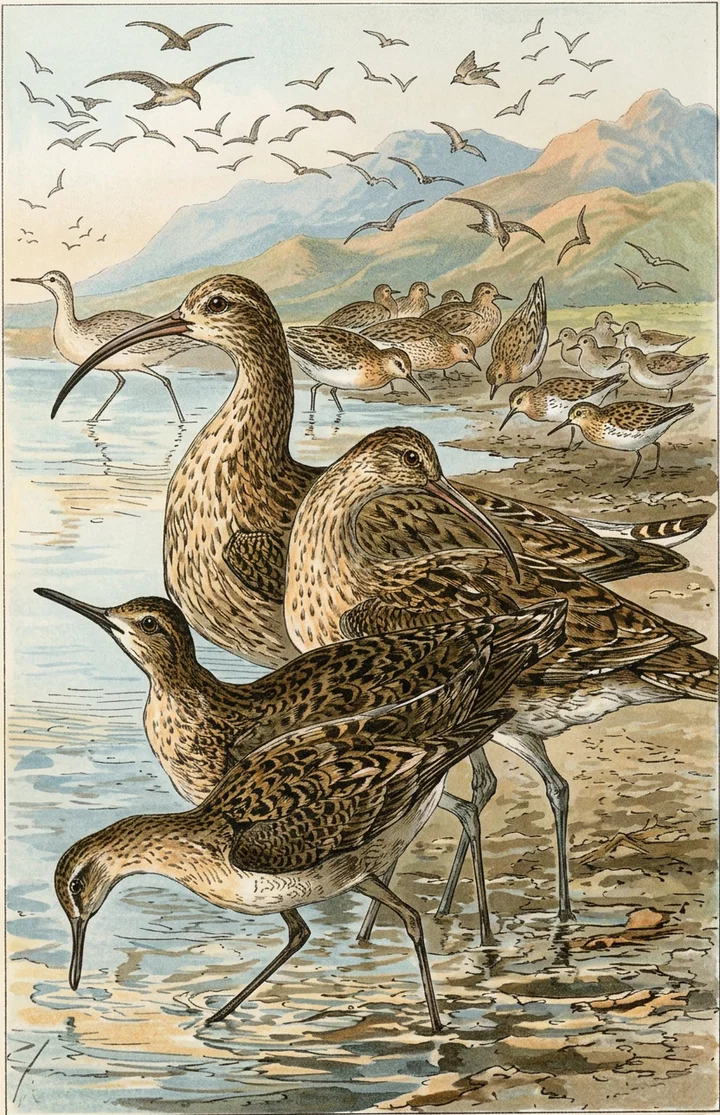
The sandpiper, scorning the high trees, builds its nests anywhere in the sand or on the ground, lining it with only a few weeds or a little grass. Here can soon be found four little eggs, with the small end placed toward the center of the nest in such a way that if you were to remove one, it would be hard to place it back just as it was before.
The little sandpipers are very active, and can run swiftly as soon as they are hatched. The first thing they do is to hunt for bugs and worms; they seem to understand all about this on the start, and do not have to be taught. But they cannot always tell good food from that which is poisonous, so for awhile the mother sandpiper has to watch her little ones. This is about all the bringing up they have.
Sandpipers are little birds only about ten inches long, with feathers of such a color that it is very hard to distinguish them from surrounding objects. They are also very wary, and fly away at the first alarm. But their flesh is considered very good food, and the hunters are very persevering in trying to shoot them. At the first sight of a sportsman or the sound of his gun, they give a wild scream, and are off, perhaps leaving one or two of their mates wounded or killed.
But sometimes the sandpiper cannot fly away and leave its nestful of eggs or its little ones; so it resorts to a trick that you would hardly think of. It limps and flutters along on the ground as if its leg or wing were broken, uttering a very distressed cry. Farther and farther it leads you away from its treasures, until it thinks they are safe, when off it flies, leaving you astonished at the sudden change.
Celia Thaxter has written a very pretty poem about the sandpiper; and although it has been printed once before in the INSTRUCTOR, I will give a few verses of it for the benefit of the boys and girls who have never read it:—
“Across the narrow beach we flit, One little sandpiper and I; And fast I gather, bit by bit, The scattered driftwood bleached and dry. The wild waves reach their hands for it, The wild wind raves, the tide runs high, As up and down the beach we flit, One little sandpiper and I.
“I watch him as he skims along, Uttering his sweet and mournful cry; He starts not at my fitful song Or flush of fluttering drapery, He has no thought of any wrong, He scans me with a fearless eye, Staunch friends are we, well-tried and strong, The little sandpiper and I.
“Comrade, where wilt thou be to-night, When the loosed storm breaks furiously? My driftwood fire will burn so bright, To what warm shelter wilt thou fly? I do not fear for thee, though wrath The tempest rushes through the sky, For are not we God's children both, The little sandpiper and I?” W. E. L.