NATIONAL SPORTS

8%

S. D. A. Publishing Association · Battle Creek, Mich. · Feb 24, 1886

FromThe Youth’s Instructor, Vol. 34, No. 8.

Read the full edition

NATIONAL SPORTS.

EVERY nation has some favorite amusement, which is indulged in to excess by the sport-loving portion of the country. In America, base-ball clubs are formed everywhere, and the national game is played with much animation by nearly all the boys and many of the young men. Here in Australia, the game of cricket takes the lead, and at certain seasons of the year, there may be seen, gathered in the open fields, large crowds of men, women, and children intently watching the progress of their national pastime. So exciting does the play become, that sometimes whole days together are occupied in the sport; and ragged urchins in the streets discuss the merits of the game and of those engaged in it, with as much warmth as those of maturer years.
There seems to be something natural in the selection of these pastimes. When the Indians had possession of the American country, and were undisturbed by the industrious advances of the enterprising white man, their favorite pastimes were running foot-races, riding horseback, and chasing wild game—sports which were in perfect keeping with the wild nature of that race. Their children were trained up in the exercise of these pursuits until they were capable of performing the most astonishing feats in athletic sports. Since this untamable people have been driven from their favorite haunts to the mountain fastnesses of the West, where they could not exercise their natural inclinations as they wished, their favorite pastimes have been discontinued, and they have become a diminished and dispirited race.
Restored with AI
One hundred years ago the natives of the Sandwich Islands, and of other islands of the Pacific, had very little knowledge of the ways of white men; and like the first inhabitants of America, were children of nature. Living in a climate where little clothing was required for comfort, and where nature provided abundance of food without any effort of their own, they were naturally an indolent people. With no regular employment, instinct alone would suggest something by which to break the monotonous routine of an idle life. Their island homes were small, and could present little to satisfy the desire for change. If amusement were found, it must be sought in the boundless ocean by which they were surrounded.
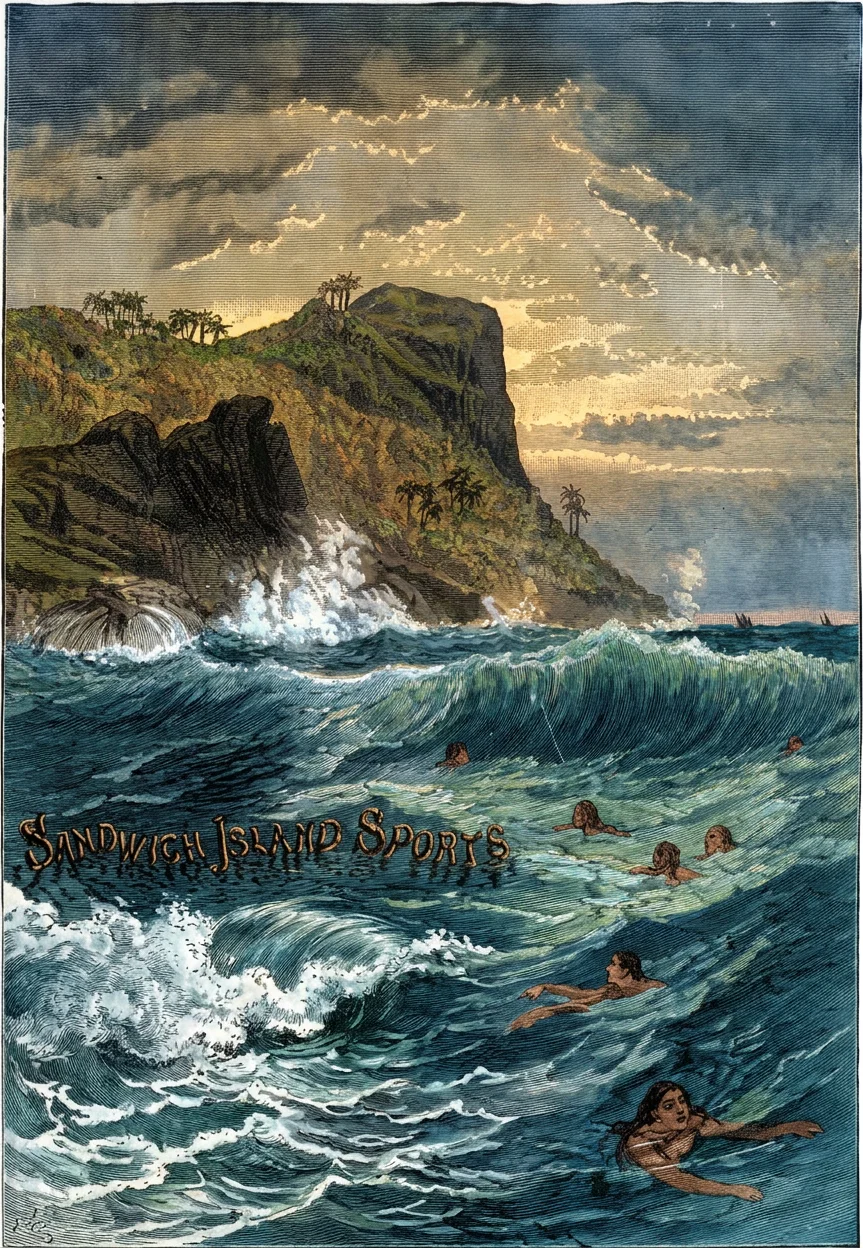
How far back in the history of these island races they became so generally skillful in the art of swimming, is not known. When the first white men came into their midst, this was the favorite employment of both men and women; and even quite young children were daily seen battling with the waves in gleeful sport. It mattered not, either, how high and strong the waves were, they entered the water fearlessly, and could be seen in the distance gracefully rising and falling with the heaving billows for hours together, or until weary with their sport. The picture accompanying this article is a fine illustration of that people enjoying their favorite pastime.
So much at home were they in the water, that many would undertake journeys to some of the nearer islands, or to distant parts of the same island, and perform them with as much ease, apparently, as we would walk the same distance by land. When vessels first began to visit the islands, they were called Moko, meaning islands. Seeing them move about, they considered them living beings, and remained near them much of the time in the water. When one would leave the harbor, many of the natives would accompany it for a long distance, sporting and talking immoderately by the way, until a peculiar signal was heard from one of their number, when in a body they would return to their companions on shore.
In fact, hardly any feat seemed too much for their skill when in the water. It is said that in very early days a look-out was stationed at some commanding point to watch for sharks in the offing. When that peculiar motion of the water, made by certain movements of that voracious monster, was seen at any point in the harbor, the signal was given; and the most daring, arming themselves each with a knife and a piece of wood a foot or more in length, and sharpened to a point at both ends, would plunge into the sea, and hastily swim toward the shark. When near the enemy of their sports, they would firmly grasp their sticks by the middle in one hand, and quietly await the attack of the man-eater. The shark, seeing his prey so near, and bent on seizing it, would quickly turn on his back (his customary method when snatching his victim), and with distended jaws, glide toward one of the natives. The native comprehending the movement, would, quick as a flash, present the sharpened stick held in a perpendicular position, and thrust it into the monster's mouth, the points of which buried themselves above and below, preventing the shark from closing his jaws. The next instant the knife of the native was plunged into the vitals of his foe, and the enemy brought to an untimely end.
In later years, since coming more under the influence of white men, the habits of these islanders have changed somewhat. Their old sport is not indulged in to excess as formerly. Having learned something of the value of money, they now make their skill in swimming contribute toward providing the scanty amount of cash they use. All the islands of the Pacific are surrounded by coral reefs, the avenues and labyrinths of which are filled with rare and curious forms of animal life. Great sea centipedes creep snake-like among delicate stars and huge prickly sea-urchins, and big crabs run and hunt amid the rugged submarine growths that loom up beneath the malachite-tinted waters. When the tide is out and the water is low upon the reefs, the natives station their boats over these coral plantations, and dive for crabs and coral. They also gather, for sale, a very pretty shellfish of a greenish-blue color shaded off into a delicate white.
Were one to pass these reefs knowing nothing of the employment of the natives, he would at first suppose that the canoes he saw scattered about had no owners; but if he would watch one of the boats a moment he would see a head bob up out of the water, and then a dark form would be seen climbing into the boat. After depositing his burden and taking breath for a moment, the native once more dives into the water to search for the treasures of the deep.
Such occupation doubtless seems strange to those who have always lived in a country far removed from the ocean. But the habits and customs of these islanders are formed from the force of circumstances, just as the habits of those are who live on the plains or in a mountainous region. Probably the ways of other nations appear as strange to these native sons of the islands as theirs do to those whose pursuits are confined to the land. It is good to think that there is a home promised to God's children in which all will have the same joys and pleasures, and in which the ways of none will appear strange to others. I am anxious to become a resident of that region. How is it with the INSTRUCTOR readers? Are you daily preparing to live in that “better country”?
J. O. CORLISS.
Melbourne, Australia.