This famous structure spanning the East River, was begun in 1870, and occupied thirteen years in building. It cost $15,000,000. Brooklyn furnished two thirds of the amount, and New York City the remainder. The designer and engineer was John A. Roebling, “the master bridge builder of the world,” but meeting with a fatal accident, while making surveys for the towers, his son Washington A. Roebling, who was associated with him in the work, carried out his father’s designs. Though he did not lose his life, he parted with the next best thing—his health, in his devotion to his work. He is an invalid for life, through exposure in and around the water, while laying the foundations of the towers.
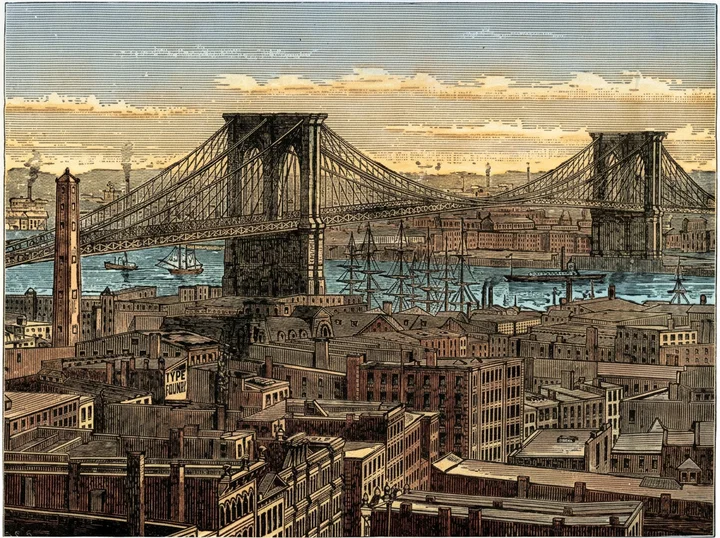
During the thirteen years of its construction, twenty-five men were accidentally killed while working on the bridge. This bridge is suspended from four granite towers, two on either bank of the river, 378 feet above high water mark and standing 45 feet below the water. It is one and one eighth miles long, and has three spans, the middle, or river span, being over a quarter of a mile long, and 135 feet above the water. The two land spans make a gradual descent to either city from the great height.
The four large cables are composed of 5,296 parallel (not twisted) galvanized steel, oil-coated wires, closely wrapped to a solid cylinder 15¾ inches in diameter. The length of each single wire is nearly three fourths of a mile. The strength of each cable is 12,200 tons. Running from each tower, are several guard ropes of steel, protected from rust by a coating of white paint.
The width of the bridge is 85 feet. A wide promenade for foot passengers occupies the center, and on either side are the carriage ways, and the railroad tracks on which the cars are run by a wire cable operated by machinery at each end of the tracks.
The trains consist of two ordinary coaches; and running one and one half minutes apart, can transport 7,000 passengers an hour. They carried more than seventeen millions of passengers last year; and three millions crossed on foot. The car fare is three cents, and the toll for foot passengers is one penny. And yet these insignificant pennies swelled to $618,914 in the yearly report of earnings.
A force of policemen are detailed for duty on the bridge, and are called the “Bridge Police.” Sometimes queer incidents occur here, as you will see.
Last summer a professional acrobat from Washington thought he could jump from the bridge into the river with safety, but he fatally miscalculated, and was picked up, bruised and insensible, by friends waiting below in a boat. He recovered sufficiently to ask if he made “a good jump,” and then died. That was his last thought while looking eternity in the face.
A few days later, a poor German, out of work, and failing after repeated efforts to get food for his family, wrote a letter telling his despair, and went to the bridge to end his life by jumping into the tide below. Fortunately, a policeman prevented him, and had his letter published in the papers. The next day his humble room was so filled with provisions sent in by kind-hearted persons who had read his story, that it looked like a prosperous grocery store; and employment was given him. Several others, hearing of his good fare, tried the same thing, but only met with arrest and imprisonment for attempting to take their own lives.
The promenade seems to be always thronged with people, some hurrying away to business, some taking it leisurely, enjoying the pure air and the view seaward, which includes Governor’s Island, with its forts; Bedloe Island, with the foundation of the Statue of Liberty; and the distant shores of Staten Island. The low line of smoke along the horizon tells of the out-going ocean steamer; while nearer, the ferry boats and busy river craft make an interesting sight.
Coming up the bay, the bridge is so high that it looks like a huge spider’s web spun from city to city; and at night its row of electric lights seem like a string of diamonds flashing across the river. It is the largest suspension bridge in the world, and has the greatest span.
New Yorkers always want to show the bridge to visiting friends as the first sight. They have something of the feeling Nebuchadnezzar had when he exclaimed, “Is not this great Babylon that I have built?”
Brooklyn, L. I.
L. E. ORTON.