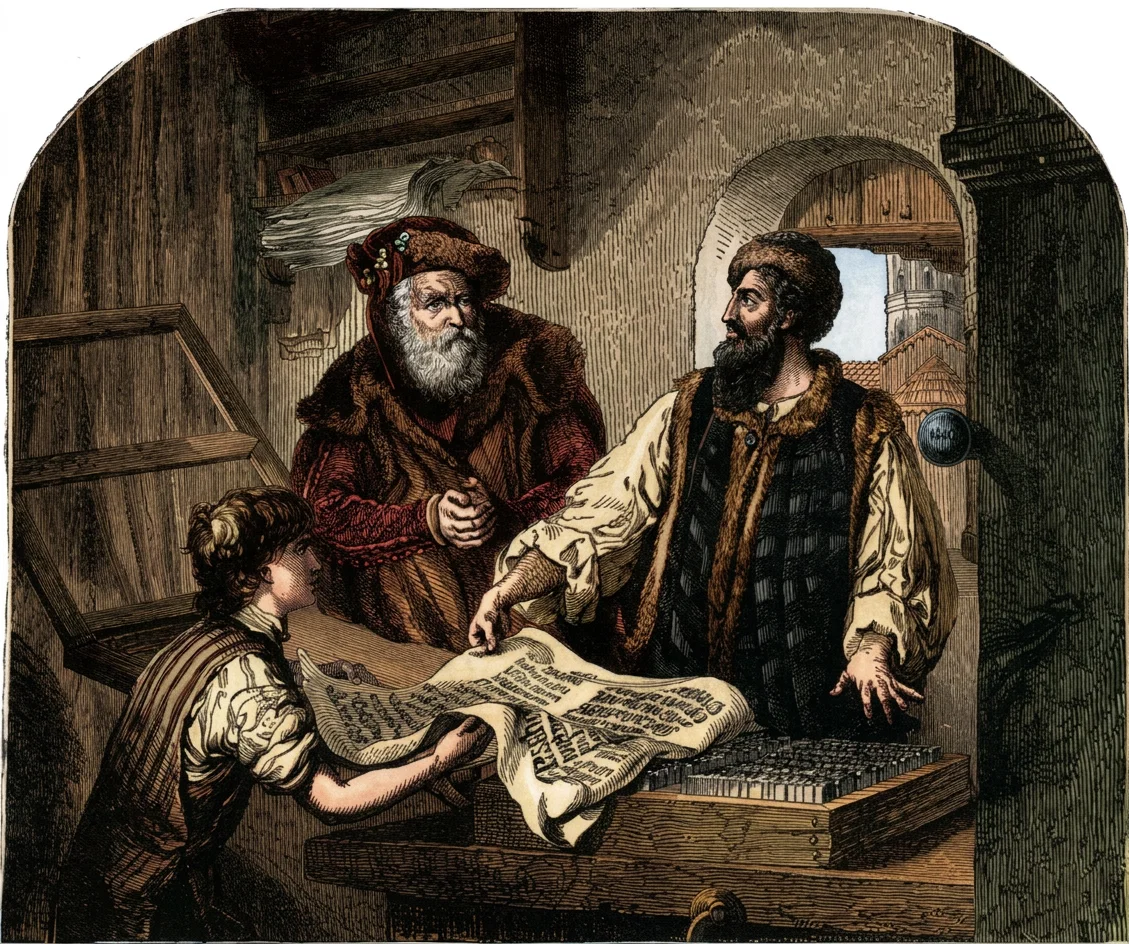
In the heart of Central Europe flows the majestic Rhine, past fair meadowlands, pleasant villages, and clustering vineyards, or by steep, wooded slopes crowned by grim castles, hoary with age. On the banks of this broad river, and amid this beautiful scenery, lies the free city of Mentz, where, four hundred and eighty six years ago, John Gutenberg, the inventor of printing was born.
It would be pleasant, indeed, if we could know all about the boyhood and youth of this remarkable man; but history has left us only a few facts of his early life that we can depend upon. He is represented as a high-spirited, thoughtful youth, early possessed with a desire to bring books into more common use; and, as one has remarked, “he said to himself, from his earliest years, God suffers in the great multitudes whom his Sacred Word cannot reach. Religious truth is captive in a small number of manuscript books, which guard the common treasure, instead of diffusing it. Let us break the seal which holds the holy things; give wings to the truth, that by means of speech, no longer written at great expense by the hand that wearies itself, but multiplied as the air by an unwearied machine, it may fly to seek every soul born into the world!” It was a noble aspiration; how well he fulfilled it we shall see.
Restored with AI
In his early manhood, the city of Mentz was embroiled in political quarrels between the nobility, the burghers, and the working people; and Gutenberg, who was of the nobility, lost all his property, and was driven from the city. He fled sixty miles up the Rhine to Strasbourg which was now to be his home for many years. His mother, who was allowed to keep her property, sent him secretly from time to time a part of the revenue that accrued from her lands, and thus he was enabled to live comfortably.
Here he married Anna von Isernen Thür, the daughter of a nobleman, to whom he was betrothed before his fortune was wrested from him. Almost the only item in his early life which we may know of with any certainty, occurred in connection with his marriage. It seems that Gutenberg, sensitive in regard to his shattered fortunes, hesitated to ask the Lady Anna to share his poverty with him; but she, sure of his affection for her, persuaded her father to sue him for failing to marry her when he agreed to, whereupon Gutenberg ended the matter by wedding the fair plaintiff in the lawsuit. This record still remains among the documents of Strasbourg. They were devotedly attached to each other, and were very happy in their humble home.
Gutenberg found it necessary to provide some way for his support; so he learned the trade of lapidary, or polisher of precious stones. Tradesmen were not as common then as now. Many of the trades had only begun to be practiced, and those who plied them were often wealthy and influential persons; so that artificers then held about the same social position that sculptors and artists do at the present time. Day after day Gutenberg toiled in the front room of the cottage, which served him for a shop, cutting precious jewels and polishing mirrors for the nobility and the wealthy monks; and here he gained that skill in handicraft that was to serve him such good turn in benefiting the world.
While he was plying his trade, he did not forget his early desire to multiply books; and his mind was actively engaged in devising some way by which it could be done. You will perhaps better realize what great difficulties stood in his path, when you learn that no such thing as a printing press or type of any description was then known, and paper had not come into common use. There were only a few books in the world, and these were carefully guarded from the common people, and chained in the libraries of the monasteries, or were owned only by the learned among the nobility. All these books had to be written by hand; and it was very tedious business, for in a whole lifetime the swiftest and most diligent scribe could not reproduce two copies of the Sacred Book.
The art of wood engraving, then in its infancy, first suggested to Gutenberg the idea of printing. If the common play-cards could be imprinted on paper, he thought, why could not the letters on a page be engraved on a block and imprinted in a like manner? Happy thought! no doubt he talked it over with his beloved Anna, when he sat in their quiet home that evening; and Anna was as enthusiastic over the plan as Gutenberg himself. All day he worked at his trade, his hand growing more swift and skillful that he might have time to devote to his new project; and all the evening he busily plied his graver’s tools, till at last he had finished an engraving of St. Christopher bearing the infant Christ across the dark stream. Then, linking the raised parts of the wood, he carefully pressed the paper to the surface, and rubbing it with a burnisher, drew off his first copy!—the beginning of greater things than he had yet dreamed of. He printed several copies, and sold them to the monks in the different monasteries. But he had to be careful not to display too many copies at once, or the shrewd monks would rightly guess that he had some quicker way of making them than by the usual slow process of the pen.
But there is scarcely room to tell you of all the trials and successes he met in his undertaking. At length he found it necessary to introduce several workmen into his shop to attend to the increasing work in polishing, while he could devote more time to his engraving. He was now toiling on the “History of St. John the Evangelist,” a small book that the prior of the monastery had lent him. He was obliged to keep this business a profound secret; for there was no patent office to guard against an infringement of his rights; and as soon as it should become known that books had been made by engraving, artisans all over would immediately engage in the work, and thus flood the market.
One evening, while he was working away, he was suddenly surprised by the abrupt entrance of Dritzh and Hielman, two of his workmen. Gutenberg immediately saw that his secret was out; and making the best of a bad matter, he, with not a few misgivings, took them into partnership, binding them by a solemn oath never to reveal the secret.
At first the new partners entered into the work with zeal; but they did not have Gutenberg’s noble enthusiasm to spur them on, and soon grew discontented.
One day, as he had nearly finished a block, his graver suddenly slipped, splitting the block in two. Days of labor thrown away! Gutenberg set his wits to work to fit the block together without having to make a new one. Was it an accident, or the guiding hand of Providence? The thought flashed across his mind, Why not have all the letters separate? then much labor could be saved, because the letters could be used over and over again, instead of being thrown away when one book was printed. He set immediately to work engraving the alphabet. This was the origin of movable type.
After a time the firm met with a great loss in the death of Dritzh, their most skillful workman. Two of Dritzh’s brothers, who came to the funeral, now demanded to be taken into partnership in their brother’s place; but as Gutenberg clearly convinced them that this was not in the agreement, they brought against him a lawsuit for all money their brother had invested in the firm. Now, indeed, Gutenberg was in trouble; for public curiosity was raised to the highest pitch, so that it was in vain he guarded his secret. Fearing discovery, he caused the types and two presses that he had invented to be broken up before his eyes; so that when a mob broke into his house a few days later, they were obliged to leave, with their curiosity unsatisfied.
“Ah!” said they, “it is a mystery! there is something wrong! he must be in league with the devil!”
“What is the use,” replied another, “of all this expense of multiplying books! No one except the monks can read them after they are printed!” With this opinion many doubtless concurred, and Gutenberg’s friends, one by one, dropped off, until only Anna was left to encourage him.
“Thou wert born a hundred years too soon
For the comfort of thy days;
But not too soon for human kind.”
It was useless to try again in Strasbourg to do anything at the printers’ trade, and so he moved to Mentz, his native town. Here, after a short time, he entered into partnership with Faust and Schoeffer, the two men who, aside from Gutenberg, did most of all to perfect the art of printing. Faust has often been called the “Patron of printing,” for he was a wealthy goldsmith, and furnished money for the new firm. Schoeffer is called the “Improver of printing,” for he originated the idea of using metal for type in the place of wood, which the ink soaked up and made too soft for use; and he also invented a method of casting it in molds, much as they do at the present day, thus making the letters faster and better. Gutenberg is called the “Inventor.” In the picture you can see the press and the wooden type used by them.
The new firm got along happily together, and had undertaken to print the Bible. But when about half way through this work, a cloud arose over the horizon, and soon darkened the whole heavens. Faust, who was somewhat embarrassed for means, grew dissatisfied with Gutenberg because money did not come in as fast as he supposed it would. Accordingly, he flattered Schoeffer, who was a young man, and ambitious of gaining fame and wealth. Moreover, he was in love with Faust’s daughter, and gave the readier ear to what this patron of printing had to say. It was proposed that Gutenberg should be compelled to leave the firm, and the business be carried on by the two remaining members. Consequently a lawsuit was brought against Gutenberg for money, which, according to the original agreement, Faust had no right to demand of him. The case was decided against Gutenberg, and Faust took possession of all the type and presses.
Once more the noble man was left destitute, and compelled42to see the cherished work of years in other hands, and taken unjustly by his most trusted friends. He was nearly wild with grief, and unable to work for a long time. Just at this critical time his Anna suddenly died. He was stricken indeed. After awhile he rallied, and tried to do a little at printing, but at length gave it up. He died in February, 1468, poor, childless, and almost friendless; yet, we trust, not wholly unhappy; for he had learned, as one has said, “There is no other actual misfortune except this only, not to have God for our friend.”