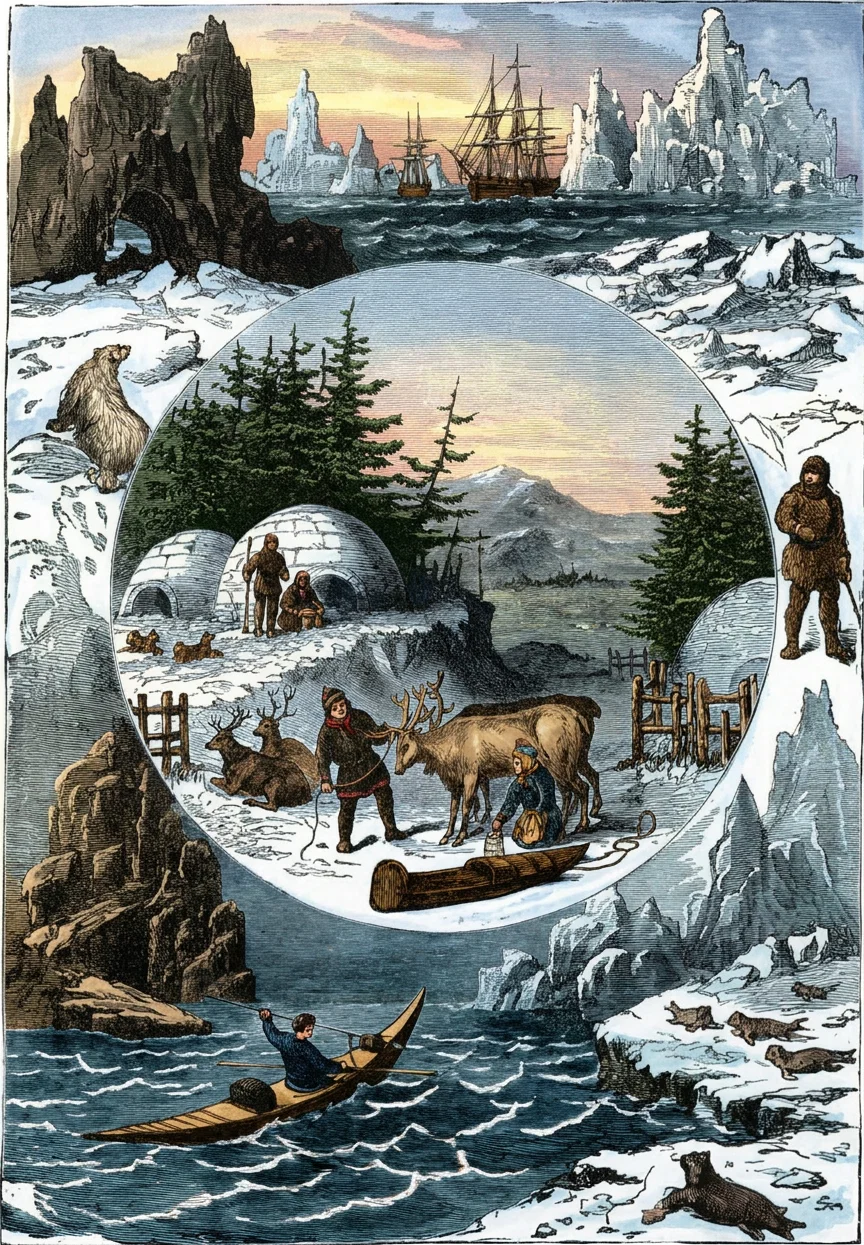
In the extreme northern part of Europe is a large tract of dreary country, about the size of France, called Lapland. It is inhabited by a stunted race of hardy little people called Lapps, or Laplanders, who number some twenty thousand, all told. This cheerless country is washed by Arctic waters on the west, north, and east, and on the south it is bounded by Norway, Sweden, and Finland. But there is really no true dividing line. This territory is often spoken of by geographers and travelers as Norwegian, Swedish, and Russian Lapland. If the size of the country were stated in figures, it would be some 500 miles in width by about 700 miles in length.
The Laplanders as a people are ranged into different classes, as the Fisher, the Mountain, and the Forest Lapps. These little folks call themselves Sami or Sabmelads. The word Lapp is a nickname given to these diminutive Northerners, and is said to be of Finnish origin, meaning “land’s-end folks.” In fact, it is held by some that the Lapps themselves are but an offshoot of the Finns.
In appearance, the Laplanders are short, being on an average a trifle over four and a half feet in height, with straight, black hair, small eyes, low foreheads, pointed chins, high cheek bones, scanty beard, and short necks. They are quick and active, but soon exhausted by hard labor. Being by nature mild and gentle, they do not seem to have many vices, only as they learn them by contact with their immediate neighbors. They have little excitability, but love their country, which they imagine is the pleasantest in the world. Their dress consists of caps, coats, trousers, and boots, made of fur and leather and stout, coarse cloth. The dress of the women is mainly distinguished from that of the men by a variety of ornaments.
The Lappish ladies are very skillful in cutting and making the garments worn by both sexes, and in sewing them together with the sinews of reindeer. The men are no less ingenious in making canoes and sledges, and bows and arrows, which many of them still use in place of guns.
As a people, the Lapps are somewhat shy, and it is said by those who understand their habits and ways, that they never look strangers square in the face. Their manner of life is rather patriarchal, the father of the household having complete authority over all the affairs; and at death this right passes to the eldest son.
The sea and river Lapps, who live by fishing and hunting, do not move much from place to place; but the mountain and forest Laplanders are a nomadic, or wandering people, and are continually moving about from one part of the country to another. The dwellings of the mountain Lapps are small tents, consisting of a skeleton of bent sticks, covered with coarse cloth, or skins. In the top is a hole which serves as a chimney, or flue, for the fire underneath. The sea Lapps have better habitations, usually consisting of wooden huts with several apartments. The latter generally live on fish, flesh, and fowl, and those near the White Sea obtain a limited supply of bread from the Russians, which is esteemed as a great delicacy.
We must not imagine, however, that nothing can be raised in the country of the Lapps. Rye and barley are grown as far north as the 70th degree of latitude, and there is also an abundance of edible berries. The streams and lakes abound with salmon and pike, trout and other fishes, while myriads of water fowl, partridges, and ptarmigan are found in various parts. In the fjords, or bays, of the Arctic Ocean and White Sea, the former of which do not freeze over on account of the warm water of the Gulf Stream, there is an abundance of cod and herring, halibut and seal, which give employment to thousands of fishermen.
In the interior, also, there is much that is serviceable to man, although agriculture cannot be carried on to any great extent by the land-tilling Lapps, on account of the extreme cold, which lasts for about nine months of the year. There are mines of iron, copper, and coal, and vast forests of birch, spruce, and fir, with a remarkable growth of lichens and moss, furnishing an inexhaustible supply of food and pasturage for the reindeer, which constitutes the great source of the Laplander’s wealth.
Restored with AI
To the Laplander, the domestic reindeer is invaluable, being in fact his ox, his sheep, and his horse, in one animal. With the milk of the herd he makes cheese; the flesh is as good for food as that of the sheep or ox; and as an animal of draught, the reindeer is more fleet than the horse, being able to draw a load of 240 to 300 pounds over the snow at the rate of fifteen to twenty miles per hour for hours in succession. It frequently travels one hundred and fifty miles in less than twenty hours. There are said to be between three and four hundred thousand reindeer in Lapland, the more wealthy sometimes owning one or two thousand apiece.
The Laplander does not have any government of his own, and the entire Lappish territory is included in the dominions of Norway, Sweden, and Russia. Formerly this singular people were all pagans, but latterly they have nominally embraced Christianity, and at the present time those belonging to Norway and Sweden have been baptized into the Lutheran faith, while those living under the protection of Russia belong to the Greek Church. Through the efforts of missionaries, the Lapps have a translation of a part of the Scriptures into their dialect, called the Lapponese Version.
While the Lapps do not have any literature of their50own, there are certain schools where their dialects are taught; and it is said that the Lappish youth have shown considerable ability in acquiring the knowledge imparted.
May we not hope that in that great day when all the inhabitants of this fallen world shall stand before the great white throne, there will be many Laplanders there who have been washed in the blood of the Lamb, and who will praise God eternally for that salvation which was so freely offered to every nation, and kindred, and people, and tongue? G. W. A.