The Bird of Piety

7%

S. D. A. Publishing Association · Battle Creek, Mich. · Mar 31, 1886

FromThe Youth’s Instructor, Vol. 34, No. 13.

Read the full edition

The Bird of Piety.

Over across the ocean, in the beautiful country through which the Rhine River flows, you may find some very large birds, such as you could see nowhere else, perhaps, in the wide world. They live in the greatest numbers in the city of Strasbourg. The Germans are glad to have them there; for they believe these birds bring good luck, and happy indeed is the man whose chimney these storks select for their home.
Restored with AI
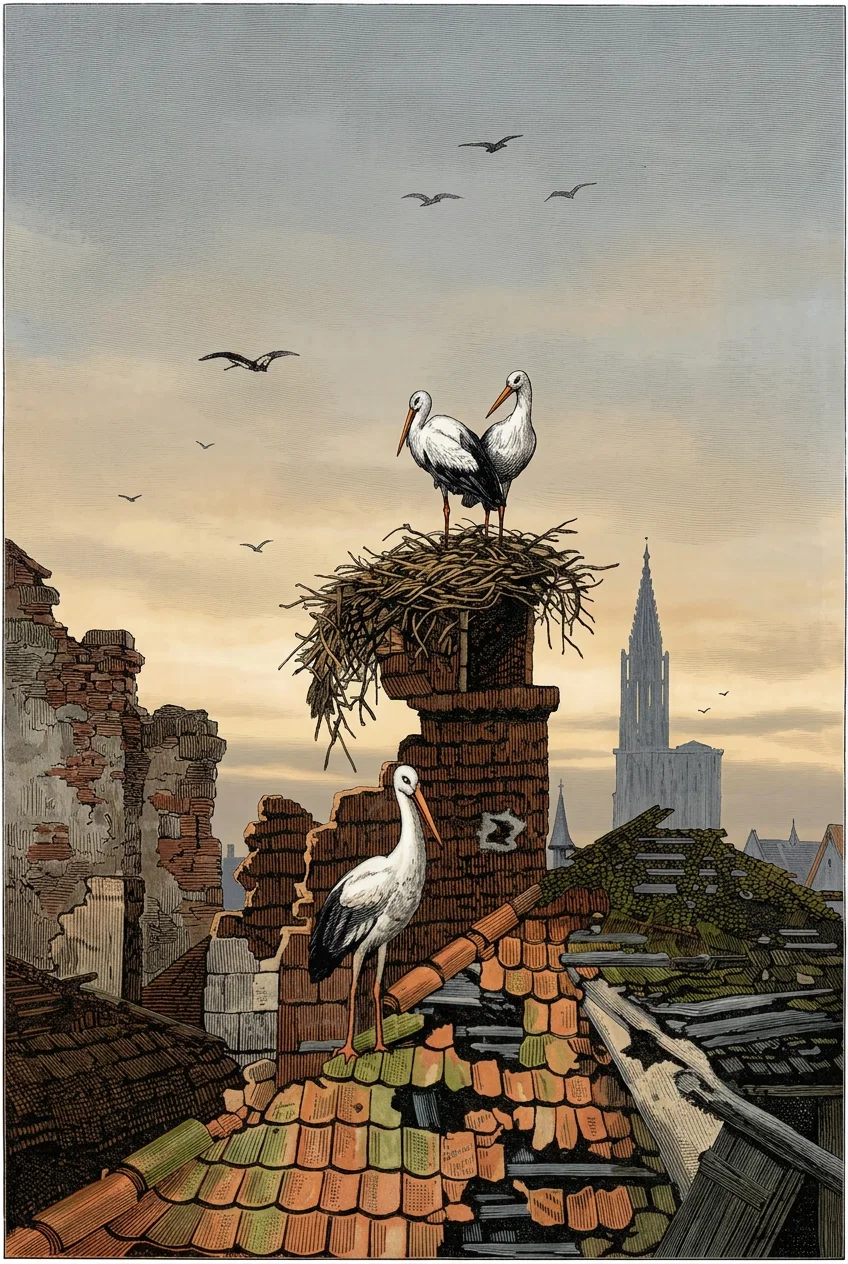
The birds even venture to build their nests up on the great cathedral; and any day you can see them sailing with a stately, solemn motion around its great, high towers. The guides take as much pains to point out the storks’ nests to strangers, as they do any other object of interest in this wonderful, quaint city.
Sometimes the people put boxes on their roofs, to coax the storks to build nests on these foundations. The nests are coarse, and made of sticks and straw, hollowed out just enough to hold three or four eggs.
The little storks look homely enough as they lie curled up in these rude nests, with their great beaks open for food. Their parents take the very best care of them. One always stays with them when the other goes off in search of food; and if it should see a stranger coming too close, it would tread around on its little ones to keep their heads down out of sight.
The storks think as much of their little ones as your papa and mamma do of you; and the Germans tell many wonderful stories of their love for one another. One time a fire broke out in the city of Delft, in Holland. On one of the burning buildings a stork had had her home. She tried in every way to save her little ones, but they were too young to fly; and so, instead of flying away and leaving them, she stayed by and perished in the flames.
At another time, when a fire broke out, the storks saved their home and their little ones by bringing water in their beaks and sprinkling it over the nest.
Once the Germans and the French had such a terrible, terrible war, right by the beautiful city of Strasbourg. All day the great cannons roared and thundered at the gates of the city, and bomb-shells from the camp of the enemy flew right over the walls, and set fire to the costly buildings. But the brave storks did not go away; they stayed right on amid the smoke and flames and falling buildings, just as you see them in the picture; and when the enemy gained the victory, and took possession of the town, the storks set quietly to work to rebuild their nests, that had been torn down.
In the autumn the storks get together and fly south to Africa, where they stay during the winter. They do not go away for fear of suffering from cold in the Rhineland, but because they can get nothing to eat in the winter time. Storks live on frogs, eels, snakes, and food of that kind; and in cold weather these all go to sleep in the ground, and do not wake up till spring, so the birds would have a hard time to get along if they did not go away to some warm country.
But wherever they go, no matter how far away, they always come back to the same old nest every year. The old birds keep the home, driving the young ones off to build new ones elsewhere.
If they have been kindly treated by the people on whose house they live, they act overjoyed to see them again. They frolic with the children, and plague the dogs and cats, and sometimes come into the house at meal-times, helping themselves to food from the table. Once in awhile they will stay year after year, never flying south when winter comes.
The Hebrews were acquainted with the storks; and if you look in the book of Psalms and in Jeremiah, you will find them mentioned. The Hebrew name means bird of mercy, or piety; and if half the things told about this bird are true, it well merits the name. It has been said that when the storks are too old to stand the long flight from one country to another, the younger birds take the old ones on their backs, and bear them on. And when the parents grow too feeble to hunt for food, the young ones place them in the old nest, and feed them. Is it not to be hoped that the INSTRUCTOR boys and girls will be as thoughtful and kind to their parents as these noble birds?
“The stork’s an emblem of true piety; Because when age has seized and made his dam Unfit for flight, the grateful young one takes His mother on his back, provides her food, Repaying thus her tender care of him Ere he was fit to fly.” W. E. L.