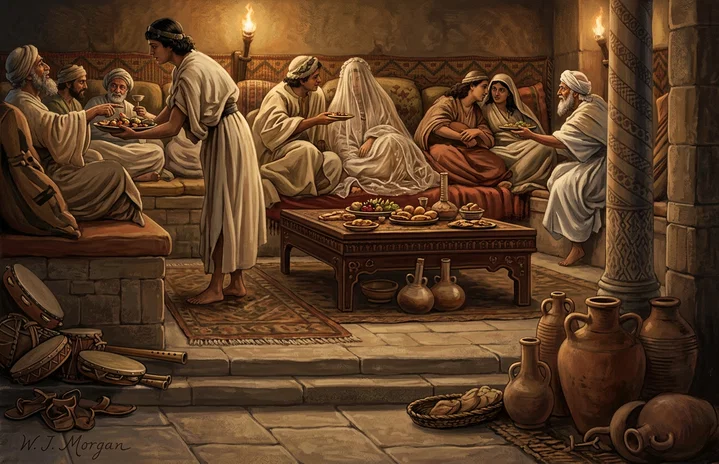
“A MARRIAGE IN CANA.”
By D. E. H.
IT is night in Galilee. In the sky the stars shine out one by one, and the crescent moon, like a barque of pearl, rides on the deep blue of heaven. Suddenly, upon the still, clear air of evening, a sound of music and of revelry breaks forth, of tinkling cymbals and sweet-sounding instruments; and from an oriental home a company set forth. The torches, ten in number, throw a wierd, uncertain light over the revelers. It is a bridal procession; and the bridegroom, with the “children of the bride chamber,” is leading home his bride. As they near the house of the bridegroom, other guests join the procession, and the music grows louder and more joyous. Now they enter the door, and pass from sight.
No doubt there was such a procession “when there was a marriage in Cana of Galilee, and the mother of Jesus was there; and both Jesus was called, and his disciples, to the marriage.” The customs of the Eastern nations have changed so little in thousands of years that in many respects the ways of the people are now nearly the same as when Christ walked among the hills of Galilee.
After the ceremony,—the leading home of the bride,—there followed the marriage feast. In this house at Cana there were no doubt many guests; and we should have no trouble in distinguishing the bride by her long veil, that falls over her face, hiding her completely from public gaze, nor of the bridegroom with his elaborate robes and gay bridal turban. If the guests are many, no doubt the custom is followed of putting three of the low couches together in the form of a crescent, appointing one of the guests to take charge of the persons at these tables. This was the “governor of the feast.” All goes merrily, until an incident occurs that causes perplexity,—the wine has given out. It would be an unprecedented thing to have a marriage feast without wine; but what shall be done? It is too late to get more. Then the mother of Jesus, whom we may suppose was a relative of the bridegroom, turns to her divine Son, saying, “They have no wine.” “And there were set there six waterpots of stone, after the manner of the purifying of the Jews, containing two or three firkins apiece,” and Jesus, ever ready to contribute to the comfort and happiness of all, bids the servants to fill the waterpots with water, and to draw out and bear to the governor of the feast. And the astonished servants, obeying his command, behold the sparkling water turned to ruby wine.
If the revelers followed the usual custom, the festivities are kept up for seven days, and then the guests return to their usual occupations, and life for the bride and bridegroom flows on in its ordinary channel. Such were the wedding ceremonies from the days of the patriarchs down to the time of Christ; and such they are at the present day, with some modifications. D. E. H.