WILLIAM PENN

6%

S. D. A. Publishing Association · Battle Creek, Mich. · Apr 14, 1886

FromThe Youth’s Instructor, Vol. 34, No. 15.

Read the full edition

WILLIAM PENN

THE IRON WOLF.Restored with AI
THE IRON WOLF.
In the court of Charles II. was a noted admiral named Sir William Penn, who had a son, also called William. The admiral was an ambitious man, seeking for advancement at court. He had many friends and high connections among the nobility. So he took all possible pains with his only son, sending him to the best college in the land, that he might be able to fill with honor the high position that would be his when his father was dead.
While young William was away to school, he fell in with a Quaker youth, who converted him to his religion. William was an ardent professor, and his zeal sometimes led him beyond bounds. It got him into trouble with the students and officers of the college, and he was expelled. You may imagine how Sir William felt to think that his son, on whom he had placed such high hopes, had been expelled; had left the Church of England, and joined the despised Quakers; had donned the drab, long-skirted coat of the sect, said “thee” and “thou” instead of “you,” hated war, and said, “If a man smite thee on one cheek, turn to him the other also,” and would not doff his broad-brimmed hat even in the presence of the king.
Old Sir William stormed and raved. Finally he sent his son off to the Continent, to get this nonsense taken out of him. Young William traveled much in France, and learned to be gayer in his manners and dress, was well-informed and well bred, and came back a polished gentleman, but still a Quaker.
Then his father sent him to Ireland to look after two large estates. Here he fell in with the youth who had converted him at college, and all his old zeal returned. He attended the Quaker meetings, and with several others was arrested and thrown into prison for attending “unlawful assemblies.” On returning to England, all the old disputes between himself and his father revived. Sir William at last offered to tolerate every other peculiarity, if his son would not say “thee” and “thou” in the presence of the king, the duke of York, and himself, and would remove his hat in their presence.
But young William steadfastly refused to make any compromise, saying that “as to this same hat-worship upon which you do insist, I may not, in conscience, remove my hat to any man, lest by so doing I do perjure myself, seeming thus to proffer to a human creature the same honor I would give to my Creator.”
Then the bottled wrath of the admiral burst forth. “Get you gone! get you gone!” he cried. “From henceforth you are no son of mine; and though you do rot in jail, I will not lift hand to help or save you.”
But even this did not move young Penn, who replied: “My prison shall become my grave before I will budge a jot. For I do owe my conscience to no mortal man.”
Then the admiral, boiling with rage, whipped out his sword, and, as the record says, “fell upon him, and beat him sorely, and drove him from the house.” It was a long time before the hot-tempered old man could be prevailed upon by his loving-hearted wife to forgive their son. He never quite forgot their troubles, though he left him his property when he died.
Penn now traveled throughout the kingdom and in Germany, preaching the Quaker doctrines. Often he was cast into prison; yet he was not idle while there, but wrote pamphlets and tracts explaining his doctrines. At one time he wrote: “I abhor two principles in religion, and pity them that own them; the first is obedience upon authority without conviction; and the other, destroying them that differ from me for God’s sake. Such a religion is without judgment, though not without teeth.”
The “teeth” of this intolerant spirit soon made England a very uncomfortable place for the Quakers, and they, together with the Puritans, turned their faces to the New World as the only place of refuge. The king was deeply in debt to the admiral, and when William proposed to call the matter settled if he would give him a grant of land in the New World, he no doubt thought it an excellent bargain.
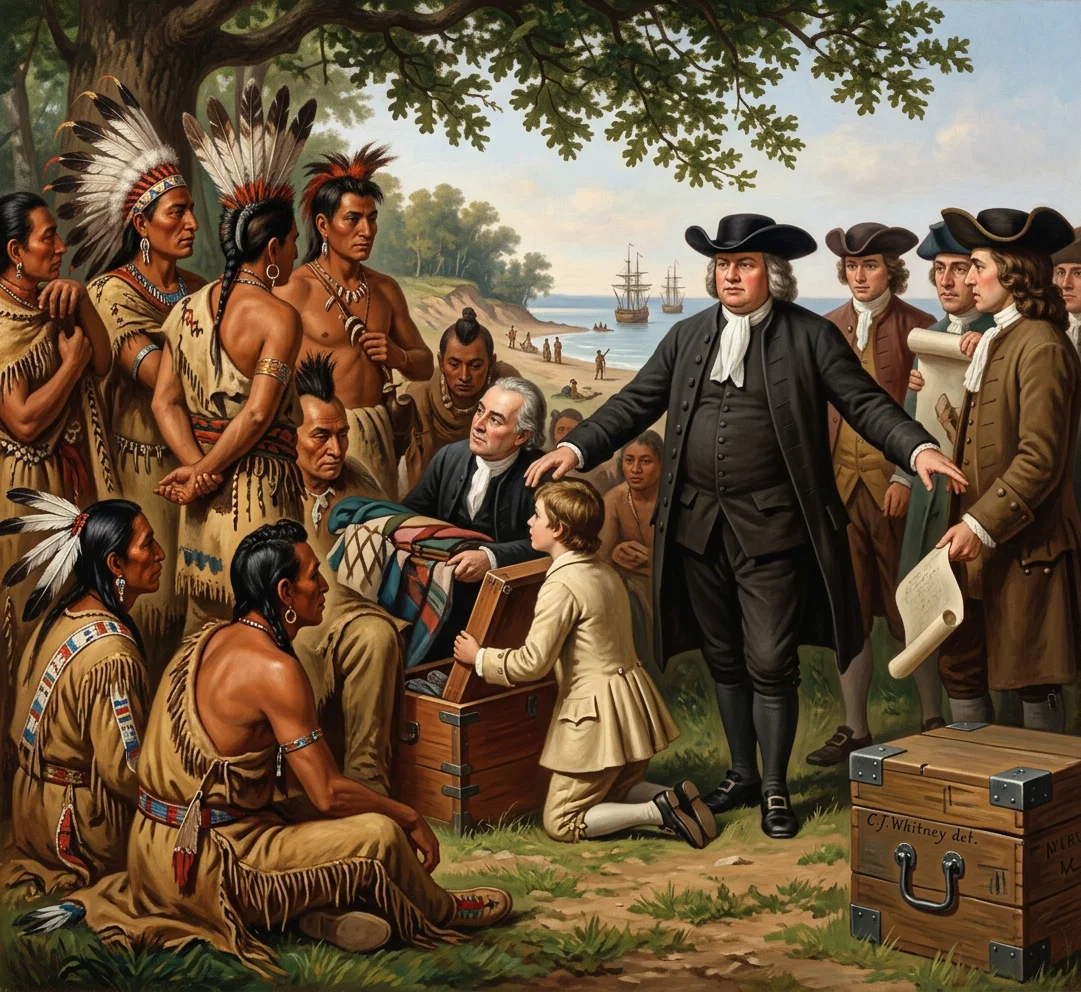
In company with a good many Quakers, Penn set sail for America, going up the Delaware River, and landing at Philadelphia. Under a broad-spreading oak, he called the Indians together to purchase of them the land that the king had given him. There met the Quakers, in their broad-brimmed hats and drab clothes, and there the Indians, gorgeous in war paint and gay feathers, strings of wampum, and pelts of fur, to make a treaty of peace, “the only one never sworn to and never broken.” This old oak flourished for many years, and now a monument marks the spot where it grew. Here he built a city, and called it Philadelphia, or “the city of brotherly love,” for in it he hoped all men would dwell in peace.
At length troubles in England called Penn to his native land, and he never returned to America. Toward the close of his life he suffered repeated shocks of paralysis, at length depriving him of memory and the power of motion. When he died, he was buried near the village of Chalfont St. Giles, in Buckinghamshire.
Penn governed his territory wisely and well. The Quakers had learned good lessons from their persecutions, and made wise and tolerant laws. To the end of his life, Penn retained the intense affection of the Indians; and when he died, “they sent to his widow a message of sorrow for the loss of their ‘brother Onas,’ with some choice skins to form a cloak which might protect her ‘while passing through the thorny wilderness without her guide.’”
W. E. L.